Russia · Leningrad Oblast · Gatchina
Mariyenburg, Gatchina — Area Guide & Where to Stay
Mariyenburg is a historic district in the northwest of Gatchina, known from the end of the 18th century and named for Maria Feodorovna, the wife of Paul I.
About Mariyenburg


Where to stay in Mariyenburg
Where the beds are, and what that means for the visit.
Rooms are few out here. Mariyenburg is mostly wooden housing on streets laid out in the 18th century, and the one exception is the block bounded by Kuprina, 120-y Gatchinskoy Divizii, Ryseva and Zavodskaya, where stone blocks of up to five storeys stand instead. The halt is the argument.
Mariyenburg station sits in the district on the Baltic line, which makes a bed here a short ride from Gatchina proper and from the palace park most visitors come for, and the Church of the Protection of the Most Holy Theotokos stands a few minutes from the platform. Gatchina's own centre holds the hotels.
Things to do in and around Gatchina
Ranked by global recognition; descriptions from Wikidata (CC0).
Churches & Religious Sites
1- Church of the Protection of the Theotokos (Gatchina) Heritage
Landmarks & Notable Places
8- Jäger's Sloboda (Gatchina) Heritage
- Ptichnik (Gatchina) Heritage
- Black Gates, Gatchina Heritage
- Farm in Sylvia park (Gatchina) Heritage
- Dacha of V.V. Grachev Heritage
Show 3 more →
- Marienburg station building Heritage
- Жилой дом (Гатчина) Heritage
- Жилой дом коммерсанта Кобелева (Гатчина) Heritage
worth knowingacross 2 categories in and around Gatchina
About Mariyenburg
What are the main landmarks in Mariyenburg?
The church is the fixed point. Consecrated in 1888 in honour of the Protection of the Most Holy Theotokos, it stands among the wooden streets that make up most of the district, and it is what the register lists first for Mariyenburg. The station building is the other.
It went up in 1879 after a petition from the settlement for a stop on the line beside it, to a design by the architect Kupinsky, and the halt it serves still carries the district's name. Everything grander belongs to Gatchina itself, where Sylvia park keeps its farm buildings and the Black Gates and the Ptichnik stand in the palace grounds rather than in this quarter.
What is the history of Mariyenburg?
Mariyenburg grew around a foundry and took its name from the court. The settlement was known from the end of the 18th century, four km out from the Gatchinskaya myza, and it took the name of Maria Feodorovna, wife of Paul I. Its four first streets are now Roshalya, Ryseva, Igorya Rybakova and Kustova, laid down in the 18th century under the older names Marienburgskaya, Srednyaya, Naberezhnaya and Krainyaya. Industry arrived in 1877.
Major General Alexander Stepanovich Lavrov built a copper foundry here, the oldest enterprise in Gatchina, to cast the phosphor bronze he had invented himself, and the works became known for artillery castings, railway parts and church bells sent across Russia. The Soviet years renamed both. The foundry became the Roshal Factory and was retooled in 1932 for paper-making machinery, while the settlement took the name posyolok imeni Roshalya after Semyon Roshal, the first Bolshevik commandant of Gatchina, who had lived there.
German occupation ended on 25 January 1944. In 2000 the factory became the Gatchina experimental plant for paper-making equipment.
Where is Mariyenburg?
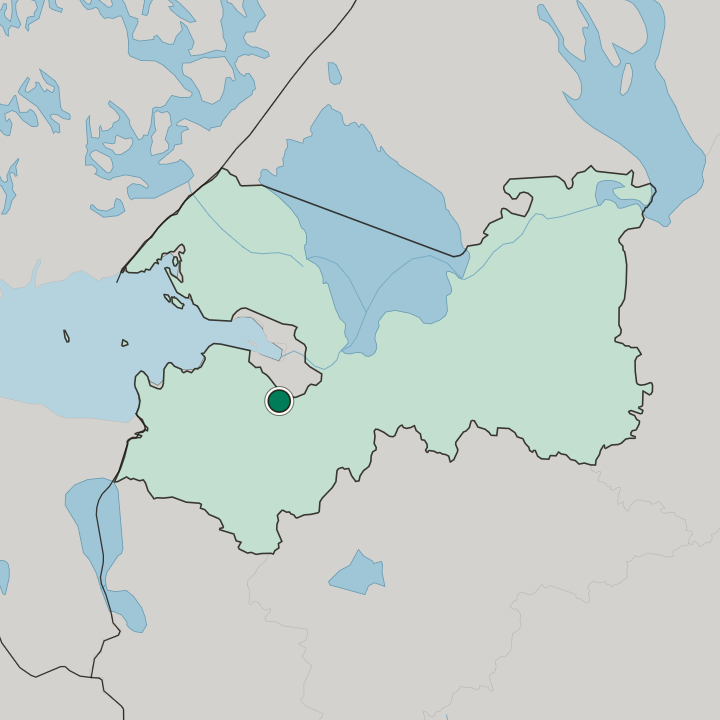
Mariyenburg lies northwest of the Gatchina centre and west of the Baltic-direction railway, with the second industrial zone and its Elektronstandart-pribor works beyond 120-y Gatchinskoy Divizii street, and the Gatchinskaya myza four km to the southeast.
Updated October 2026