
Latvia · Rīga
Where to Stay in Riga, Rīga
The Daugava widens toward the Gulf of Riga at Riga, the capital of Latvia, known for its Art Nouveau streets and a UNESCO-listed old town.
Hotel links are affiliate links: booking through them may earn us a commission, at no extra cost to you. It never affects how places are ranked. How this works


Where to stay in Riga
Each area has its own feel; here's who each one suits.

 RigaLatvia
Dārzciems
Dārzciems sits in the Latgale Suburb on the right bank of the Daugava, one of the driest neighbourhoods in Riga.Where to stay → RigaLatvia
Čiekurkalns
Čiekurkalns holds the southwestern shore of Lake Ķīšezers, a neighbourhood of the Northern District of Riga with housing in place of monuments.Where to stay → RigaLatvia
Mežciems
Mežciems is a Riga district known less for a centre of its own than for the Riga Motor Museum and a Lutheran parish church.Where to stay →RigaLatviaBolderaja
Bolderāja, a Riga neighbourhood on the left bank of the Daugava in Kurzeme District, probably began as a fishing village among shifting dunes.Where to stay → RigaLatvia
Daugavgrīva
Daugavgrīva is a Riga neighbourhood on the left bank of the Daugava, where a Swedish-built fortress commands the river's mouth.Where to stay →Hotel links are affiliate links: booking through them may earn us a commission, at no extra cost to you. It never affects how places are ranked. How this works
Find hotels in Riga
Direct booking searches for these neighbourhoods.
Old Town core
The medieval quarter packs Riga Cathedral, St. Peter's Church, and the Powder Tower into a few blocks below Riga Castle.Find hotels in Old Town coreQuieter nights within walking reach of the Freedom MonumentArt Nouveau quarter
North of the old-town canal, the Art Nouveau blocks stay residential yet keep the Freedom Monument and the city museums close.Find hotels in Art Nouveau quarterHotel links are affiliate links: booking through them may earn us a commission, at no extra cost to you. It never affects how places are ranked. How this works
Things to do in Riga
Ranked by global recognition; descriptions from Wikidata (CC0).
Museums & Galleries
3- Riga Motor Museum
- Museum of the History of Riga and Navigation
- Latvian Museum of National History
Churches & Religious Sites
8- St. Peter's Church Heritage
- St. John's Church Heritage
- St. Gertrude Old Church Heritage
- St. Mary Magdalene's Church Heritage
- St. Alexander Nevsky Church Heritage
Show 3 more →
- Our Lady of Sorrows Church Heritage
- St. Saviour's church, Riga Heritage
- St. Paul's Lutheran Church Heritage
Castles & Historic Sites
2- Freedom Monument Heritage
- Riga Castle Heritage
Stadiums & Sports
1- Ice hall "Riga"
Landmarks & Notable Places
1- Powder Tower
worth knowingacross 5 categories in Riga
About Riga
What is Riga known for?
Riga is best known for the Art Nouveau facades of its centre and a medieval core inscribed as a UNESCO World Heritage site. Its old town gathers Riga Cathedral, St. Peter's Church, and the brick Powder Tower within a few walkable blocks, all rising above the west bank of the Daugava. Riga Castle stands over the river as the seat of the Latvian state, and the Freedom Monument marks the edge of the old quarter.
Wooden architecture survives beyond it. This is the largest city in Latvia.
What are the main landmarks in Riga?
Riga's landmarks crowd its old town above the Daugava. Riga Cathedral anchors the medieval square. It stands at the heart of the quarter, while the brick Powder Tower and Riga Castle mark the surrounding streets and guard the riverbank as the seat of the Latvian state.
The Freedom Monument rises at the quarter's edge, and the spire of St. Peter's Church marks the walkable set that runs on to St. John's Church a few streets over. The Museum of the History of Riga and Navigation keeps the maritime record of the Baltic port.
What is the history of Riga?
Riga was founded in 1201 at the mouth of the Daugava, where the river reaches the Gulf of Riga. The site drew traders from the start. Its harbour on the Baltic Sea pulled the settlement into the medieval network of northern merchant towns, and successive empires each governed the port and stamped their mark on its churches, walls, and warehouses.
Riga Cathedral and St. Peter's Church rose in this era. The Powder Tower survives from the ring of defences that once enclosed the old quarter. Centuries of shifting rule reshaped the city above the river.
The old town kept its medieval street plan while the districts beyond filled with the Art Nouveau blocks that later earned Riga its UNESCO listing. Riga Castle passed from garrison to state seat over that long span. The Freedom Monument was raised to mark the country's independence, and it still stands at the edge of the historic core.
The capital of Latvia now carries all these layers within one compact centre above the Daugava.
Where is Riga?
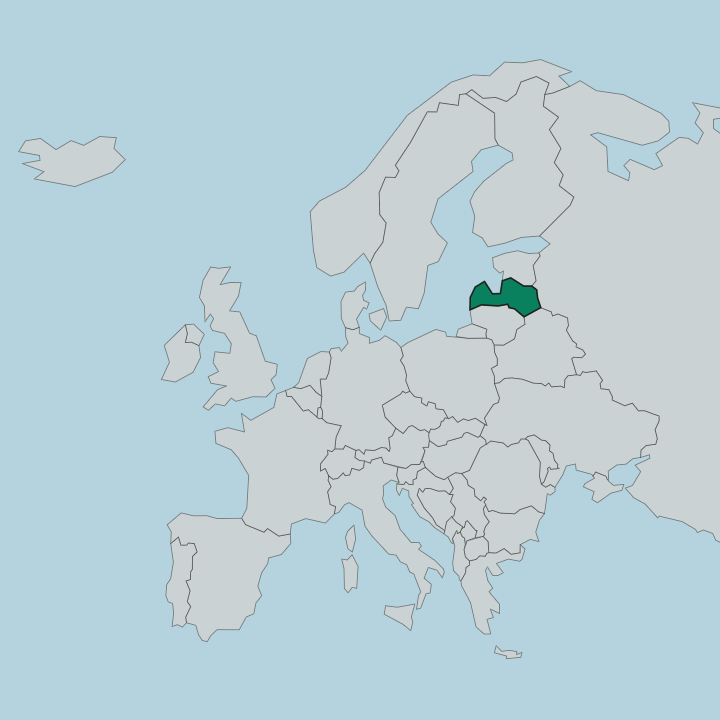
Riga sits on a flat, sandy plain where the Daugava meets the Gulf of Riga. The land lies barely above sea level. The river splits the city as it runs the last stretch toward the Baltic Sea, and the old town holds its west bank below Riga Castle.
Low ground and open water shape the setting on every side. The Gulf of Riga opens the city to the wider Baltic.
What is the climate of Riga?
Riga has a temperate climate shaped by its place on the Gulf of Riga. Riga's winters come in cold and grey. The nearby Baltic Sea moderates the extremes, so the cold rarely bites as hard as it does inland, and snow settles over the old town through the darkest months before a slow spring thaw.
Summers stay mild and long-lit. Rain falls across the year along this stretch of coast.
How do you get to Riga?
Riga is the main gateway into Latvia and the wider Baltic region. Its international airport lies west of the centre. Rail and long-distance coach lines converge on the old town from across the country, and the port on the Daugava handles ferries that cross the Baltic Sea from the Gulf of Riga.
Roads fan out toward the coast and the border. Most arrivals reach Riga Cathedral within a short ride of the terminals.
Common questions
What is the best area to stay in Riga?
Old Town core: First-timers who want Riga Cathedral and the Daugava at their door. Art Nouveau quarter: Quieter nights within walking reach of the Freedom Monument.
Good for
Updated October 2026