Portugal · Distrito de Setúbal
Where to Stay in Barreiro, Distrito de Setúbal
Barreiro is a city in the Distrito de Setúbal, an industrial-era town whose churches and works buildings still carry its record.
Hotel links are affiliate links: booking through them may earn us a commission, at no extra cost to you. It never affects how places are ranked. How this works


Where to stay in Barreiro
Where visitors usually base themselves, and why.
The streets around the Igreja de Nossa Senhora do Rosário are the obvious first choice, close to the Igreja da Misericórdia do Barreiro and short of nothing that a visitor needs on foot. Rooms there are plain. They suit you if you came for the built record rather than for a view, and if you would rather step out of the door into the working town than drive to it each morning.
Espaço Memória and the Central Diesel building sit within the same short radius, which makes the core the practical base for anyone reading Barreiro through its industrial fabric. Ponta da Passadeira offers the opposite. The ground thins out toward the water there, and evenings turn quiet in a way the centre never quite manages, though it trades the walk to the churches for a trip back in.
Alhos Vedros is a third option, a parish with its own Igreja Paroquial de Alhos Vedros and a rhythm of its own. Seixal, over by the Igreja de Nossa Senhora da Conceição, works the same way. Beds are few in both.
Booking ahead matters more in those parishes than it does around the Palácio de Alfredo da Silva and the older core, where more of the town's rooms sit.
Find hotels in Barreiro
Direct booking searches for these neighbourhoods.
Nossa Senhora do Rosário
Streets around the Igreja de Nossa Senhora do Rosário, minutes from Espaço Memória and Central Diesel.Find hotels in Nossa Senhora do RosárioWater-facing evenings away from the yardsPonta da Passadeira
The built ground thins toward Ponta da Passadeira, where shoreline replaces sheds and rail. Few places to stay nearby — book ahead.Find hotels in Ponta da PassadeiraParish quiet at the Igreja ParoquialAlhos Vedros
A parish of its own around the Igreja Paroquial de Alhos Vedros, slower than Barreiro's core. Beds are limited here, so book early.Find hotels in Alhos VedrosThe Nossa Senhora da Conceição side of the shoreSeixal
Neighbouring ground by the Igreja de Nossa Senhora da Conceição, with very few rooms of its own. Few places to stay nearby — book ahead.Find hotels in SeixalHotel links are affiliate links: booking through them may earn us a commission, at no extra cost to you. It never affects how places are ranked. How this works
Things to do in Barreiro
Ranked by global recognition; descriptions from Wikidata (CC0).
Museums & Galleries
2- Espaço Memória
- Palacete do Morgado da Casa da Cova
Churches & Religious Sites
7- Igreja de Nossa Senhora da Conceição (Seixal) Heritage
- Igreja Paroquial de Alhos Vedros Heritage
- Igreja de Santa Maria, adro envolvente e antigo edifício dos serviços paroquiais Heritage
- Igreja de Santa Maria Heritage
- Igreja de Nossa Senhora do Rosário Heritage
Show 2 more →
- Santa Cruz Church Heritage
- Igreja da Misericórdia do Barreiro Heritage
Castles & Historic Sites
2- Palácio de Alfredo da Silva Heritage
- Ponta da Passadeira
Stadiums & Sports
1- Futebol Campus
worth knowingacross 4 categories in Barreiro
About Barreiro
Heavy industry shaped Barreiro.
What is Barreiro known for?
The Central Diesel hall and the Espaço Memória keep that century within reach, standing among the yards and sheds that once ran the town's working day from first light to last. Faith left its own marks: the Igreja de Nossa Senhora do Rosário, the Igreja de Santa Maria, and the Igreja da Misericórdia do Barreiro. Grand houses survive too, among them the Palácio de Alfredo da Silva and the Palacete do Morgado da Casa da Cova.
What are the main landmarks in Barreiro?
Churches lead the roll. Igreja de Santa Maria comes with its adro and the former parish service building, protected together as one grouping rather than as a single church. Santa Cruz Church and the Igreja da Misericórdia do Barreiro follow.
The secular side runs to the Palácio de Alfredo da Silva, the Palacete do Morgado da Casa da Cova, and the Central Diesel building. Futebol Campus sits apart. Espaço Memória gathers what the works left behind.
What is the history of Barreiro?
Barreiro's past sits in its fabric rather than in a charter year. The parochial layer comes first: Igreja de Santa Maria, protected together with the adro around it and the former parish service building, then the Igreja de Nossa Senhora do Rosário and Santa Cruz Church. Igreja da Misericórdia do Barreiro belongs to the same older stratum.
Wealth left its own marks. The Palacete do Morgado da Casa da Cova stands for a family with means and a reason to build in the town itself, and it survives among plainer neighbours as the clearest sign of that. Industry rewrote the rest.
Central Diesel and the Palácio de Alfredo da Silva belong to the industrial chapter, one a plant building and the other a residence, and between them they show how completely manufacturing reset the town's shape. Espaço Memória keeps that record. The neighbouring parishes held their own lines through it all, and the Igreja Paroquial de Alhos Vedros and the Igreja de Nossa Senhora da Conceição over at Seixal remain the anchors of communities older than the works beside them.
Futebol Campus marks the newest layer.
Where is Barreiro?
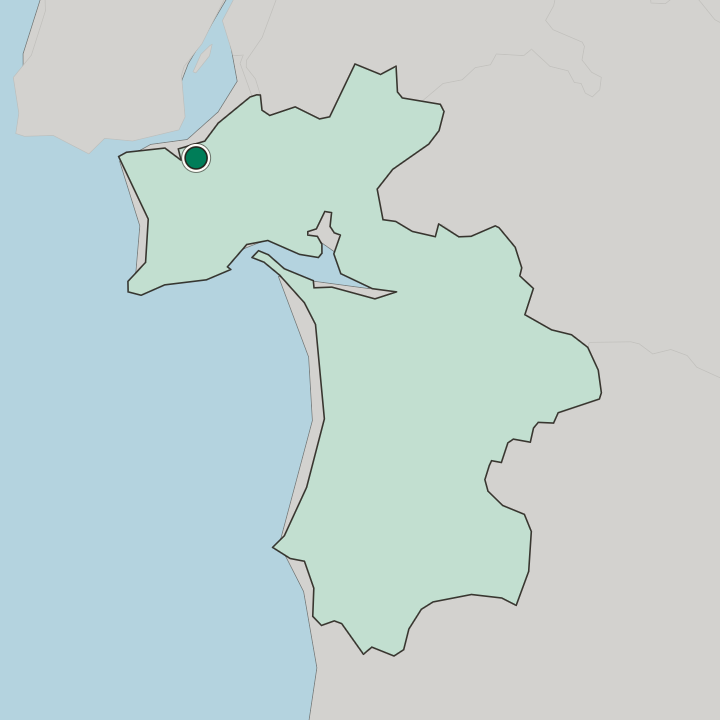
The Distrito de Setúbal sets Barreiro's frame. Built ground runs right to the water at Ponta da Passadeira, and the settlement pattern along that shore is tight enough that the parishes read as one continuous stretch rather than as separate towns. Alhos Vedros lies on one side and Seixal on the other, each close enough to Barreiro that a church in one is a short journey from a church in the next.
Water sets the limit.
What is the climate of Barreiro?
Temperate air governs the year in Barreiro. The water beyond Ponta da Passadeira takes the edge off both ends of it, keeping the cold stretch short and softening the warm one more than ground set back from this shore ever manages. Layers serve better than extremes.
Nothing about the seasons here demands special preparation, and the churches and works buildings stay walkable in any of them.
How do you get to Barreiro?
Road links do the connecting. Approaches run through Alhos Vedros and through Seixal, linking Barreiro to the wider Distrito de Setúbal, while the shoreline at Ponta da Passadeira closes the town on its far side. You can cross it on foot.
Once inside, the Igreja de Nossa Senhora do Rosário, the Igreja da Misericórdia do Barreiro, and the Espaço Memória all sit within a walk of each other.
Common questions
What is the best area to stay in Barreiro?
Nossa Senhora do Rosário: Walking between Barreiro's churches and its works. Ponta da Passadeira: Water-facing evenings away from the yards. Alhos Vedros: Parish quiet at the Igreja Paroquial. Seixal: The Nossa Senhora da Conceição side of the shore.
Good for
Another city in Distrito de Setúbal
Updated October 2026