Russia · Komi
Where to Stay in Ukhta, Komi
Ukhta is an industrial town of the Komi Republic, founded in 1929 and set about with taiga in the subpolar band.
Find your area →


Where to stay in Ukhta
Where the beds are, and what that means for the visit.
Rooms in Ukhta follow the working town, not a tourist quarter. The blocks along Pervomayskaya hold the addresses most visitors are given, and from there the park of culture and rest, its entrance group off Kosolapkina, the listed school building and the Bushuyev monument all fall within an easy walk of one another. Little in Ukhta lies out of reach.
Because work rather than sightseeing fills most beds, the busiest weeks track the schedules of the plants and institutes of the Komi Republic rather than any holiday season, and a room booked ahead spares an awkward evening. Quieter streets sit back from that core. Away from Pervomayskaya the town thins into residential blocks and then into taiga, so a car earns its keep for the run in to the shops, the listed school building and the memorials, including the monument to Arsen Pavlov.
Distances inside Ukhta are modest by the standards of the Komi Republic, where settlements can stand a full day of forest apart, and the whole built area covers barely 320 square kilometres. If you want the park and the shops underfoot, take the central streets; if quiet matters more, the outer blocks answer better and the drive in is short. Winter shortens every walk.
Snow lies on the taiga for much of the year, and an address a few streets nearer the centre is worth more in January than any view.
About Ukhta
Industry made Ukhta.
What is Ukhta known for?
The town grew as a working centre of the Komi Republic after 1929, and its plants and institutes still set the rhythm of a place that has never traded on visitors. Civic set pieces punctuate the blocks: the Bushuyev monument, the listed school building, and the entrance to the park of culture and rest off Pervomayskaya and Kosolapkina. Komi is a forest republic.
Ukhta belongs to the industrial half of that story, a manufacturing town holding its ground in the taiga.
What are the main landmarks in Ukhta?
Ukhta keeps a short register of protected sights, and most of them are civic. The Bushuyev monument stands among the blocks, the monument to Arsen Pavlov was raised in the same town, and a school building carries heritage protection of its own. The park of culture and rest, named for the fortieth anniversary of the VLKSM, is entered through a formal group of gateposts on the Pervomayskaya and Kosolapkina side, which is the piece most photographed.
No old town survives here. Nothing predates the twentieth century, because the town itself does not.
What is the history of Ukhta?
Ukhta dates from 1929. That single year explains almost everything about the shape of the place: there is no kremlin, no merchant quarter and no cathedral square, because the town was laid out as an industrial settlement in a stretch of Komi taiga that had carried nothing of the kind before. Forest came first.
Everything built here was built to serve production, and the street grid, the plants and the institutes went up together rather than accreting over centuries as they did in the older towns of Russia. The Soviet century left the register of monuments the town still keeps. Its park of culture and rest takes its name from the fortieth anniversary of the VLKSM, the youth league whose jubilees were marked in parks across the country, and the entrance group off Pervomayskaya and Kosolapkina survives as a designed piece of that era.
The Bushuyev monument belongs to the same civic habit of commemoration, as does a school building now listed in its own right. Later decades added more memorials, among them the monument to Arsen Pavlov. Industry stayed the constant.
Through every change of system the Komi Republic treated Ukhta as a producing town rather than an administrative one, and the taiga around it went on setting the limits of what could be built and how far the next settlement lay.
Where is Ukhta?
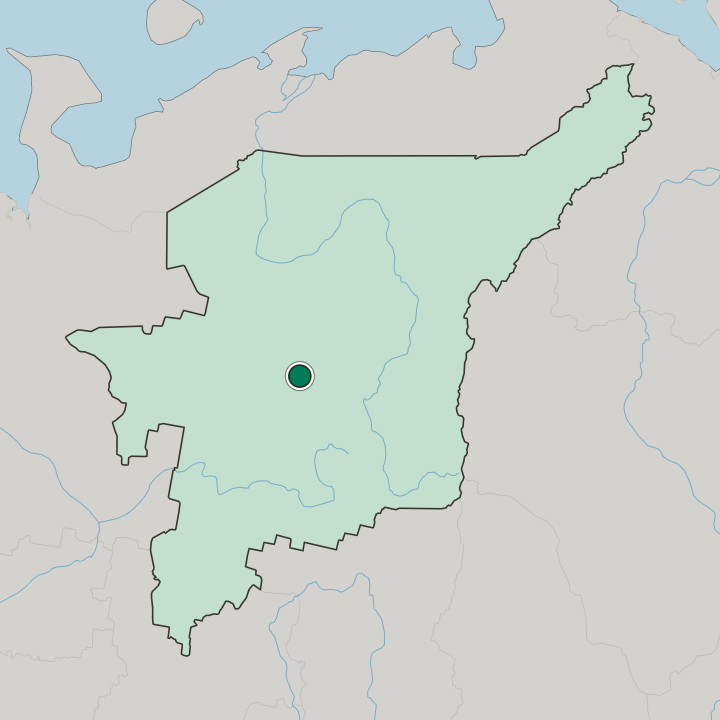
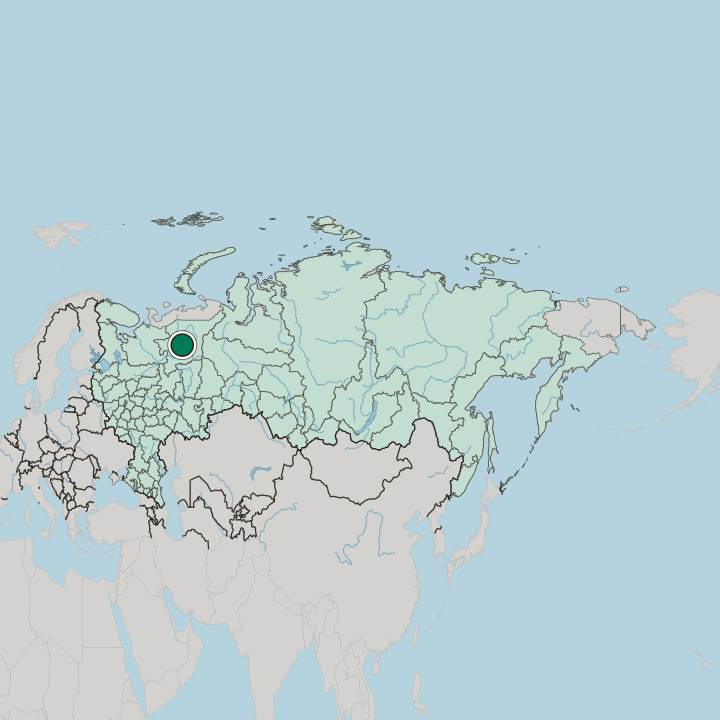
Taiga surrounds Ukhta on every side. The town lies inland in the Komi Republic, well up in the subpolar band, where coniferous forest runs to the horizon and the built area, spread loosely across roughly 320 square kilometres, never fills the ground it claims. Ukhta stands far from any sea.
Komi is a thinly settled forest republic, and the distances between its towns are measured in hours of driving rather than in the short hops familiar further south in Russia.
What is the climate of Ukhta?
The Komi taiga sets the terms of the year in Ukhta. Sitting in the subpolar band with no sea near enough to temper it, the town holds snow cover for a long half of the year, and the dark stretch around midwinter shortens daylight to a few dim hours. Then it turns fast.
Warmth arrives over the forest in a rush, the birches green in weeks rather than months, and the short bright season ends as abruptly as it began.
How do you get to Ukhta?
Reaching Ukhta means crossing the Komi Republic. Any approach runs for hours through forest before the industrial blocks appear, and the taiga rather than any range of hills is what makes the journey a long one. Arrivals are rarely quick.
Once here the town is walkable in its core, with Pervomayskaya, the park of culture and rest and the Bushuyev monument close together in the central streets.
Good for
More cities in Komi
Updated September 2026