Switzerland · Kanton St. Gallen
Where to Stay in Sankt Gallen, Kanton St. Gallen
Two Baroque towers rise over the Steinach valley at Sankt Gallen, a city in Kanton St. Gallen, Switzerland, known for its abbey library and its embroidery.
Hotel links are affiliate links: booking through them may earn us a commission, at no extra cost to you. It never affects how places are ranked. How this works


Where to stay in Sankt Gallen
The right area depends on your trip — here's what each neighbourhood is best for.

 Sankt GallenSwitzerlandThe Drei Weieren bathing ponds and the walk along the Freudenberg
St. Georgen
The Mühleggbahn lifts this quarter clear of the valley floor, and the ponds and the wooded ridge start at its top station.St. Georgen → Sankt GallenSwitzerlandQuiet nights on the Rosenberg near the Wildpark Peter und Paul
Rotmonten
The northern ridge holds the university campus and the deer enclosures, with the centre a downhill walk away. Rooms are few around here — worth securing early.Rotmonten →Sankt GallenSwitzerlandA residential base on the Appenzell narrow-gauge lineRiethüsli
The quarter has its own halt on the line toward Gais and Appenzell, and the Irabach begins its buried run to the centre here. Lodging is scarce in this area; reserve in advance.Riethüsli → Sankt GallenSwitzerlandArriving by car from the west
Winkeln
Winkeln lies beyond the Sittertobel with its own federal station and the Gübsensee close by, farthest of the quarters from the abbey. Lodging is scarce in this area; reserve in advance.Winkeln →Hotel links are affiliate links: booking through them may earn us a commission, at no extra cost to you. It never affects how places are ranked. How this works
Find hotels in Sankt Gallen
Direct booking searches for these neighbourhoods.
The old town and the Stiftsbezirk
The abbey precinct, the cathedral and the oriel lanes sit inside one loop of about ten minutes.Find hotels in The old town and the StiftsbezirkA bed beside the station and the StadtloungeBleicheli
The business quarter west of the old town puts the platforms and the red square of the Raiffeisenplatz within sight of each other.Find hotels in BleicheliHotel links are affiliate links: booking through them may earn us a commission, at no extra cost to you. It never affects how places are ranked. How this works
Things to do in Sankt Gallen
Ranked by global recognition; descriptions from Wikidata (CC0).
Museums & Galleries
3- St. Gallen Museum of Art Heritage
- open art museum Heritage
- Seifenmuseum
Churches & Religious Sites
5- Church of St. Lawrence Heritage
- Kloster Notkersegg Heritage
- former dominican convent of St. Catherine Heritage
- Bruder-Klaus-Kirche Winkeln Heritage
- Old Catholic Church of Christ Heritage
Castles & Historic Sites
3- Alt-Meldegg, medieval castle site Heritage
- Abbey District, early medieval-modern Monastery Heritage
- Bernegg, medieval castle site Heritage
Stadiums & Sports
2- Kreuzbleiche
- Grundenmoos
Parks & Gardens
1- Botanical Garden St. Gallen
worth knowingacross 5 categories in Sankt Gallen
About Sankt Gallen
What is Sankt Gallen known for?
Sankt Gallen is known for the Stiftsbezirk, the abbey precinct UNESCO listed as World Heritage in 1983. The Abbey Library of St. Gallen keeps about 2,100 medieval manuscripts under the hall Peter Thumb raised between 1758 and 1767, and a Greek line over the door calls the room a healing place for the soul. Schepenese lies in the same hall.
The Egyptian mummy has pulled visitors up the stairs for generations. Cloth built the other reputation, and the Textilmuseum St. Gallen holds the pattern books, laces and sample volumes that the embroidery trade left in the city.
What are the main landmarks in Sankt Gallen?
Sankt Gallen keeps its main landmarks in the Stiftsbezirk, the abbey precinct UNESCO listed in 1983. St. Gallen Cathedral fills it under two towers of 68 metres, and the Abbey Library of St. Gallen runs along one wing. Two churches hold the old town: St. Laurenzen behind its 1851 neo-Gothic skin, and Kloster St. Katharina with its Dominican cloister.
The Karlstor is the last gate. The Mühleggbahn of 1893 climbs to Drei Weieren on the Freudenberg, and the Wildpark Peter und Paul keeps ibex and marmots on the Rosenberg. Kloster Notkersegg still holds Capuchin sisters.
Textilmuseum St. Gallen and Kunstmuseum St. Gallen carry the rest.
What is the history of Sankt Gallen?
Sankt Gallen began as a hermit's cell beside the Steinach, where the Irish monk Gallus settled around 612. Otmar took over the community in 719 and built it into a Benedictine abbey, and the abbey made everything that followed. Monks were copying manuscripts here by the middle of the eighth century, and the plan of an ideal monastery drawn in the scriptorium under Abbot Gozbert survives as the oldest architectural drawing in the West.
A town grew against the abbey wall. By 1180 the place ranked as a free imperial city under a reeve who answered to the emperor rather than to the abbot, and in 1454 its burghers swore themselves into the Swiss Confederation. The Reformation then split the ground in two, with the city Protestant under Vadian and the abbot's countryside Catholic.
Cloth paid for both sides. Linen came first, cotton next, and then the embroidery that had grown into the largest export trade in Switzerland by 1910, and the merchants who ran it built the carved and painted oriels that still overhang the old town. The abbey was dissolved in 1805, two years after the canton of St. Gallen was drawn around it, and its church became a cathedral instead.
Straubenzell and Tablat came in 1918. That merger brought Winkeln, Riethüsli, Rotmonten and St. Georgen inside the boundary, and the commercial academy the canton had founded in 1898 grew into the Universität St. Gallen on the Rosenberg.
Where is Sankt Gallen?
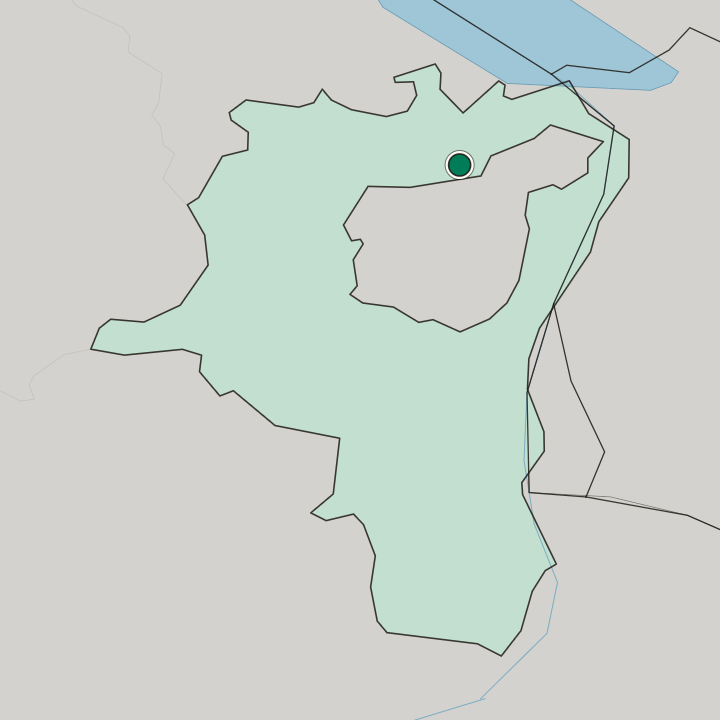
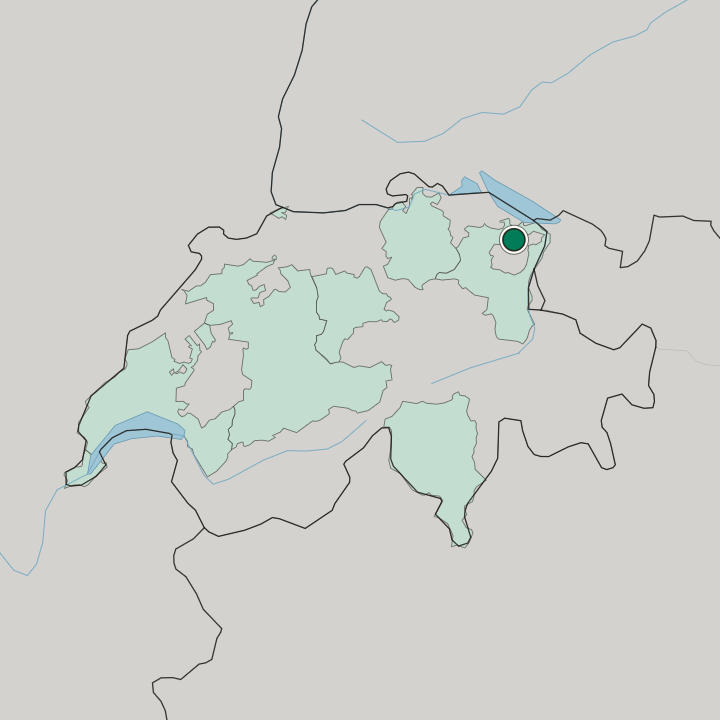
Sankt Gallen lies in eastern Switzerland, in a valley about 700 metres above sea level between Lake Constance and the Appenzell Alps. Two wooded ridges pen the city in: the Rosenberg to the north, which carries Rotmonten and the Wildpark Peter und Paul, and the Freudenberg to the south. The Steinach threads through it.
The stream runs culverted under most of the centre and reaches Lake Constance past the north-eastern city limit, while the Sitter cuts the deep Sittertobel along the western side toward Winkeln. Säntis rises to the south.
What is the climate of Sankt Gallen?
The climate of Sankt Gallen is temperate but wetter and colder than the Swiss lowland average, because the city stands about 700 metres up and its ridges are the first high ground the western weather meets. Cloud piles against the Alpstein. That stalling turns into days of steady rain, or in winter into snow that can lie in shaded lanes into April.
Fog off Lake Constance fills the basin through autumn, and on the better of those days the higher quarters such as Rotmonten sit in sun above it. Then the Föhn arrives and lifts the temperature in a few hours.
How do you get to Sankt Gallen?
Sankt Gallen sits on the main line from Zürich and Winterthur out to Rorschach, and trains have run in since 1856. The station is the neo-Baroque hall Alexander von Senger finished in 1913, and the Appenzeller Bahnen leave from beside it for Trogen, Gais and Appenzell, running as a street tram through the city on the way out. Three more stations of the federal railway serve the outer quarters, at St. Fiden, Bruggen and Winkeln.
The A1 passes underneath. Its Rosenberg and Stephanshorn tunnels opened in 1987 and take the through traffic below the centre, while Zürich lies about 80 kilometres to the south-west.
Common questions
What is the best area to stay in Sankt Gallen?
The old town and the Stiftsbezirk: Walking to the Abbey Library of St. Gallen before breakfast. Bleicheli: A bed beside the station and the Stadtlounge. St. Georgen: The Drei Weieren bathing ponds and the walk along the Freudenberg. Rotmonten: Quiet nights on the Rosenberg near the Wildpark Peter und Paul. Riethüsli: A residential base on the Appenzell narrow-gauge line. Winkeln: Arriving by car from the west.
Good for
Updated October 2026