India · State of Tamil Nādu
Where to Stay in Cumbum, State of Tamil Nādu
Grapevines and coconut gardens fill the valley floor at Cumbum, a town of the Theni district in Tamil Nadu, natively enunciated as Kambam.
Hotel links are affiliate links: booking through them may earn us a commission, at no extra cost to you. It never affects how places are ranked. How this works


Where to stay in Cumbum
Where the beds are, and what that means for the visit.
Cumbum has few beds, and the ones it has sit in the middle of the town rather than in any hotel quarter. Rooms are plain and aimed at traders coming to the grape and cardamom market, not at visitors making a holiday of the Cumbum Valley. Booking ahead matters more here than choosing an area, because a valley market town does not carry the spread of districts that a larger Tamil Nadu city offers.
The address to know is Kottai, the quarter that holds the Kambaraya Perumal temple. Anything within walking reach of it is inside the working town, close to the market and to the stands where buses leave for the rest of the Theni district. Anyone whose reason for coming is business will want to be there.
The alternative is to sleep outside Kambam. Uthamapalayam, the taluk seat a short run north on National Highway 183, carries more rooms, and travellers working through the hills often base themselves at Kumily on the Kerala border and come into the valley for a morning. That is the ordinary arrangement where a town has no hotel trade of its own.
Expect little choice. What Cumbum offers is a plain room among people who came for the same harvest, and most stays here run to a night or two.
Find hotels in Cumbum
Direct booking searches for these neighbourhoods.
Kottai
The quarter that holds the town's temple, within reach of the market and the bus stands. Few places to stay nearby — book ahead.Find hotels in KottaiTravellers who want more rooms than Cumbum carries and a short run down the valleyUthamapalayam
The taluk seat north of Cumbum on National Highway 183, with the same valley on its doorstepFind hotels in UthamapalayamHotel links are affiliate links: booking through them may earn us a commission, at no extra cost to you. It never affects how places are ranked. How this works
About Cumbum
What is Cumbum known for?
Cumbum is the market town of the Cumbum Valley, one of the few tracts in Tamil Nadu where grapes are grown in quantity. Muscat vines and coconut gardens cover the valley floor of the Theni district, and cardamom comes down to the same trading counters from the estates in the hills above. The market handles all three.
Buyers from elsewhere in India ask for Kambam at the counter, which is what the growers call the place.
What are the main landmarks in Cumbum?
Cumbum's landmark is the temple at Kottai, where Kambaraya Perumal and Kasi Viswanathar share one campus with a flag post for each shrine. The temple is about 500 years old. Tradition holds that the Perumal idol was found beneath a stone post, a kambam, and that the post named the town; a vanni tree in the courtyard is worshipped as Brahma.
The Aani festival in June and July stages the robbing of Tirumangai Azhwar as a mock arrest brought before the god. The other draw is water, at Suruli Falls, 10 km south.
What is the history of Cumbum?
Cumbum's recorded past begins with a temple and a dam. The shrine of Kambaraya Perumal at Kottai is reckoned at about 500 years old, and the older part of the town grew around it, on a valley floor that farmed dry land until the Periyar water arrived. The date that changed Kambam is 1895.
Work on the Mullaperiyar Dam ran from 1887 under Colonel John Pennycuick, who dammed the Periyar River in the hills to the west so that water running to the Arabian Sea could be turned east instead, into the rain shadow around Madurai. Monsoon floods carried the works away more than once, and when the British government would not pay for the rebuilding, Pennycuick went home to England and sold his own property to raise the money. Landowners in Cumbum and Gudalur put in cash and men.
The dam was finished in 1895, Periyar water reached the Cumbum Valley, and families from the dry country to the east moved in to farm it. A third thread runs through the century after. Peer Mohammad, born in 1888 and known as Cumbum Pavalar, was a sub-inspector of police at Andipatti who resigned after the Non-Cooperation Movement of 1920.
He published Gandhi Maaligai, a book of songs on Hindu-Muslim unity carrying a foreword by Periyar E.V.R., and he opened a reading room near the municipal office in Cumbum.
Where is Cumbum?
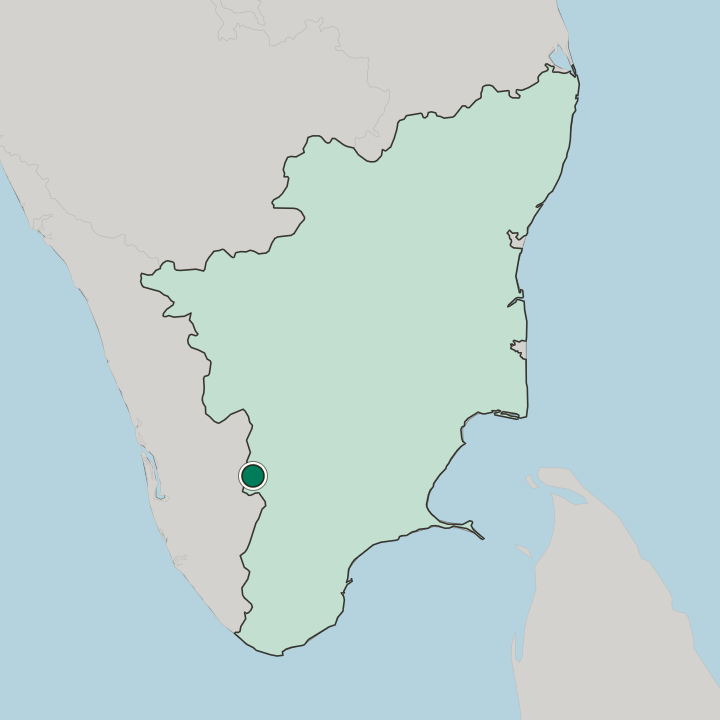
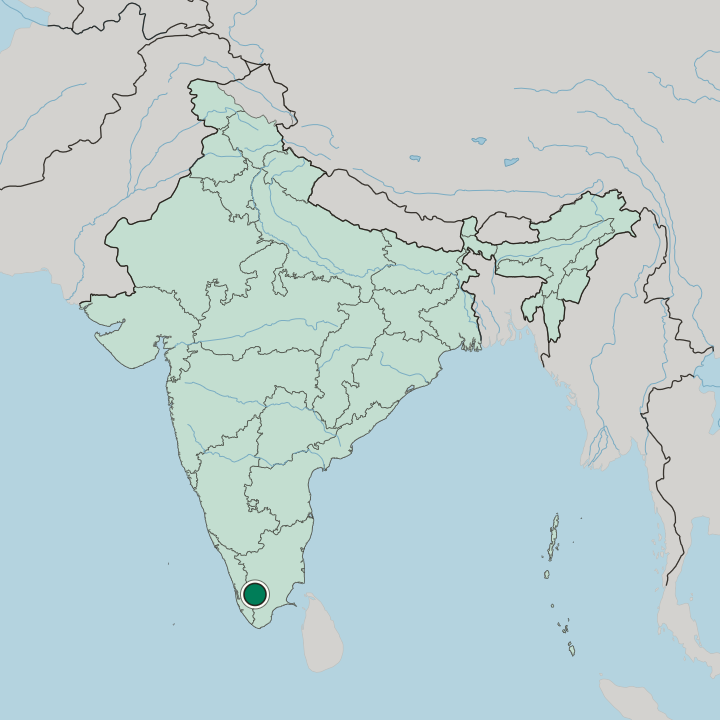
Cumbum stands at 391 metres on the floor of the Cumbum Valley, in the Theni district of Tamil Nadu. The Western Ghats close it off to the west and the Varusanadu Hills to the south. Kerala begins at the ridge.
The Vaigai River rises in those hills and runs north through the valley, and water off the Meghamalai range feeds Suruli Falls, 10 km south of the town. The Kodaikanal Hills stand at the far end of the view north.
What is the climate of Cumbum?
Cumbum takes its rain from the southwest monsoon, and the streams off the Meghamalai range run hardest between June and October. Rain comes from the west. Days stay warm through the year at 391 metres in the tropics, so the seasons in the Theni district are marked by wet and dry rather than by cold, and the grape and cardamom calendar is worked around that.
A traveller arriving in Kambam from elsewhere in India should plan for heat first and rain second.
How do you get to Cumbum?
Cumbum sits on National Highway 183, the Kollam to Dindigul road, which crosses out of Kerala at Kumily and runs on through Gudalur to the town. No train reaches Kambam. The nearest railheads are 40 km away at Bodinayakkanur and at Theni, and the nearest flights are 115 km off at Madurai International Airport.
Thekkady is 30 km to the southwest, and buses run from the town to Suruli Falls on the way there.
Common questions
What is the best area to stay in Cumbum?
Kottai: Market business and a walk to the Kambaraya Perumal temple. Uthamapalayam: Travellers who want more rooms than Cumbum carries and a short run down the valley.
Good for
More cities in State of Tamil Nādu
Updated September 2026