United States · New Jersey
Where to Stay in Passaic, New Jersey
Passaic, founded in 1679, is a densely built city in Passaic County, New Jersey, holding two cathedrals and a run of colonial-era houses.
Hotel links are affiliate links: booking through them may earn us a commission, at no extra cost to you. It never affects how places are ranked. How this works


Where to stay in Passaic
Where visitors usually base themselves, and why.
Short distances take the pressure off the decision. The city covers barely eight square kilometres, so a room almost anywhere leaves the Cathedral of St. Michael the Archangel and St Joseph's Roman Catholic Church inside a walk, and no quarter is cut off from the rest. Density has a cost, though.
Streets carry more people to the block than almost any city in the United States manages, which shows up as traffic noise, crowded pavements, and kerb space that disappears early in the evening. The house circuit points to a calmer side. Ground near the Van Houten-Hillman House and the Garritse-Doremus-Westervelt House keeps the older residential grain, which suits a visit built on the colonial record rather than on the parish one.
Rooms stay limited throughout. Passaic works as a place of employment rather than as a visitor destination, so anyone wanting a wider choice ends up looking at the larger municipalities of Passaic County and beyond, and travelling back in for the day. Saints Peter & Paul Russian Orthodox Cathedral, the Fridolin Arnault House, and the William Carlos Williams House all sit near enough to the middle that even a short stay reaches them.
Find hotels in Passaic
Direct booking searches for these neighbourhoods.
Around the Cathedral of St. Michael the Archangel
Central ground where the cathedral and St Joseph's Roman Catholic Church stand minutes apart on foot.Find hotels in Around the Cathedral of St. Michael the ArchangelA stay beside Saints Peter & Paul Russian Orthodox CathedralThe Saints Peter & Paul quarter
Streets around the Russian Orthodox cathedral, which marks the congregational mix packed into this corner of Passaic County. Beds are limited here, so book early.Find hotels in The Saints Peter & Paul quarterColonial fabric from the Van Houten-Hillman House outwardThe old house streets
The older residential grain of Passaic, where the Garritse-Doremus-Westervelt House and the Fridolin Arnault House survive among later building. Beds are limited here, so book early.Find hotels in The old house streetsQuiet nights within reach of the William Carlos Williams HouseNear the William Carlos Williams House
Blocks a short walk out from the churches, with the William Carlos Williams House and St. John's Evangelical Lutheran Church as the local markers.Find hotels in Near the William Carlos Williams HouseHotel links are affiliate links: booking through them may earn us a commission, at no extra cost to you. It never affects how places are ranked. How this works
Things to do in Passaic
Ranked by global recognition; descriptions from Wikidata (CC0).
Churches & Religious Sites
3- St. John's Evangelical Lutheran Church Heritage
- Cathedral of St. Michael the Archangel
- St Joseph's Roman Catholic Church
Landmarks & Notable Places
3- William Carlos Williams House Heritage
- Van Houten-Hillman House Heritage
- Fridolin Arnault House Heritage
worth knowingacross 2 categories in Passaic
About Passaic
Congregations shape the streetscape.
What is Passaic known for?
The Cathedral of St. Michael the Archangel and the Saints Peter & Paul Russian Orthodox Cathedral both hold cathedral rank inside one small city, while St Joseph's Roman Catholic Church and St. John's Evangelical Lutheran Church bring two further traditions onto the same ground. Old houses survive between them. The Van Houten-Hillman House, the Garritse-Doremus-Westervelt House, the Fridolin Arnault House, and the William Carlos Williams House make up the domestic half of a compact record.
What are the main landmarks in Passaic?
Two cathedrals head the list. The Cathedral of St. Michael the Archangel and the Saints Peter & Paul Russian Orthodox Cathedral are joined by St Joseph's Roman Catholic Church and St. John's Evangelical Lutheran Church, which between them cover four traditions in a city of modest size. Houses take the rest of it.
The Van Houten-Hillman House, the Garritse-Doremus-Westervelt House, the Fridolin Arnault House, and the William Carlos Williams House survive from earlier phases of building, and every one of the eight stands within the same compact grid.
What is the history of Passaic?
The settlement dates from 1679. Family names on the oldest surviving buildings carry that first period forward, and the Garritse-Doremus-Westervelt House, the Van Houten-Hillman House, and the Fridolin Arnault House are the clearest evidence left of the landholders who worked this ground before the city existed. Growth came later and came fast.
What had been farmland turned into one of the most tightly packed municipalities in the United States, sixteenth in size among the municipalities of New Jersey and just behind Bayonne. The churches record who arrived. St Joseph's Roman Catholic Church and St. John's Evangelical Lutheran Church answer to different communities, and the Cathedral of St. Michael the Archangel and Saints Peter & Paul Russian Orthodox Cathedral show that two of those communities grew large enough to seat a cathedral within one small city.
Few places of this size carry four such buildings. The William Carlos Williams House belongs to the same century of building, standing among the streets that filled in once Passaic County industry drew people to the district, and it survives where much of the surrounding fabric has been replaced.
Where is Passaic?
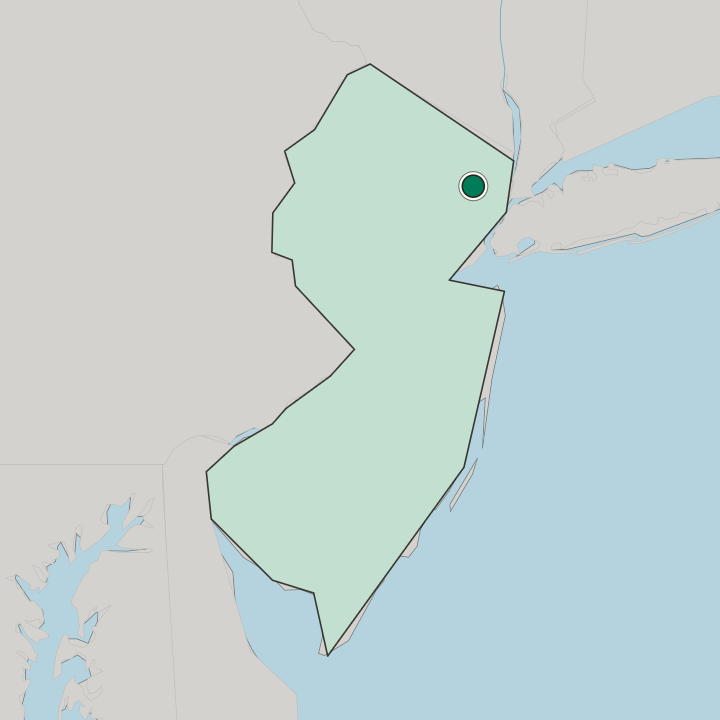
Passaic County frames the city. Passaic itself takes up only about eight square kilometres, a small footprint for a municipality that ranks sixteenth in size across New Jersey, and the built-up ground continues past its boundary without a break. There is no open country here.
The Cathedral of St. Michael the Archangel, the Van Houten-Hillman House, and the William Carlos Williams House all fall inside that short compass, which keeps the whole landmark list within one walkable grid.
What is the climate of Passaic?
Masonry holds the summer heat. Passaic lies in the temperate band of the northern hemisphere, and a grid built this tightly warms faster than open country and gives that warmth back slowly through the night. Snow reaches Passaic County each winter.
Spring and autumn are the seasons that suit walking between the Cathedral of St. Michael the Archangel and the old houses, since shade is thin on streets built edge to edge.
How do you get to Passaic?
Passaic is compact enough to cross on foot. Arrivals come in by road from the rest of Passaic County and finish with a short walk, because eight square kilometres of grid puts the churches and the old houses within reach of one another. Parking is the real difficulty.
Kerb space runs out quickly on streets carrying this many people to the block, so leaving a car at the edge and crossing on foot to Saints Peter & Paul Russian Orthodox Cathedral or St Joseph's Roman Catholic Church saves the search.
Common questions
What is the best area to stay in Passaic?
Around the Cathedral of St. Michael the Archangel: Liturgy and architecture at the Cathedral of St. Michael the Archangel. The Saints Peter & Paul quarter: A stay beside Saints Peter & Paul Russian Orthodox Cathedral. The old house streets: Colonial fabric from the Van Houten-Hillman House outward. Near the William Carlos Williams House: Quiet nights within reach of the William Carlos Williams House.
Good for
More cities in New Jersey
Updated September 2026