Brazil · Bahia · Salvador
Baixa de Quintas, Salvador — Area Guide & Where to Stay
Baixa de Quintas is a district of Salvador in Bahia around the Jesuit Quinta do Tanque of 1555, since 1980 the Arquivo Público do Estado da Bahia.
Hotel links are affiliate links: booking through them may earn us a commission, at no extra cost to you. It never affects how places are ranked. How this works


Where to stay in Baixa de Quintas
Where the beds are, and what that means for the visit.
No hotel carries a Baixa de Quintas address, and no metro platform does either: Salvador's Line 1, open since 2014, keeps its stations clear of the district. A visitor still has a reason to come up here on a day plan, because the Arquivo Público do Estado da Bahia takes booked visits inside the Quinta do Tanque. Sleep in the Centro Histórico instead.
From there it is a short ride inland along Avenida Barros Reis, which turns into the district at Rua Cônego Pereira, roughly two kilometres from the bay.
Few places to stay in Baixa de Quintas — most visitors book in Centro Historico nearby.
Find hotels in Baixa de Quintas
Direct booking search for this neighbourhood.
Hotel links are affiliate links: booking through them may earn us a commission, at no extra cost to you. It never affects how places are ranked. How this works
About Baixa de Quintas
What are the main landmarks in Baixa de Quintas?
Two things anchor Baixa de Quintas, and both are old. The Quinta do Tanque, granted to the Jesuits by Tomé de Sousa in 1555 and listed by IPHAN in 1949, holds the Arquivo Público do Estado da Bahia, which opens its rooms to booked visits. Its cemeteries date from 1856.
Cemitério Quinta dos Lázaros, laid out on the slope above Rua Quinta dos Lázaros, counts among the oldest burial grounds in Salvador, and it shares that hillside with the Cemitério da Ordem Terceira de São Francisco, the Cemitério dos Humildes de São Francisco of 1857, the Cemitério da Ordem Terceira do Carmo begun in 1877, and the Cemitério Israelita, added in the twentieth century.
What is the history of Baixa de Quintas?
Tomé de Sousa gave this ground to the Jesuits in 1555, a rest house for the Colégio da Bahia far enough from the colonial capital to count as country. The order held it until 1759. After the auction of 1761 the property turned into a leprosarium, and the Hospital dos Lázaros opened on 21 August 1787; the patients gave Quintas dos Lázaros its name.
The 1850s cholera changed that. Salvador's irmandades answered the epidemic by laying out burial grounds on this hill, beginning in 1856 and running through the Ordem Terceira do Carmo and its cemetery of 1877, whose chapel courtyard was finished only in 1919. Candomblé priests and priestesses were buried here through the twentieth century, and in 1969 the preserved heads of the cangaceiros Lampião and Maria Bonita were taken from display at the Museu Antropológico Estácio de Lima and put in the same cemetery.
The Arquivo Público do Estado da Bahia, founded on 16 January 1890, moved into the old Jesuit house in 1980.
Where is Baixa de Quintas?
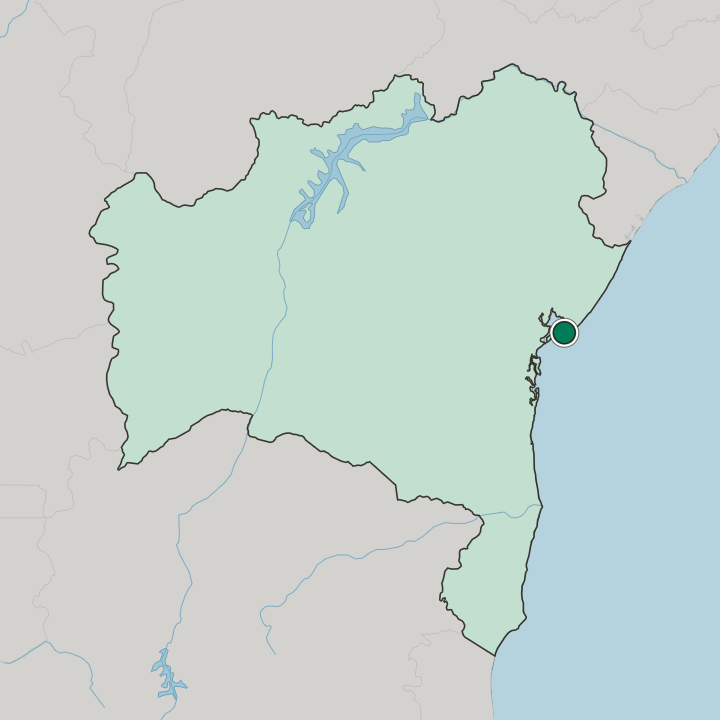
Baixa de Quintas covers a slope in the older inland belt of Salvador, bounded by Barbalho to the west, Caixa d'Água to the north, Cidade Nova to the east, and by Dois Leões and Macaúbas on the south. Three roads carry it: Estrada da Rainha, Rua Quinta dos Lázaros and Rua General Argolo. Traffic enters at Avenida Barros Reis.
That avenue follows the old bed of the Rio das Tripas down to the Largo dos Dois Leões, where the water reaches the Rio Camarajipe just beyond the district line, and it is at Rua Cônego Pereira that the turn into Quintas is made.
Common questions
What is the best area to stay in Baixa de Quintas?
Baixa de Quintas: a researcher with an appointment at the state archive. Centro Histórico: anyone who wants Salvador's hotel stock and a short run up Avenida Barros Reis.
More areas in Salvador
Updated October 2026