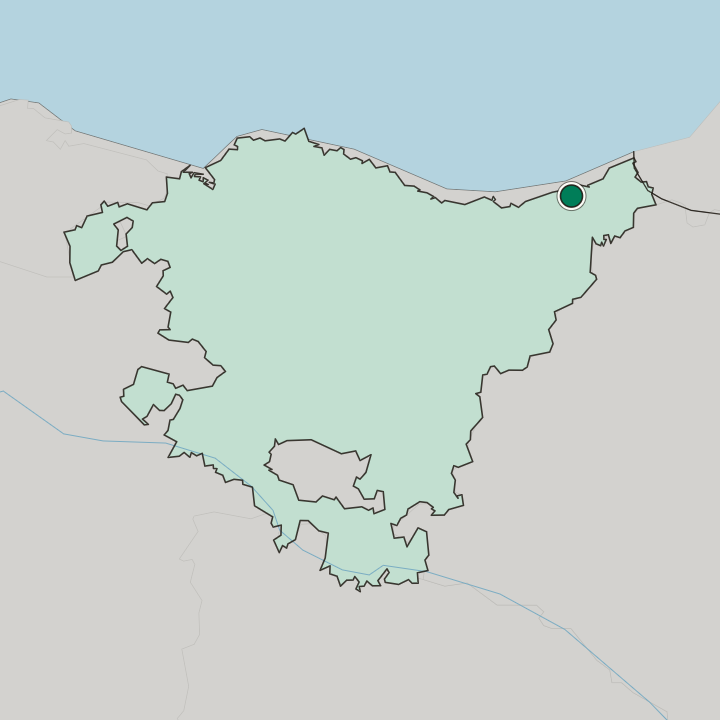
Spain · Euskal Autonomia Erkidegoa · Donostia / San Sebastián
Aiete, Donostia / San Sebastián — Area Guide & Where to Stay
Aiete is the hill quarter of Donostia / San Sebastián, strung along the paseo de Aiete, the old cart road to Hernani, named for the Palacio de Aiete.
Hotel links are affiliate links: booking through them may earn us a commission, at no extra cost to you. It never affects how places are ranked. How this works


Where to stay in Aiete
The practical side of choosing where to sleep.
Rooms in Aiete are few. The hotel stock of Donostia / San Sebastián is gathered in Centro and along the beach, under two kilometres downhill from here by the cuesta de Aldapeta. What the quarter gives back is height: the mirador on the paseo Duque de Baena opens the whole of La Concha, and the park at the Palacio de Aiete is a gate away rather than a bus ride.
Centro holds the beds, not Aiete. Choose this address for a long stay in a residential district, not for a short visit spent in the old town.
Few places to stay in Aiete — most visitors book in Donostia / San Sebastián nearby.
About Aiete
What are the main landmarks in Aiete?
The Palacio de Aiete stands in 8.65 hectares of walled park off the paseo de Aiete, its gardens and ponds laid out by the royal gardener Pierre Ducasse, with an artificial grotto below them by the French architect Combaz. Its Lawson cypresses now reach 34 metres. The old carriage stables hold the Aieteko Topalekua, the district library and exhibition room.
Two further palaces sit in the quarter and neither is open to visitors: the Palacio de Arbaizenea of 1881, in English cottage style and still held by the house of Alba, and the Palacio de La Cumbre of 1862 on the paseo Duque de Baena. Lower down, the Casa Alquiza keeps its coat of arms at 51 paseo de Aiete, and the semicircular Parque de Basoerdi drops away below the paseo de Beloka.
What is the history of Aiete?
In 1865 the marqués de Portugalete, later the third duke of Bailén, bought 3.42 hectares beside the Hernani road, and the Belgian architect Adolf Ombrecht built the Palacio de Aiete on it in 1878. The regent María Cristina summered there with the young Alfonso XIII from 1887 to 1893, leaving once the Palacio de Miramar was finished down on the bay. The city bought the estate in 1940 and offered it to Francisco Franco as a summer residence.
He came back every year until 1973. The gardens opened as a public park on 20 July 1977, and the palace reopened in 2010 as a human rights institute. On 17 October 2011 it hosted the San Sebastián International Peace Conference, days before ETA announced the end of its armed campaign.
Where is Aiete?
Aiete covers about 2.67 square kilometres of ridge and hollow, high ground looking down on the flat districts around it. Centro closes it to the north, Amara Nuevo to the east, Miramón-Zorroaga to the south, Ibaeta to the west and El Antiguo to the north-west. In Basque it was Goiko Galtzara.
That upper causeway is now the paseo de Aiete, which runs the length of the quarter from the Cumbre junction, where the cuesta de Aldapeta comes up from town. Bera-Bera, built in the 1970s as Bidebieta II, steps down its own hollow, and the mirador on the paseo Duque de Baena hangs over La Concha at the northern edge.
Common questions
What is the best area to stay in Aiete?
Aiete: a long stay on the hill, with the Aiete park at the door.
More areas in Donostia / San Sebastián
Updated October 2026