Indonesia · Jawa Timur
Where to Stay in Madiun, Jawa Timur
Madiun is a city of Jawa Timur in Indonesia, a railway and sugar town known as Kota Gadis.
Hotel links are affiliate links: booking through them may earn us a commission, at no extra cost to you. It never affects how places are ranked. How this works


Where to stay in Madiun
Where visitors usually base themselves, and why.
Madiun railway station is the hinge of most stays. Trains from Surabaya and Surakarta stop there, the arrival hall sits close to the older commercial streets, and a room within walking distance of the platforms spares a visitor any transfer at all in a city of thirty-three square kilometres. That compactness matters.
Pecel warungs and brem sellers work the streets nearest the platforms, so the food the city is named for is on the doorstep of the cheapest beds. Nothing on the landmark list is far from anything else. The Chinese quarter offers a different morning, and rooms near Hwie Ing Kiong Temple and the House of Chinese Captain Njoo Swie Lian put a visitor among the shophouse frontages that the sugar money built.
Sleko Water Tower marks the colonial civic layer nearby. Madiun Regency spreads beyond the city limits, and a stay out that way trades the walkable core for the farmland that feeds the mills. Saint Cornelius Catholic Church anchors a third pocket, quieter than the station side and closer to the ground the Rejo Agung Sugar Factory Complex occupies, which suits anyone here for the industrial record rather than the food stalls.
Purabaya Museum is the one stop worth a walk. Beds cluster where the trains do.
Find hotels in Madiun
Direct booking searches for these neighbourhoods.
Around Madiun railway station
The platforms, the brem sellers and the older commercial blocks of Madiun sit togetherFind hotels in Around Madiun railway stationWalkers drawn to the shophouse frontages of the Chinese trading townThe Hwie Ing Kiong Temple quarter
Hwie Ing Kiong Temple and the House of Chinese Captain Njoo Swie Lian share these streetsFind hotels in The Hwie Ing Kiong Temple quarterStays built around the Rejo Agung Sugar Factory Complex and Purabaya MuseumToward Saint Cornelius Catholic Church
The quieter civic side of Madiun, with Sleko Water Tower and the mill ground closeFind hotels in Toward Saint Cornelius Catholic ChurchHotel links are affiliate links: booking through them may earn us a commission, at no extra cost to you. It never affects how places are ranked. How this works
About Madiun
Trains and sugar built the name.
What is Madiun known for?
Madiun is called Kota Gadis, an acronym for a trading, education and industrial city, and it is equally a pecel town, a brem town, and the seat of the railway industry centred on INKA. The Rejo Agung Sugar Factory Complex still stands in the middle of it. Purabaya Museum keeps the local record.
Students give the streets their second name.
What are the main landmarks in Madiun?
Seven listed sites carry the city's record. Madiun railway station sits at the centre of the list, the plain fact of a city that builds rolling stock, and the Rejo Agung Sugar Factory Complex preserves the mill plant that made the cane of the surrounding country worth grinding. Sleko Water Tower still stands.
Hwie Ing Kiong Temple and the House of Chinese Captain Njoo Swie Lian mark the Chinese merchant town, Saint Cornelius Catholic Church marks another congregation entirely, and Purabaya Museum holds what survives of the earlier layers.
What is the history of Madiun?
Madiun was established in 1918. Sugar came first, and the Rejo Agung Sugar Factory Complex marks the industry that drew Dutch capital, Chinese trading houses, and a rail connection into the country west of Surabaya long before the town had any municipal standing of its own. Njoo Swie Lian's house survives from that commerce.
Dutch records name the place Milaan van Java. Saint Cornelius Catholic Church and Hwie Ing Kiong Temple stand for the two other communities that the mill economy pulled in, each keeping its own quarter of the growing town. Administration split in 1950.
The city and Madiun Regency were formed as separate bodies that year, and yet the city went on housing the regency's administration for six decades afterwards, an arrangement that only ended in 2010. Rolling stock joined cane in the city's trade, and INKA gave Madiun a second industrial identity beside the mills the Dutch had left. Other names accumulated around it, City of Brem, Pecel City, Student Town, and City of Literature among them, each one attaching to a trade or a habit rather than to any administrative fact.
Purabaya Museum keeps the objects. Iswahyudi Airbase lies over the boundary in Magetan, among the major air force stations of Indonesia, close enough that the city is regularly named alongside it.
Where is Madiun?
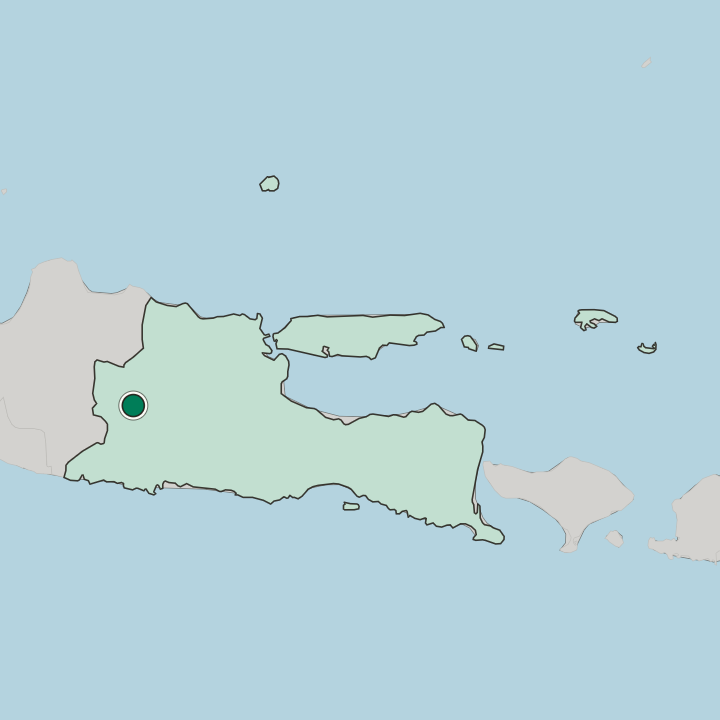
Madiun occupies a little over thirty-three square kilometres of the Jawa Timur interior, some 169 km west of Surabaya and 114 km east of Surakarta, with Ngawi 38 km to the northwest. The city is inland. Madiun Regency wraps around it on every side, farmland worked for the cane that the mills once took, and the boundary between the two has been an administrative line rather than a visible one since the pair were separated.
Sleko Water Tower still gives a fix on the older street grid.
What is the climate of Madiun?
Nothing in the calendar swings far. Madiun sits south of the equator well inside the tropics, so the strongest heat falls around the turn of the year rather than in its middle, and the seasons register as wet and dry rather than as warm and cold. Cane sets the rhythm that matters.
The wet months feed the crop that the Rejo Agung Sugar Factory Complex was built to grind, and the farming country of Madiun Regency has organised its year around that division for as long as the mills have run.
How do you get to Madiun?
Madiun railway station does most of the work. The city's standing as a railway town rests on that station and on the INKA works beside the tracks, which build rolling stock rather than move passengers. Surabaya lies 169 km to the east, Surakarta 114 km to the west, and Ngawi only 38 km off to the northwest, which puts all three within a day's travel of the station.
Iswahyudi Airbase sits over the boundary in Magetan, an air force station rather than a civil airport. Most arrivals come by rail.
Common questions
What is the best area to stay in Madiun?
Around Madiun railway station: Arrivals by train who want the pecel warungs on the doorstep. The Hwie Ing Kiong Temple quarter: Walkers drawn to the shophouse frontages of the Chinese trading town. Toward Saint Cornelius Catholic Church: Stays built around the Rejo Agung Sugar Factory Complex and Purabaya Museum.
More cities in Jawa Timur
Updated October 2026