India · State of Rājasthān
Where to Stay in Makrāna, State of Rājasthān
Makrāna is a marble town in Didwana-Kuchaman district, Rajasthan, whose quarries supplied the stone and the stonemasons for the Taj Mahal.
Hotel links are affiliate links: booking through them may earn us a commission, at no extra cost to you. It never affects how places are ranked. How this works


Where to stay in Makrāna
Where visitors usually base themselves, and why.
Quarries or offices, that is the split. Makrāna serves as the headquarters of the largest tehsil in Didwana-Kuchaman district, with 136 villages under it, so a share of the beds here are taken by people whose business is administrative rather than geological. Stone brings the rest.
Buyers, cutters and anyone tracking a slab of Makrana Marble back to its bed wants to be near the workings on the edge of town, not in the middle of it. Kuchaman City sits close by. Travellers crossing Didwana-Kuchaman district often treat the two as one stop, and a room on that side of Makrāna suits a schedule that includes both rather than one deep in the marble quarter. Jaipur is the larger fallback.
It stands 110 km to the east, which is far enough that nobody drives it casually, but near enough that a visitor wanting a full range of hotels can base there and come out for the day. Modicharna gives the scale. The biggest village in the tehsil by area lies out in the same jurisdiction, a reminder that Makrāna is the centre of a wide rural block rather than a compact town with a tourist quarter, and that beds thin out fast beyond the built-up part.
Find hotels in Makrāna
Direct booking searches for these neighbourhoods.
The tehsil headquarters
The administrative middle of the largest tehsil in Didwana-Kuchaman districtFind hotels in The tehsil headquartersStone buyers and anyone visiting the Makrana Marble workingsThe quarry edge
The working rim of Makrāna, where the marble that faced the Taj Mahal is still cut. Beds are limited here, so book early.Find hotels in The quarry edgeDrivers pairing Makrāna with Kuchaman City in one run across the districtThe Kuchaman City side
The approach facing Kuchaman City, convenient for crossing Didwana-Kuchaman district rather than stopping long. Rooms are few around here — worth securing early.Find hotels in The Kuchaman City sideHotel links are affiliate links: booking through them may earn us a commission, at no extra cost to you. It never affects how places are ranked. How this works
About Makrāna
Marble made the name.
What is Makrāna known for?
Makrana Marble went out of these quarries to the Taj Mahal, and the craftsmen and stonemasons went with it, which is a claim on the history of world architecture that few towns of this size anywhere can put forward. The stone has formal standing too. Its GHSR designation from the IUGS ranks the deposit among the internationally significant ones, and cutting marble is still what Makrāna does.
What are the main landmarks in Makrāna?
The quarries are the sight. Nothing in Makrāna competes with the beds of Makrana Marble themselves, which have been worked long enough to have faced a UNESCO world heritage monument several hundred kilometres away. That monument is the Taj Mahal.
The stone left here for it, and the building it faced stands elsewhere in India, so what a visitor gets in Makrāna is the source rather than the result.
What is the history of Makrāna?
The Taj Mahal begins here. Makrāna supplied the marble for it, and supplied the craftsmen and stonemasons as well, which places this town inside the making of a UNESCO world heritage monument rather than merely near one. Its own beginning went unrecorded.
What stands instead is the quarry record: the beds were working, and working at scale, by the time the Taj Mahal was built. Geology gave the town its argument. Makrana Marble later took the GHSR designation from the IUGS, a formal recognition that the deposit matters beyond Rajasthan, and the same beds that faced that tomb still supply the trade.
Administration followed the stone. Makrāna became the headquarters of a tehsil covering 136 villages, the largest in Didwana-Kuchaman district, with Modicharna the biggest of those villages by area. Language marks the town as local rather than imported.
Rajasthani is widely spoken in Makrāna, which sets it apart from the cities that bought its marble, and the connections that matter day to day run to Kuchaman City nearby rather than to Jaipur 110 km east or Jodhpur 190 km to the south-west. Growth has been steady. The town is counted among the developing cities of the state, still built on the one resource that made it worth naming.
Where is Makrāna?
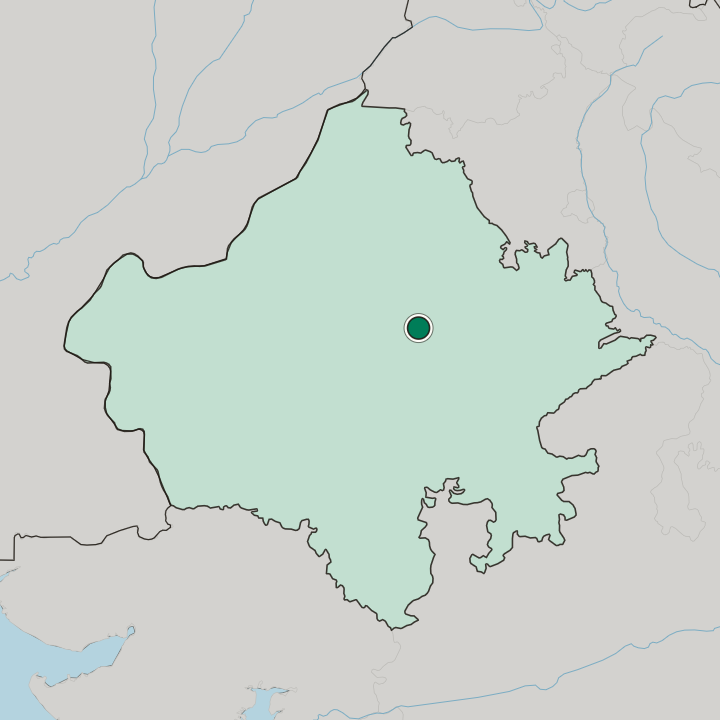
Makrāna stands at the centre of the state. Kuchaman City lies close at hand in the same Didwana-Kuchaman district, Jaipur is 110 km to the east, and Jodhpur 190 km away to the south-west, which fixes the town between two of Rajasthan's larger centres without belonging to either. The ground is subtropical and dry.
Marble beds under it are the reason anybody drew a town on this spot.
What is the climate of Makrāna?
Open country dictates the year. Makrāna lies in the subtropical band north of the equator with no coast to soften anything, on the same dry ground that runs east to Jaipur and south-west to Jodhpur, so the seasonal swing is a wide one. Quarry work feels it first.
Cutting Makrana Marble happens in open pits, and the pits give little shelter.
How do you get to Makrāna?
Jaipur is the usual starting point. Makrāna lies 110 km west of it, while travellers coming instead from Jodhpur face 190 km up from the south-west, which makes the approach from the east the shorter of the two by a wide margin. Kuchaman City is the near neighbour.
Coming from there takes minutes rather than hours, and most movement inside Didwana-Kuchaman district runs on that short link.
Common questions
What is the best area to stay in Makrāna?
The tehsil headquarters: Business with the Makrāna tehsil that administers 136 villages. The quarry edge: Stone buyers and anyone visiting the Makrana Marble workings. The Kuchaman City side: Drivers pairing Makrāna with Kuchaman City in one run across the district.
More cities in State of Rājasthān
Updated September 2026