Brazil · Goiás
Where to Stay in Rio Verde, Goiás
Grain trucks roll in off the Cerrado at Rio Verde, a city in southwest Goiás, Brazil, known for its soy harvest and the Comigo cooperative.
Hotel links are affiliate links: booking through them may earn us a commission, at no extra cost to you. It never affects how places are ranked. How this works


Where to stay in Rio Verde
Where visitors usually base themselves, and why.
Rio Verde keeps almost all of its beds in Setor Central, the older grid around the Praça da Matriz, and that is where most visitors should start. The banks and the restaurants sit within a few blocks of each other here, with the Terminal Rodoviário de Rio Verde just west of the grid, which makes this the one part of a very spread-out city that works on foot. The centre also has the shortest run onto the BR-060 if you are driving on in the morning.
West of the grid the city turns newer and residential. Morada do Sol and Jardim Presidente are apartment country, and beyond them Avenida Universitária runs out to the Universidade de Rio Verde, which is what brings most of the visiting agronomists and company staff to this side of town. The campus sits about 4 km west.
Rooms out here are quieter and usually cheaper than the centre, and the trade-off is that you will drive to dinner. South of the centre, Shopping Buriti anchors a newer commercial strip along the ring of avenues, which suits a stay built around meetings rather than around the old town. The city counts more than thirty hotels and over fifteen hundred beds, so a room is normally easy, with one exception: during the Tecnoshow Comigo the fair fills the whole city and rates move with it.
Beyond the built-up area the municipality runs on for a very long way. Its outlying districts, Riverlândia and Ouroana, lie an hour or more southeast of the city, and the beds out there are tied to the working farms rather than to travellers.
Find hotels in Rio Verde
Direct booking searches for these neighbourhoods.
Setor Central
The old grid holds the banks, the restaurants and the bus terminal, and it is the only part of Rio Verde that works without a car.Find hotels in Setor Centralquieter and cheaper rooms west of the centreMorada do Sol
The western setores are newer and residential, close to the university and to the avenues that carry you out of town quickly.Find hotels in Morada do Solbusiness on the land rather than in the townRiverlândia and Ouroana
The outlying districts of the municipality sit an hour or more southeast of the city, and the few beds there answer to the working farms. Rooms are few around here — worth securing early.Find hotels in Riverlândia and OuroanaHotel links are affiliate links: booking through them may earn us a commission, at no extra cost to you. It never affects how places are ranked. How this works
About Rio Verde
What is Rio Verde known for?
Rio Verde is known for grain and for the industry that grew around it. The municipality is the largest soy producer in Goiás. Maize and sorghum follow the soy.
Industry tracks the harvest: BRF runs its biggest operation here across three shifts, and Cargill refines soy oil in the city. The Comigo cooperative, formally the Cooperativa Agroindustrial dos Produtores Rurais do Sudoeste Goiano, dates from 1975. Its store here is the largest of the ten the cooperative runs, and the Tecnoshow Comigo brings a national agricultural technology fair to the same fields every year.
What are the main landmarks in Rio Verde?
Rio Verde keeps its oldest ground at the Praça da Matriz, where the Igreja Nossa Senhora das Dores carries the dedication the settlement took its name from in 1846. A few blocks south the Igreja São Sebastião answers to the municipality's patron saint. East of the square the Feira Coberta, the covered market, is where the farm country comes indoors.
The Parque Ecológico Lauro Martins Filho gives the newer setores on the southern side their green space. It lies about 3 km out.
What is the history of Rio Verde?
Rio Verde begins with a land grant and a chapel. José Rodrigues de Mendonça, born in Minas Gerais in 1784, reached this corner of Goiás around 1840 with his wife and children and settled at what became the Fazenda São Tomás. On 25 August 1846 the couple gave seven sesmarias of their land to the church so a chapel could be raised, and the arraial that gathered around it took the chapel's dedication as its name.
A provincial law made it a district on 5 August 1848, the date the city still keeps as its anniversary, and Law 8 of 6 November 1854 raised the settlement to a vila. Cattle held the ground until the 1970s. For more than a century this was a stock town on the southwestern edge of settled Goiás, and the change came only when the Cerrado was opened to mechanised farming and paved roads reached Goiânia and Itumbiara.
Farmers arrived from the south and southeast of Brazil with machinery and capital, and a colony of American growers settled alongside them. Soy followed, and then the plants built to crush and process it. The poet Leo Lynce caught the turn early.
Writing in the 1940s he called Rio Verde a hive of work and plenty, decades before the grain money arrived. What the boom did not produce was an old townscape: the Portuguese street names of the centre sit on a mostly twentieth-century city, and the record of what happened here is legible in silos, plants and road numbers rather than in architecture.
Where is Rio Verde?
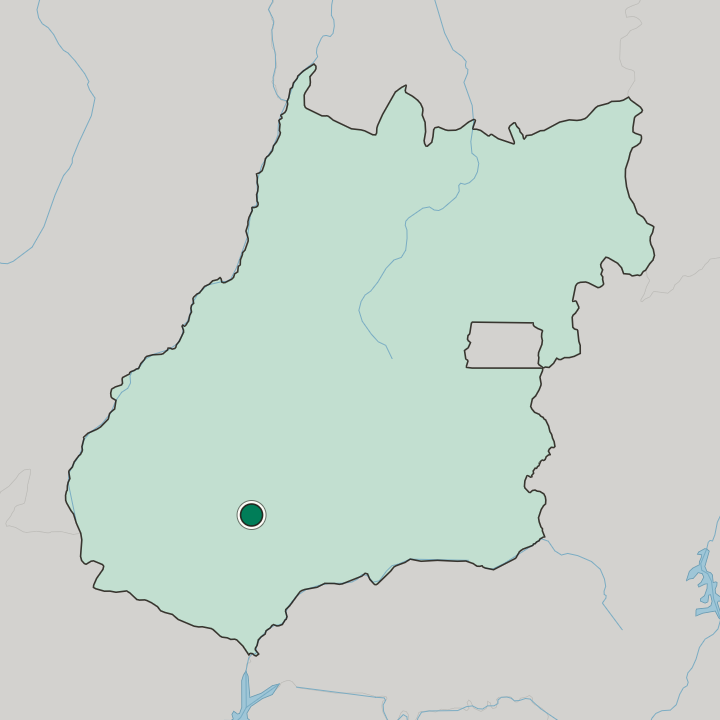
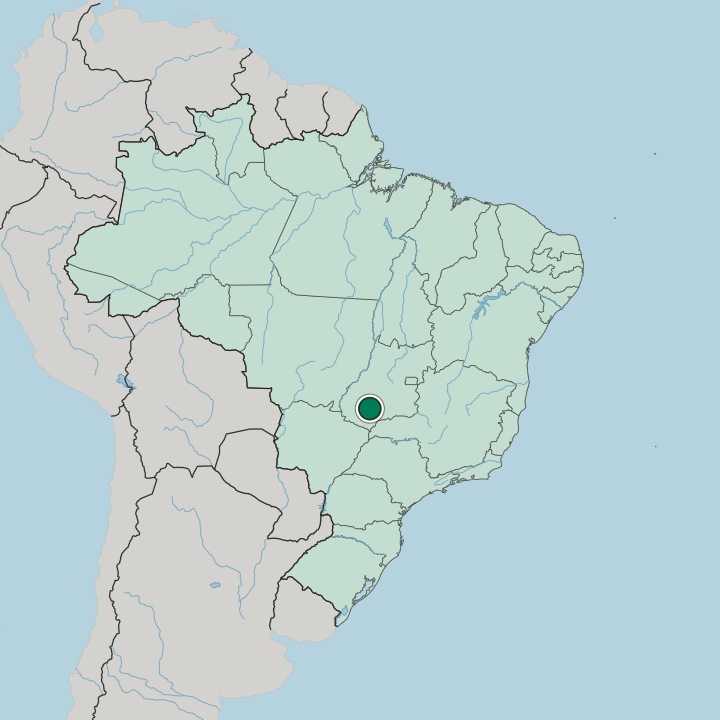
Rio Verde stands at 748 metres on the Cerrado plateau of southwest Goiás, on flat to gently rolling ground worked over deep red latosols. The municipality runs past 8,300 square kilometres, so the city itself is a small dot in the territory that carries its name. Its southern country drains to the Rio Doce, which feeds the Rio Claro and then the Rio Paranaíba, the river that carries this part of central Brazil away to the south.
Goiânia lies 232 km to the northeast.
What is the climate of Rio Verde?
The Cerrado sets the calendar here. Rain falls from October to April and the Cerrado dry season holds from May to September, with the annual mean between 20 C and 25 C. The weather station on the Universidade de Rio Verde campus has logged a low of 0.7 C in July 2000 and a high of 40.3 C in September 2024. Rainfall averages about 1,612.9 mm a year, and July is the month it very nearly stops.
How do you get to Rio Verde?
Rio Verde is a road town first. The BR-060 carries the traffic 232 km northeast to Goiânia, and the BR-452 is the working link toward the southeast, which is how most of the harvest leaves. Rail arrived late: the Ferrovia Norte-Sul reached the municipality in 2021 and crosses it for 93 km, and the largest complex on the whole line was built at the BR-452 crossing, about 20 km out of town.
The city keeps its own airport, the Aeroporto General Leite de Castro, on a 1,500 m asphalt runway.
Common questions
What is the best area to stay in Rio Verde?
Setor Central: walkable hotels around the Praça da Matriz. Morada do Sol: quieter and cheaper rooms west of the centre. Riverlândia and Ouroana: business on the land rather than in the town.
Good for
More cities in Goiás
Updated September 2026