Dominican Republic
La Vega, Dominican Republic — Towns & Travel Guide
La Vega is one of the 32 provinces of the Dominican Republic, spread through the Cibao Valley around its namesake capital.
Hotel links are affiliate links: booking through them may earn us a commission, at no extra cost to you. It never affects how places are ranked. How this works


Towns & cities in La Vega
One town here has its own guide — it links to where to stay.

 Dominican Republic
La Vega
La Vega, founded in 1494 as Concepción de la Vega, is the Carnival city of the Dominican Republic and the capital of its own province.Where to stay →
Hotel links are affiliate links: booking through them may earn us a commission, at no extra cost to you. It never affects how places are ranked. How this works
About La Vega
Four municipalities, one valley.
What is La Vega known for?
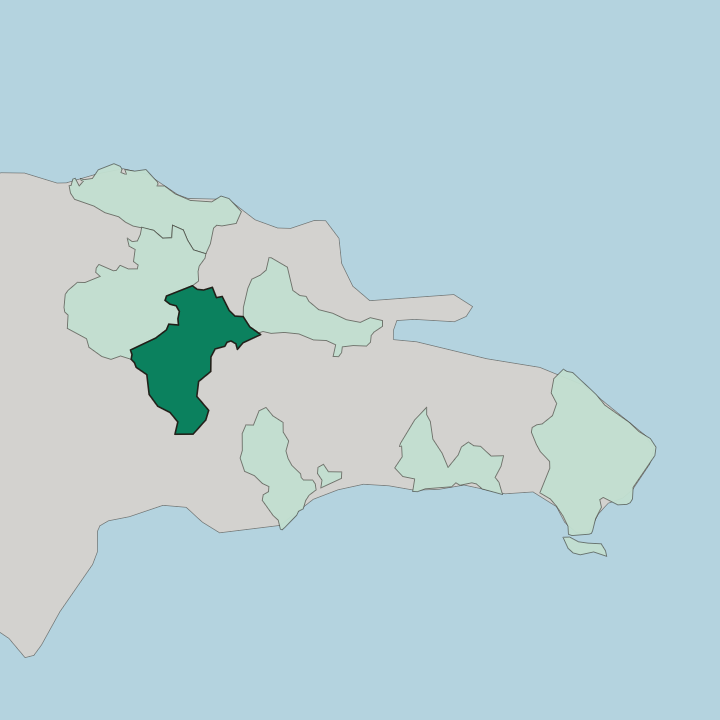
La Vega is known first as a province of the Cibao Valley, the north-central region of the country, where its four municipalities gather around a capital that carries the same name as the province itself. Neighbours press on every side. Espaillat and Hermanas Mirabal lie to the north, Duarte to the east, Monseñor Nouel to the south, and Santiago to the west, which leaves La Vega without a coast of its own.
Where is La Vega?
La Vega occupies the floor of the Cibao Valley, the north-central region of the country. The province takes in something over two thousand square kilometres of that valley, ground that runs between provincial lines rather than out to any sea, since every one of its edges meets another province. Nowhere does it meet the sea.
Espaillat and Hermanas Mirabal close the northern side, Duarte the eastern, Monseñor Nouel the southern, and Santiago the western, so the whole of La Vega is interior land inside the Dominican Republic. The valley does the organising. Settlement, farmland, and the roads between the four municipalities follow the low ground of the Cibao Valley, and the province's shape is best read as a section of that valley cut out and given a border.
The tropics cover all of it. La Vega sits in the northern hemisphere well inside them, which gives the valley floor its growing conditions and keeps the seasonal swing across the province narrow. Distance across the province is modest.
A journey from the Santiago line in the west to the Duarte line in the east crosses the whole of La Vega, and the four municipalities that make up the province all look to the capital that shares its name.
What is La Vega like?
Spanish is the language of the province, spoken across all four of its municipalities and in the capital that shares the provincial name. La Vega has been an administrative unit since 1844, and the long continuity of that arrangement shows in how firmly the capital and the province share both a name and an identity. The valley shapes daily life.
Farming country on the floor of the Cibao Valley sets the rhythm of the smaller municipalities, while the capital carries the offices, the markets, and the traffic that a provincial seat attracts. Borders here are close. Someone on the northern edge is near Espaillat or Hermanas Mirabal, someone on the eastern edge near Duarte, and someone in the south near Monseñor Nouel, so the province is porous to its neighbours in a way that a larger territory would not be.
Santiago sits on the western side. Its place in the national frame is fixed all the same: La Vega is one of the 32 provinces of the Dominican Republic, distinct from the ones that ring it and tied to the Cibao Valley that carries them all.
What is the history of La Vega?
The province dates from 1844. La Vega was drawn as one of the divisions of the Dominican Republic in that year, and it has carried the name of its capital ever since, a pairing that ties the administrative unit to the town at its centre. Four municipalities make it up.
The province's borders with Espaillat, Hermanas Mirabal, Duarte, Monseñor Nouel, and Santiago mark out the section of the Cibao Valley that has answered to that name for well over a century.
What is the climate of La Vega?
Warmth is the baseline. La Vega lies within the tropics of the northern hemisphere, so its year divides into wet and dry spells rather than into the hot and cold halves that a temperate province would know. Frost plays no part.
Across the floor of the Cibao Valley the four municipalities share much the same conditions, and the difference between the Santiago side and the Duarte side is slight.
How do you get to La Vega?
Getting about the province means driving. Every approach to La Vega crosses a provincial line, since Espaillat and Hermanas Mirabal sit to the north, Duarte to the east, Monseñor Nouel to the south, and Santiago to the west. The capital is the pivot.
Traffic through the Cibao Valley passes the city of La Vega, and the four municipalities of the province link to one another along that valley corridor rather than around it.
Common questions
What is the best area to stay in La Vega?
La Vega city: working the four municipalities of the Cibao Valley from their administrative seat. the Cibao Valley towns: farm-country nights between the Hermanas Mirabal and Monseñor Nouel lines.
More regions in Dominican Republic
Updated September 2026