Spain · Comunitat Valenciana · Valencia
Poble Nou, Valencia — Area Guide & Where to Stay
Poble Nou is a pedania of Valencia in Pobles del Nord: one line of houses with orchards and old farmhouses on every side.
Hotel links are affiliate links: booking through them may earn us a commission, at no extra cost to you. It never affects how places are ranked. How this works


Where to stay in Poble Nou
Where the beds are, and what that means for the visit.
Base yourself here for a quiet, rural stay inside Valencia. Poble Nou is a pedania with its own alcalde de barrio, a single road of low houses among orchards and old farmhouses. Nights here mean fields, not streets.
It does not suit anyone who wants a compact centre, because the village has none.
About Poble Nou
What are the main landmarks in Poble Nou?
The Camí de Montcada is the main street. South of the village, on the approach from Valencia, stands the church of Sant Bernat Màrtir, a single nave under a pointed barrel vault, with a small park beside it. A mill faces it.
On the curve of the road, the white Molí dels Alters milled flour and rice. Four named farmhouses stand in the fields: the Alquería del Pi, now a celebration hall, the Alquería de Falcó, the Alquería Fonda and the Alquería de Tallaròs. On the Casa Tota sits the listed Coat of Arms of Fernando de Aragón.
What is the history of Poble Nou?
The village grew out from its church. Its old core lies around Sant Bernat, on the south side, and from there it spread north along the road to Moncada towards Borbotó. Several of its farmhouses are older than the 17th century; the Alquería del Pi dates from the 16th.
At the beginning of the 20th century Poble Nou became a pedania of Valencia, as the other villages of Pobles del Nord did. The present church opened on 16 October 1951. The population grew for decades and has been falling since the 1960s; the 2022 census counted 908.
Where is Poble Nou?
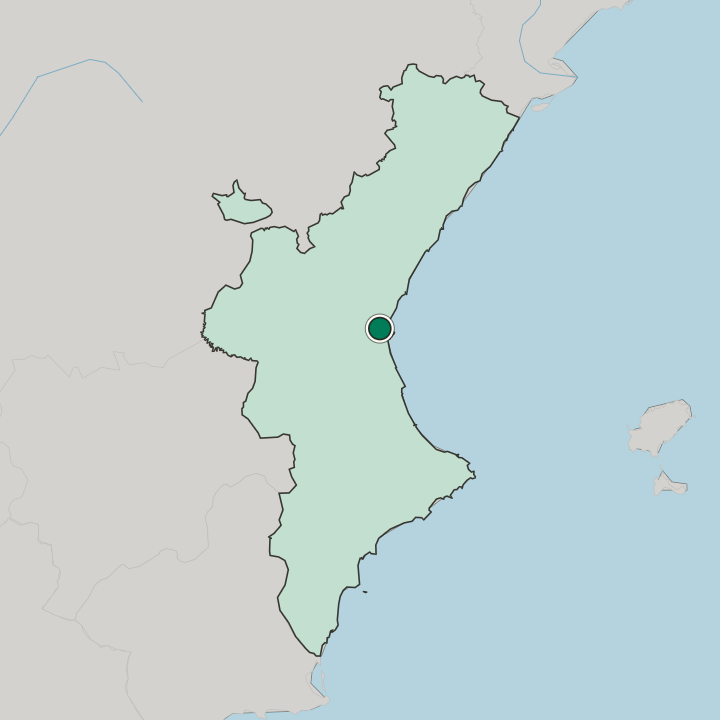
Poble Nou lies on the northern side of Valencia, within the district of Pobles del Nord. Burjassot borders it on the west, Borbotó and Carpesa on the north, and the city on the south. Low houses line the Camí de Montcada, and the population is split between that line of buildings and the farmhouses scattered among the crops.
Orchards fill the ground around them. The Brazo de Petra, an arm of the Acequia de Mestalla, runs past the mill.
More areas in Valencia
Updated October 2026