France · Provence-Alpes-Côte d'Azur · Marseille
Arenc, Marseille — Area Guide & Where to Stay
Between the Bassin de la Joliette and the Bassin Léon Gourret, Arenc gives its ground to the Grand Port Maritime de Marseille and to Euroméditerranée.
Hotel links are affiliate links: booking through them may earn us a commission, at no extra cost to you. It never affects how places are ranked. How this works


Where to stay in Arenc
The practical side of choosing where to sleep.
Arenc is a business address first. Rooms stand among the offices of Euroméditerranée rather than in old streets, and the compensation is reach. Arenc-Euroméditerranée opened on 3 February 2014 and is the only passenger stop on the line from L'Estaque to Marseille-Saint-Charles, which leaves the main terminus one stop away.
Trams run south from the boulevard Mirabeau along the docks into the centre. The A55 runs overhead. Les Terrasses du Port, a short walk down the quay, holds 210 shops and a sea-facing terrace, and that is where most guests end up eating.
About Arenc
What are the main landmarks in Arenc?
The skyline of Les Quais d'Arenc is the one sight nobody misses. Zaha Hadid designed the Tour CMA CGM, opened in 2011: 147 metres, 33 floors, still the tallest building in Marseille, and the head office of the shipping group CMA CGM. Jean Nouvel's Tour La Marseillaise followed in October 2018 at 136 metres.
Beside them La Porte Bleue, eighteen storeys of flats by Jean-Baptiste Pietri, replaced a taller tower dropped from the plan in 2016. Down at the water, Les Terrasses du Port opened on 24 May 2014 with 210 shops on a deck laid over the working quay. One more building repays the walk.
The silo d'Arenc, a grain store of 1924 listed as twentieth-century heritage in 2004, reopened in 2011 as the CEPAC Silo concert hall, on the boundary quay Arenc shares with La Joliette.
What is the history of Arenc?
Arenc takes its name from the Provençal areno, a sandy place. Until the middle of the nineteenth century a beach lay here at the mouth of the Aygalades and Plombières streams, backed by bathing houses and by the Château-Vert, a pre-Revolutionary folly turned restaurant that fed Alexandre Dumas. Digging for the Lazaret and Arenc basins began in 1856.
The spoil buried the beach. A law of 10 June 1854 had already handed the docks to Paulin Talabot, head of the Paris-Lyon-Méditerranée railway, on a ninety-nine-year concession, and the tracks followed: a marshalling yard in 1891, the Arenc goods station in 1897. On 24 January 1943, during the rafle de Marseille, fifteen thousand people cleared from the Vieux-Port were brought to that goods station and put into cattle wagons for Fréjus.
A port hangar between the Arenc and Grande Joliette basins later held foreigners awaiting expulsion outside any legal framework, a practice exposed in April 1975 as the affaire d'Arenc.
Where is Arenc?
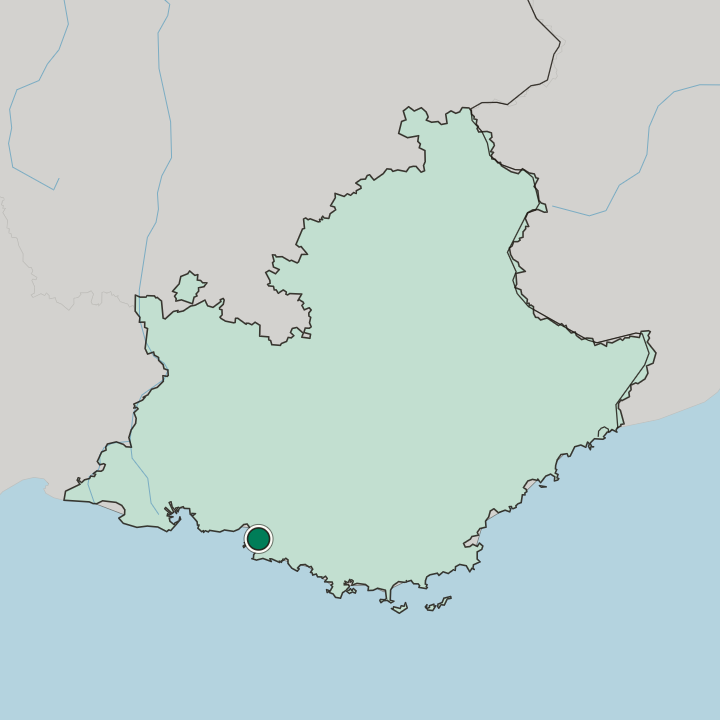
Arenc is long and thin: dock water on one side, a narrow band of streets on the other. It runs north from the Bassin de la Joliette to the Bassin Léon Gourret, held inland by the chemin du Littoral, the avenue Roger-Salengro and the boulevard Mirabeau, and closed seaward by the port breakwater. Cap Pinède marks the northern shore.
Rail takes most of what is left. Marseille-Maritime-Arenc spreads twenty-five service tracks between the chemin de la Madrague-Ville and the boulevard des Bassins de Radoub, crossed by a footbridge carrying the GR 2013 walking route, while the Sogaris freight platform has held the old goods-station site at 14 rue d'Anthoine since 2010. La Joliette adjoins to the south, Les Crottes and La Cabucelle lie inland to the north, and La Villette and Saint-Mauront sit east beyond the tracks.
More areas in Marseille
Updated October 2026