France · Provence-Alpes-Côte d'Azur
Where to Stay in Fréjus, Provence-Alpes-Côte d'Azur
Fréjus is a historic town on the Côte d'Azur in southern France, once the great Roman naval port of Forum Julii.
Hotel links are affiliate links: booking through them may earn us a commission, at no extra cost to you. It never affects how places are ranked. How this works


Where to stay in Fréjus
How the choice of base plays out on the ground.
Where you stay in Fréjus turns on the old town or the beach. The lanes around the cathedral and the arena keep the Roman sites, the market, and the shops within a walk, and staying in the old town suits anyone here for the history. The old stones stand among the streets.
Rooms sit near the arena. Down at Fréjus-Plage and the marina, the town meets the sea. A room by the beach trades the old stones for the sand, the port, and the long promenade by the water.
The blue sea opens past the edge. If you want the Roman town, stay in the old centre; if you want the beach, take a room by the sea. Whichever you pick, the Roman centre stays within reach.
Find hotels in Fréjus
Direct booking searches for these neighbourhoods.
The old town
Around the cathedral within a walk of the arenaFind hotels in The old townStays wanting the beach and the marinaFréjus-Plage
By the sea along the promenade and the portFind hotels in Fréjus-PlageHotel links are affiliate links: booking through them may earn us a commission, at no extra cost to you. It never affects how places are ranked. How this works
Things to do in Fréjus
Ranked by global recognition; descriptions from Wikidata (CC0).
Museums & Galleries
2- musée Louis-de-Funès
- Musée d'Histoire, de Préhistoire et d'Archéologie sous marine de Saint-Raphaël
Churches & Religious Sites
3- Église Saint-Raphaël Heritage
- église Saint-Roch de Fréjus Heritage
- Église orthodoxe de Saint-Raphaël Heritage
Castles & Historic Sites
3- Forum Iulii
- Hôtel de Ville, Fréjus
- Fréjus (Samian Ware Discovery Site)
Stadiums & Sports
3- stade Pourcin
- Elit fitness club la Palud
- Flying Safari
Landmarks & Notable Places
1- Maison Maria de Fréjus Heritage
worth knowingacross 5 categories in Fréjus
About Fréjus
What is Fréjus known for?
Fréjus is the Roman town of the Côte d'Azur. Founded by Julius Caesar as Forum Julii and made a great naval port by Augustus, it keeps a Roman amphitheatre, an aqueduct, and a harbour gate, an old cathedral group among the oldest in France, and a coast of golden beaches below the red Estérel hills. The blue sea spreads to the south.
Rome and the sea mark the town.
What are the main landmarks in Fréjus?
The Roman arena stands at the edge of old Fréjus. The great oval amphitheatre, built to seat thousands in the days of Forum Julii, still holds shows within its stone tiers, the emblem of the town, west of the centre. An ancient cathedral rises inland.
The old cathedral group keeps a cloister and a baptistery from the earliest Christian days, while the aqueduct, the harbour gate, and the beaches mark the country around Fréjus.
What is the history of Fréjus?
Fréjus began as a Roman town on the coast. Julius Caesar founded Forum Julii here on the road to Spain, and under Augustus it became a great naval base, where the war fleet lay that helped win the sea at Actium. The town grew rich and Roman.
An amphitheatre, a theatre, and an aqueduct rose in the port, and ships came and went from a harbour cut into the plain. In time the sea drew back from the town. The old harbour silted up and left Fréjus stranded inland, and the port fell quiet as the water withdrew.
The church took the Roman town in hand. In the middle ages a bishop's city grew within the old walls, with a cathedral, a cloister, and one of the oldest baptisteries in France, and the town lived on by its fields and its faith. The old arena still stands in the town.
Fréjus keeps its Roman stones and its beaches on the Côte d'Azur.
Where is Fréjus?
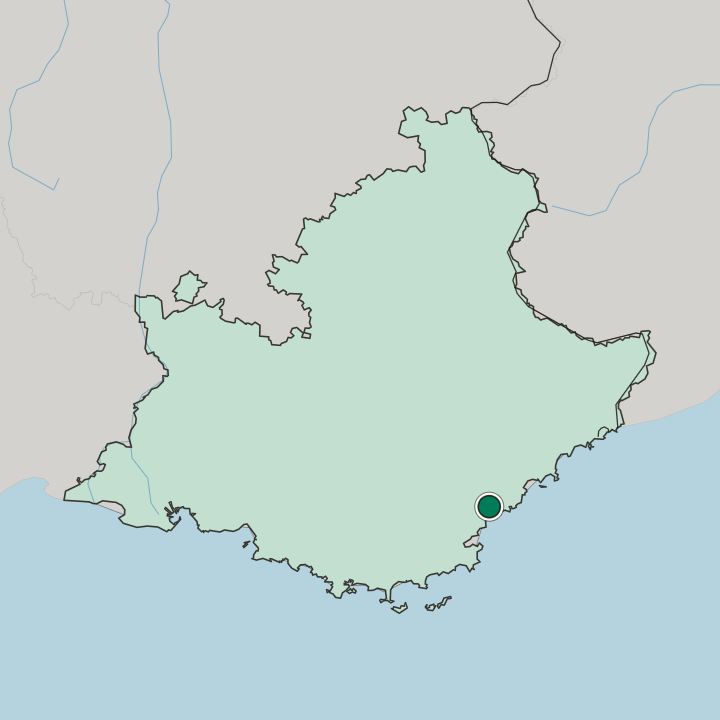
Fréjus lies on the Côte d'Azur in the Var, southern France, between the sea and the Estérel hills. The town sits on a low rise above the plain of the Argens, a short way back from the beaches, where the red porphyry hills meet the coast. Red hills rise to the east.
The plain runs down to the sea.
What is the climate of Fréjus?
The climate at Fréjus is Mediterranean and warm. Hot, dry summers draw crowds to the beaches, and mild winters bring the short rains, with long sunny springs and autumns over the coast. Sea breezes cool the shore in summer.
The hills stay green above the town.
How do you get to Fréjus?
Fréjus lies on the Côte d'Azur in the Var, between Cannes and Saint-Tropez. Trains and the motorway run to it along the coast from Cannes and Nice, and roads climb into the red Estérel hills. Local buses serve the neighbouring towns along the Var shore.
Most arrive by road from Cannes.
Common questions
What is the best area to stay in Fréjus?
The old town: Visitors here for the Roman sites, cathedral, and market. Fréjus-Plage: Stays wanting the beach and the marina.
Good for
More cities in Provence-Alpes-Côte d'Azur
Updated September 2026