Italy · Piemonte
Where to Stay in Collegno, Piemonte
Collegno is a comune on the western edge of Turin, where the Dora Riparia leaves the Val di Susa, known for its Certosa and the Villaggio Leumann.
Hotel links are affiliate links: booking through them may earn us a commission, at no extra cost to you. It never affects how places are ranked. How this works


Where to stay in Collegno
One neighbourhood here has its own guide — here's what it is best for.
 CollegnoItalythe direct metro into Turin
Borgata Paradiso
The quarter holds the Fermi and Paradiso stations on line 1, on Corso Francia at the Turin boundary.Borgata Paradiso →Hotel links are affiliate links: booking through them may earn us a commission, at no extra cost to you. It never affects how places are ranked. How this works
Find hotels in Collegno
Direct booking searches for these neighbourhoods.
Certosa and Leumann
The charterhouse park and the Leumann workers' village lie close together in the middle of Collegno.Find hotels in Certosa and Leumannthe old village by the riverCentro Storico
The historic centre gathers on a bend of the Dora Riparia below the castle tower. Few places to stay nearby — book ahead.Find hotels in Centro StoricoHotel links are affiliate links: booking through them may earn us a commission, at no extra cost to you. It never affects how places are ranked. How this works
About Collegno
The Certosa is the landmark.
What is Collegno known for?
Maria Cristina of France ordered the charterhouse in 1641, and from 1853 it held the royal asylum of Turin, which grew into one of the largest psychiatric hospitals in Italy before it closed in stages after its wall came down in 1977. Its grounds are now a park. The Villaggio Leumann is the other draw, a workers' village built at the start of the twentieth century by Napoleone Leumann with the architect Pietro Fenoglio, with its own church, school and station.
The Turin Metro ends here. Its line 1 terminus at Fermi has served Collegno since 2006.
What are the main landmarks in Collegno?
The Certosa heads the list. Begun in 1641 and completed by Filippo Juvarra, the charterhouse is now a public park among the old hospital pavilions. Villaggio Leumann follows, a model workers' village with its own church, station and school.
San Massimo stands over the remains of an early church built from a Roman villa in the fifth century. The Castello di Collegno keeps a square tower from around the year 1000, and the rest of it became a Baroque residence. Little else is original.
Along the river, the Parco Agronaturale della Dora, shared with Alpignano, Pianezza and Turin, protects the woods and the old irrigation channels.
What is the history of Collegno?
Collegno began as a Roman staging post on the road over the Mont Cenis, five miles from Turin, and its name is thought to come from Collegium ad quintum milium. Remains of an early church lie beneath San Massimo. Lombards came next.
Digging for the metro uncovered a Lombard settlement and necropolis, and around the year 1000 the village gathered beneath the Castello di Collegno on a bend of the Dora Riparia. The Provana family held the fief from about 1599 until feudal rule ended in 1799. Then came the Certosa, ordered in 1641 and turned into the royal asylum in 1853.
Lajos Kossuth, the exiled leader of the Hungarian revolution, lived here from 1874 to 1882, and the Leumann mill village followed in the early twentieth century. War reached it in 1945, when retreating German troops killed 68 people at Grugliasco and Collegno. Migrants from Asti, the Veneto and the south arrived in the 1950s and 1960s, and the built-up area merged with Turin along Corso Francia.
Where is Collegno?
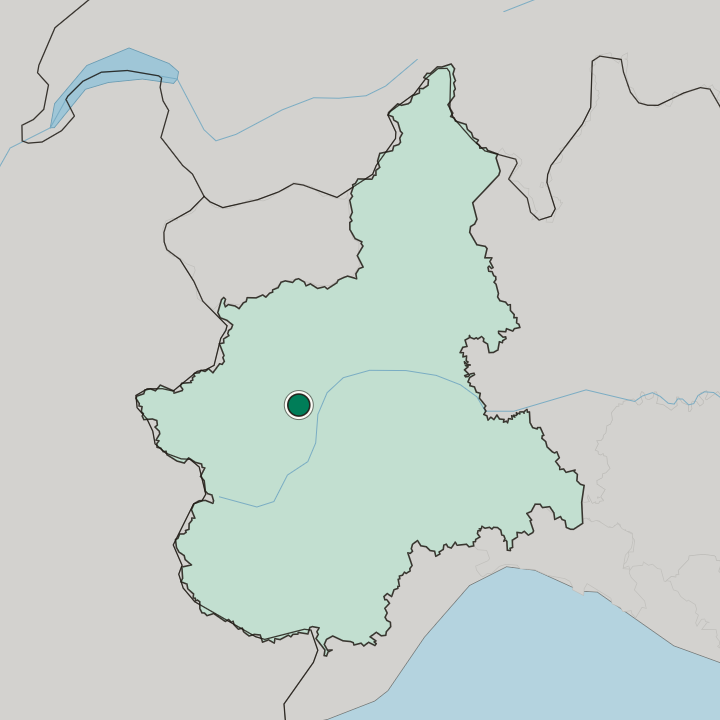
Collegno lies on an alluvial plain where the Val di Susa ends, between Rivoli and Turin and at the foot of Monte Musinè, with the Dora Riparia running through the last stretch of its course. The densest part was built along Corso Francia, where Collegno, Rivoli, Grugliasco and Turin now run together without a gap. Savonera is its only recognised frazione.
Common questions
What is the best area to stay in Collegno?
Borgata Paradiso: the direct metro into Turin. Certosa and Leumann: a slower stay among the comune's sights. Centro Storico: the old village by the river.
Good for
More cities in Piemonte
Updated October 2026