Italy · Sicilia · Siracusa
Tiche, Siracusa — Area Guide & Where to Stay
Tiche runs north from Siracusa across the plateau to the Targia plain, where the coast opens at Santa Panagia. It takes in Scala Greca and the shore.
Hotel links are affiliate links: booking through them may earn us a commission, at no extra cost to you. It never affects how places are ranked. How this works


Where to stay in Tiche
The practical side of choosing where to sleep.
Tiche is a residential district rather than a hotel quarter, so a stay here means a flat in the modern blocks off viale Santa Panagia. The trade-off is distance. Ortygia and the ruins in Neapolis both lie south, a bus ride down the length of the city. What Tiche gives instead is room to park, a daily market on viale Santa Panagia, and streets that empty out after dark.
If you want the sea rather than the sights, that trade works. Tankers berth in the roadstead off Santa Panagia, and the refineries beyond Targia are close enough to notice on the wrong wind.
Things to do in and around Siracusa
Ranked by global recognition; descriptions from Wikidata (CC0).
Museums & Galleries
1- Museo archeologico regionale Paolo Orsi Heritage
Churches & Religious Sites
3- San Nicolò dei cordari Heritage
- Santa Maria Addolorata
- Sacra Famiglia
Castles & Historic Sites
3- Latomia dei Cappuccini Heritage
- Monumento ai Caduti italiani d'Africa Heritage
- Greek Theatre of Syracuse
Landmarks & Notable Places
2- Torre Pizzuta Heritage
- Torre della Targia Heritage
worth knowingacross 4 categories in and around Siracusa
About Tiche
What are the main landmarks in Tiche?
Tiche keeps its oldest monuments at its northern edge, where the Greek road out of Siracusa was cut straight into the rock. Scala Greca is named for that cutting. Two parallel wheel-ruts and the hoof-marks of horses are worn into the limestone, dropping toward the Targia plain, and from below the scar reads like a flight of steps.
Porta Scea, a gate in the Dionysian wall circuit, survives close by. Torre della Targia stands farther north above the plain that was once a fief of the Arezzo della Targia family. Out beyond it near the industrial edge lie the rock-cut ditch and hut floors of Stentinello, the Neolithic village that gave a whole Sicilian pottery culture its name.
Nothing marks it. The Chiesa di Sant'Antonio di Padova and the market on viale Santa Panagia are the working landmarks, and the Tonnara di Santa Panagia stands out on the headland north of the bay.
What is the history of Tiche?
Tiche was one of the five walled quarters of Greek Syracuse, and the name is the oldest thing about it. Cicero traced it to a temple of Tyche, the goddess of fortune, which Diodorus placed near the Cappuccini quarries in neighbouring Acradina. Thucydides preferred sike, the fig, for the trees that once grew here.
Diodorus records the quarter being walled in 463 BC, in the circuit later called the walls of Gelon. Rome broke in through this side of the city: Marcus Claudius Marcellus found the Dionysian wall above the bay at Santa Panagia low enough to climb, took Epipoli, and camped between Tiche and Neapolis until both quarters sent envoys to surrender. Their houses were then stripped.
After that the sources go quiet, the city shrank back to Ortygia for the whole of the Middle Ages, and Tiche returned only after the Second World War, when Siracusa built north again over the same ground.
Where is Tiche?
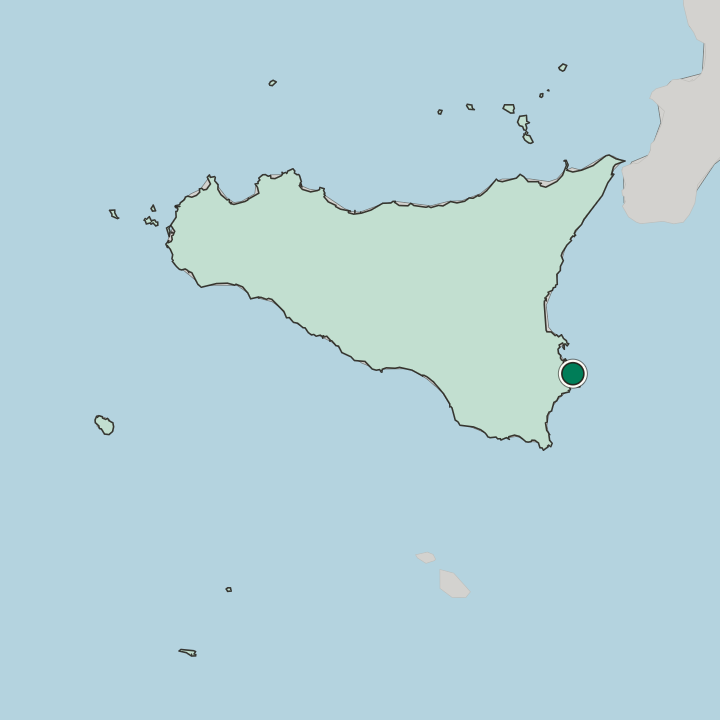
Tiche is the northern district of Siracusa, running from Acradina and Neapolis up the coast to the Targia plain. The Ionian Sea closes it on the east, the Epipoli plateau on the west, and the Santa Panagia gorge cuts down through the middle of it to the shore. Scala Greca marks the top of the slope.
Good for
More areas in Siracusa
Updated October 2026