Brazil · Pernambuco
Where to Stay in Recife, Pernambuco
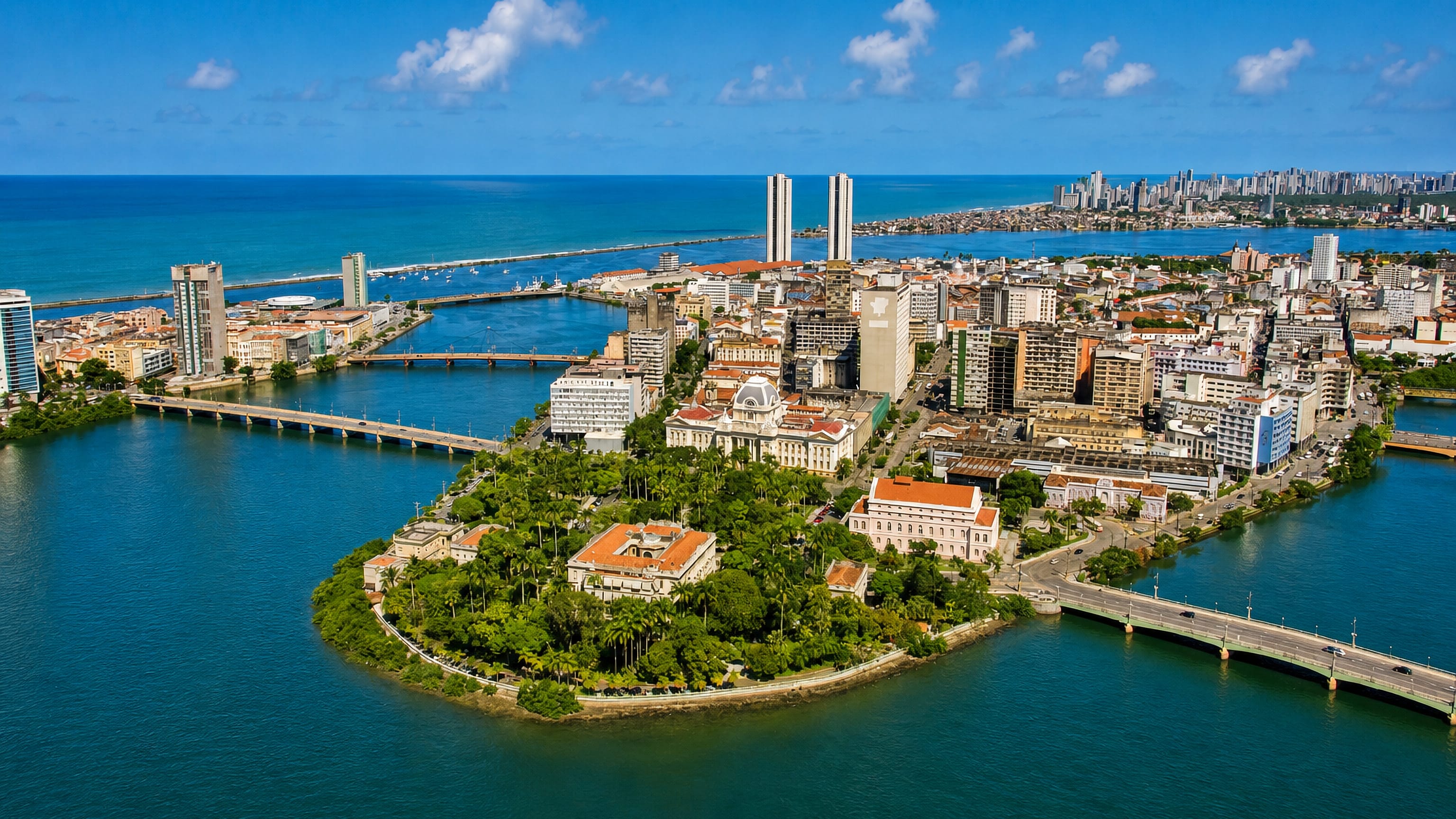
Recife is the capital and port of Pernambuco, built on islands at the mouths of the Capibaribe and Beberibe. Bridges hold it together.
Hotel links are affiliate links: booking through them may earn us a commission, at no extra cost to you. It never affects how places are ranked. How this works


Where to stay in Recife
Each area has its own feel; here's who each one suits.

 RecifeBrazil
Santo Amaro
Santo Amaro is a neighbourhood of Recife founded in 1681, holding the Paço do Frevo and the Museu Cais do Sertão among its cultural houses.Where to stay → RecifeBrazil
Ilha do Leite
Ilha do Leite is a district of Recife holding the Memorial Dom Helder Câmara, the Igreja de São Gonçalo and a cluster of older churches.Where to stay → RecifeBrazil
Espinheiro
Espinheiro is an inner district of Recife, close to Aflitos, Graças and Santo Amaro, in the state of Pernambuco, Brazil.Where to stay →RecifeBrazilAflitos
Aflitos is a district of Recife in the state of Pernambuco, held on three sides by Graças, Espinheiro and Jaqueira.Where to stay →RecifeBrazilGraças
Graças is a district of Recife holding the Museu do Estado de Pernambuco, the state's own museum, on streets a short way from Aflitos.Where to stay →RecifeBrazilArruda
Arruda names a district of Recife three and a half kilometres out from the centre, with Jaqueira, Aflitos and Casa Amarela as its nearer neighbours.Where to stay →RecifeBrazilJaqueira
The Museu Murillo La Greca stands in Jaqueira, a district of Recife roughly three kilometres from the city's middle, in Pernambuco, Brazil.Where to stay →RecifeBrazilCasa Amarela
Casa Amarela is a residential district of Recife, in the state of Pernambuco, with the cultural ground of Sítio Trindade at its centre.Where to stay →RecifeBrazilMorro da Conceiçao
Morro da Conceição is a Recife neighbourhood named after the monument to Nossa Senhora da Conceição raised on its summit in 1904.Where to stay → RecifeBrazil
Poço da Panela
Poço da Panela is a neighbourhood in the north of Recife, running along the Capibaribe and known for the Museu do Homem do Nordeste.Where to stay →Hotel links are affiliate links: booking through them may earn us a commission, at no extra cost to you. It never affects how places are ranked. How this works
Find hotels in Recife
Direct booking searches for these neighbourhoods.
Santo Antônio
The old island centre keeps Igreja Matriz de Santo Antônio, the Basilica and Convent of Nossa Senhora do Carmo and the Recife City Museum inside one walk, with the bridges to the port at its edge.Find hotels in Santo AntônioEvenings around Mercado da Madalena rather than in the historic centreMadalena
An inland Recife neighbourhood built around Mercado da Madalena and the Sobrado da Madalena, where the restaurants keep going long after the museums across the river have shut.Find hotels in MadalenaStays pitched at Paço do Frevo and Museu Cais do SertãoThe old dockside
Recife's port frontage carries Museu Cais do Sertão and Paço do Frevo within sight of the water, so this corner is walkable before the bridge traffic builds.Find hotels in The old docksideHotel links are affiliate links: booking through them may earn us a commission, at no extra cost to you. It never affects how places are ranked. How this works
Things to do in Recife
Ranked by global recognition; descriptions from Wikidata (CC0).
Museums & Galleries
3- Museu do Estado de Pernambuco Heritage
- Museu do Homem do Nordeste
- Museu Cais do Sertão
Churches & Religious Sites
8- Basilica and Convent of Nossa Senhora do Carmo Heritage
- Church of the Mother of God Heritage
- Convent and Church of Santo Antônio Heritage
- Church of Our Lady of the Rosary of Saint Antony of the Black People Heritage
- Basilica of Our Lady of the Rock, Recife Heritage
Show 3 more →
- Igreja Matriz de Santo Antônio Heritage
- Church of Our Lady of the Conception of the Military Heritage
- Igreja do Divino Espírito Santo Heritage
Castles & Historic Sites
3- Sítio Trindade Heritage
- Monumento da Cruz do Patrão Heritage
- Mercado da Madalena
Landmarks & Notable Places
2- Casa natal de Joaquim Nabuco Heritage
- Casa Natal de Oliveira Lima Heritage
worth knowingacross 4 categories in Recife
About Recife
Reefs named it.
What is Recife known for?
Stone reefs offshore gave Recife both its name and its shelter, and inside them grew the main harbour of the Captaincy of Pernambuco, shipping the sugar cane that the captaincy produced on a large scale. The port still works. Museu Cais do Sertão turns the old dockside toward the interior it once shipped for, and Paço do Frevo gives the city's music a building of its own.
What are the main landmarks in Recife?
Ten museums against ten churches. Museu do Estado de Pernambuco, Museu de Arte Moderna Aloísio Magalhães, Museu do Trem and the Francisco Brenand Sculpture Park carry the state's collections, while Museu Cais do Sertão and Paço do Frevo take the port and the music. The churches are older.
Basilica of Our Lady of the Rock, the Church of Our Lady of Pilar and the Church of Our Lady of the Rosary of Saint Antony of the Black People each carry a separate parish history.
What is the history of Recife?
Recife was founded in 1537. The harbour came first and everything else followed it, because the Captaincy of Pernambuco needed a port for sugar cane grown on a large scale, and the water sheltered by the offshore reefs supplied one. Sugar paid for the churches.
Convent and Church of Santo Antônio, the Basilica and Convent of Nossa Senhora do Carmo and the Church of Our Lady of Pilar belong to the centuries when that trade set the terms. For a while it answered to another name. In the seventeenth century Recife served as Mauritsstad, capital of the colony of New Holland in Dutch Brazil, which gave the port a second identity before the earlier one returned.
Parishes trace what came after. Igreja Matriz de Santo Antônio, the Church of the Mother of God and the Church of Our Lady of the Rosary of Saint Antony of the Black People each stand for a congregation, the last of them for one the others did not serve. The rivers kept their say.
Bridges over the Capibaribe and the Beberibe multiplied past fifty as the city spread across its islands, and the Recife City Museum and Museu do Estado de Pernambuco hold the paperwork for all of it.
Where is Recife?
Two rivers and a reef. The Capibaribe and the Beberibe come together at Recife before draining into the South Atlantic, and the stone reefs lying offshore give the coast the shelter the city is named for. Islands take up the rest.
More than 50 bridges tie them into one municipality of roughly 219 square kilometres, which is where the comparison with Venice comes from.
What is the climate of Recife?
The South Atlantic sets the terms. Recife lies open to the ocean inside the tropics of the southern hemisphere, which keeps temperature steady across the year and leaves rainfall as the variable deciding how a day in the city goes. Rivers answer to it.
The Capibaribe and the Beberibe run through the built-up part, so the wet half of the year is a presence at ground level as much as overhead, and the museums, Paço do Frevo and Museu de Arte Moderna Aloísio Magalhães among them, take the overflow.
How do you get to Recife?
Everything in Pernambuco funnels here. Recife is the state capital and the largest urban area of its region, so arrivals from outside the state generally reach the city itself rather than anywhere nearby, and the seaport still handles the water side. Inside it, bridges rule.
More than 50 of them carry traffic between the islands, which makes the crossing rather than the kilometre the real unit of a trip between Santo Antônio, Madalena and the dockside at Museu Cais do Sertão.
Common questions
What is the best area to stay in Recife?
Santo Antônio: Historic-centre days built around the Convent and Church of Santo Antônio. Madalena: Evenings around Mercado da Madalena rather than in the historic centre. The old dockside: Stays pitched at Paço do Frevo and Museu Cais do Sertão.
Good for
More cities in Pernambuco
Updated October 2026