Brazil · Rio de Janeiro
Where to Stay in Itaguaí, Rio de Janeiro
Itaguaí, founded in 1688, is an iron-ore port town of the Baixada Fluminense, midway between Rio de Janeiro and Angra dos Reis.
Hotel links are affiliate links: booking through them may earn us a commission, at no extra cost to you. It never affects how places are ranked. How this works


Where to stay in Itaguaí
Where visitors usually base themselves, and why.
The Igreja Matriz de São Francisco Xavier and the Casa de Cultura de Itaguaí mark the part of town worth walking. That is the walkable half. The Chafariz da Rua Maria Mota Santiago names its own street, the Antiga Estação Ferroviária de Itaguaí stands from the railway era, and both belong to the same round as the two wooden images the town lists, São Francisco Xavier and Nossa Senhora do Pilar.
The cemetery gateways, Pórtico 1 do Cemitério Municipal and Pórtico 2 do Cemitério Municipal, are listed too. You want the old streets if any of that is the reason for the trip. Working travel pulls the other way.
Itaguaí handles iron ore through several loading ports, Ilha Guaíba included, and a stay built around that work answers to the water rather than to the Igreja Matriz de São Francisco Xavier. Position helps either way. The municipality lies midway between Rio de Janeiro and Angra dos Reis, so a bed in Itaguaí works as a stop on that run as much as a destination, and the municipality sits inside Grande Rio, which makes a night here a matter of convenience.
Portuguese covers the desks, and 1688 is the year the place counts from.
Find hotels in Itaguaí
Direct booking searches for these neighbourhoods.
The Matriz streets
The Igreja Matriz de São Francisco Xavier and the Chafariz da Rua Maria Mota Santiago hold the old streets of Itaguaí.Find hotels in The Matriz streetsAnyone in Itaguaí for the Ilha Guaíba loading portsNearer the ore terminals
The iron ore terminals, Ilha Guaíba among them, are the working reason to be in this municipality.Find hotels in Nearer the ore terminalsHotel links are affiliate links: booking through them may earn us a commission, at no extra cost to you. It never affects how places are ranked. How this works
About Itaguaí
Ore leaves here by ship.
What is Itaguaí known for?
Several of the loading ports that move iron ore belong to Itaguaí, Ilha Guaíba among them, which gives a municipality of the Baixada Fluminense a role out of proportion to its size. The town itself is older. Its list of named landmarks runs from the Igreja Matriz de São Francisco Xavier and the Antiga Estação Ferroviária de Itaguaí to a public fountain, the Chafariz da Rua Maria Mota Santiago, and two gateways at the municipal cemetery.
What are the main landmarks in Itaguaí?
Eight entries sit on the register. The Igreja Matriz de São Francisco Xavier heads it, and two wooden images are listed in their own right, the Imagem em madeira de São Francisco Xavier and the Imagem em madeira de Nossa Senhora do Pilar. Civic pieces make up the rest.
The Casa de Cultura de Itaguaí, the Antiga Estação Ferroviária de Itaguaí, the Chafariz da Rua Maria Mota Santiago and the two cemetery gateways, Pórtico 1 do Cemitério Municipal and Pórtico 2 do Cemitério Municipal, complete the set.
What is the history of Itaguaí?
Itaguaí counts its founding from 1688. The dedication to São Francisco Xavier is the oldest thread in the record, carried by the Igreja Matriz de São Francisco Xavier and by a wooden image of the saint that the municipality lists separately from the church that shares his name. A second image survives.
Nossa Senhora do Pilar is the other devotion held in carved wood, and the Chafariz da Rua Maria Mota Santiago shows the town at the stage where a public fountain was worth building and worth keeping. Rail came to Itaguaí next. The Antiga Estação Ferroviária de Itaguaí is what the line left behind, while the two gateways of the Cemitério Municipal are listed as works in their own right.
Iron changed the scale. Loading ports for iron ore took hold in the municipality, Ilha Guaíba among the several the record names, and Itaguaí moved from a parish of the Baixada Fluminense to a working link in a trade that reaches well past Grande Rio. The Casa de Cultura de Itaguaí keeps the civic memory of both halves.
Position did the rest, since the town lies midway between Rio de Janeiro and Angra dos Reis.
Where is Itaguaí?
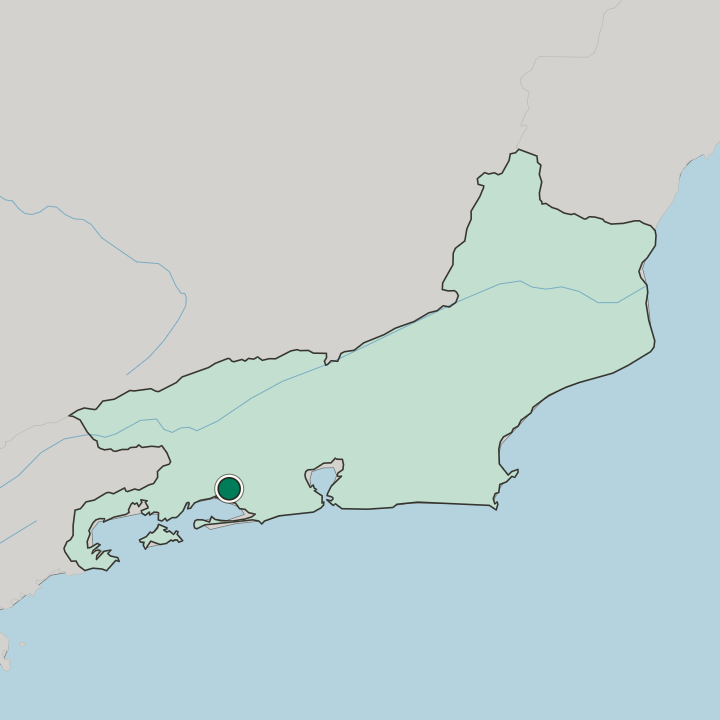
Itaguaí lies midway between Rio de Janeiro and Angra dos Reis. Its territory covers some two hundred and seventy square kilometres of the Baixada Fluminense, inside the Grande Rio region of the state of Rio de Janeiro, and it reaches the water where the ore terminals work. Ilha Guaíba lies offshore.
The tropical band runs through here, and the built-up part of the municipality is small against a territory that carries ports at one end and the old parish streets at the other.
What is the climate of Itaguaí?
Nothing here gets properly cold. Itaguaí sits in the tropical band beside the water that carries its ore ships, so January runs hot and heavy while July only takes the edge off, and the swing between them stays small. The old streets offer shade.
The Igreja Matriz de São Francisco Xavier and the Casa de Cultura de Itaguaí give the middle of the day somewhere to go that the open ground by the Chafariz da Rua Maria Mota Santiago does not.
How do you get to Itaguaí?
Itaguaí sits on the run between Rio de Janeiro and Angra dos Reis. That midway position is the practical fact about arriving, since traffic between the two passes the municipality rather than ending in it, and Itaguaí belongs to Grande Rio at the same time. Its railway station is a former one.
The Antiga Estação Ferroviária de Itaguaí survives as a landmark rather than a way in, and ships take the iron ore out through Ilha Guaíba and the other loading ports of the municipality. Portuguese covers the rest.
Common questions
What is the best area to stay in Itaguaí?
The Matriz streets: Walkers taking in the São Francisco Xavier church and the Casa de Cultura. Nearer the ore terminals: Anyone in Itaguaí for the Ilha Guaíba loading ports.
More cities in Rio de Janeiro
Updated September 2026