France · Auvergne-Rhône-Alpes
Where to Stay in Villeurbanne, Auvergne-Rhône-Alpes
Villeurbanne is a commune of the Metropolis of Lyon, with the Astroballe, the Château de La Motte and its own contemporary art institute.
Hotel links are affiliate links: booking through them may earn us a commission, at no extra cost to you. It never affects how places are ranked. How this works


Where to stay in Villeurbanne
Where the beds are, and what that means for the visit.
The boundary matters more than the address. Beds on the Villeurbanne side sit outside the pressure of central Lyon and still leave the Museum of Fine Arts of Lyon, the Musée des Hospices Civils de Lyon and the Textile Arts Museum within a short ride. Two communes behave as one.
That is the whole argument for staying on this side. The Astroballe end is the liveliest part. Match nights fill the streets around the arena, and the Institut d'art contemporain de Villeurbanne keeps the same quarter busy on days when nothing is scheduled at the hall.
Rooms here are plain. You want this end if the trip is built around a fixture, an exhibition, or an early start towards central Lyon. Château de La Motte marks the quieter option.
Streets out towards it and the Église Saint-Bernard belong to the residential half of the commune, where parking is easier and the noise of a match night never reaches. Rhône's Pool draws the other group. It sits with the Jardin zoologique de la ville de Lyon on that side, which suits a stay with children rather than one built on galleries.
Find hotels in Villeurbanne
Direct booking searches for these neighbourhoods.
Around the Astroballe
The arena end of the commune, where the Astroballe and the contemporary art institute keep the same streets in use all week.Find hotels in Around the Astroballea short ride to the Museum of Fine Arts of LyonThe Lyon boundary
The edge where Villeurbanne runs into Lyon, putting the Musée des Hospices Civils de Lyon and the Textile Arts Museum in reach without a central address.Find hotels in The Lyon boundaryparking and a night away from the arenaTowards the Château de La Motte
The residential half of the commune, marked by the Château de La Motte and the Église Saint-Bernard rather than by any museum. Lodging is scarce in this area; reserve in advance.Find hotels in Towards the Château de La Mottethe Jardin zoologique de la ville de Lyon with childrenBy Rhône's Pool
The water side of the map, where Rhône's Pool and the zoological garden give a stay something other than exhibitions.Find hotels in By Rhône's PoolHotel links are affiliate links: booking through them may earn us a commission, at no extra cost to you. It never affects how places are ranked. How this works
About Villeurbanne
Basketball and contemporary art.
What is Villeurbanne known for?
The Astroballe fills for fixtures while the Institut d'art contemporain de Villeurbanne runs the exhibitions, and the Vélodrome Georges-Préveral puts a track within the same short stretch of the metropolis. Lyon supplies the rest. The Museum of Fine Arts of Lyon, the Contemporary Arts Museum of Lyon and the Institut Lumière sit across the commune boundary, close enough to count as part of a stay in Villeurbanne.
What are the main landmarks in Villeurbanne?
The Astroballe is the local name that carries. The Institut d'art contemporain de Villeurbanne, the Château de La Motte and the Église Saint-Bernard make up most of what the commune claims for itself, and the Vélodrome Georges-Préveral belongs to the same short list. Lyon holds the heavyweights.
The amphitheater of Lyon, the Institut Lumière, the Maison des Canuts and the Musée urbain Tony Garnier stand within the metropolis, and the Veilleur de pierre and the Lyon Armenian Genocide Memorial mark its harder memories.
What is the history of Villeurbanne?
The Château de La Motte is the oldest thing standing here. It gives the commune a point of origin older than the museums and the arena, and the Église Saint-Bernard belongs to a later phase of building on the same ground. The metropolis did the rest.
Villeurbanne stands inside the Metropolis of Lyon, and its story is bound to that of the larger commune next to it. Trades left their museums. The Maison des Canuts, the Textile Arts Museum and the Musée de l'Imprimerie et de la Communication Graphique record the working crafts of the metropolis, while the Musée des Hospices Civils de Lyon keeps the record of its hospitals.
Rome is further back. The amphitheater of Lyon and the Musée des moulages de Lyon reach behind all of it, and the Musée urbain Tony Garnier deals with how the modern city was designed. Harder marks came with the twentieth century.
The Centre d'Histoire de la Résistance et de la Déportation holds that record for the metropolis, the Veilleur de pierre stands as a monument to it, and the Lyon Armenian Genocide Memorial marks a loss carried here from elsewhere. Culture followed the rebuilding. The Institut d'art contemporain de Villeurbanne and the Contemporary Arts Museum of Lyon belong to that later chapter, and the Astroballe gave the commune a name in sport.
Where is Villeurbanne?
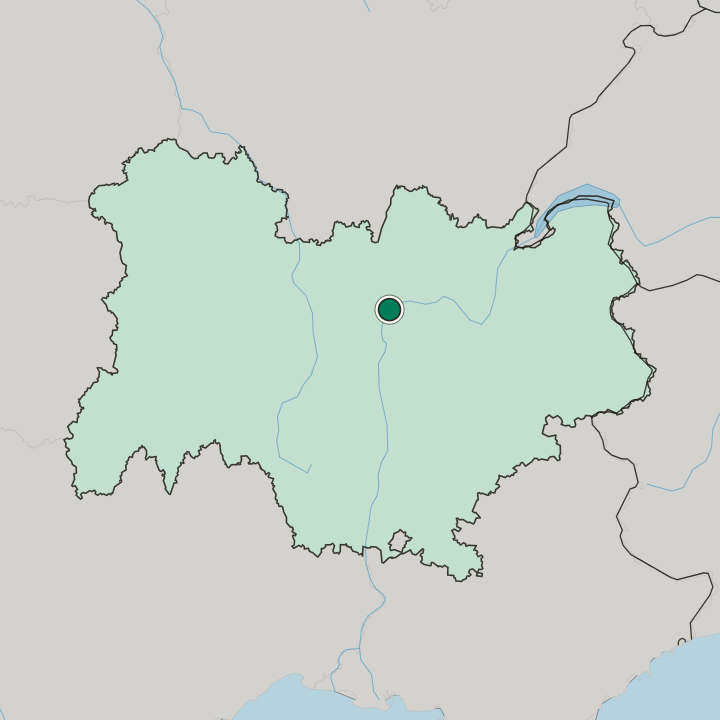
Roughly fifteen square kilometres, and no gap at the edge. Villeurbanne sits inside the Metropolis of Lyon with its built-up ground running straight into that of Lyon, so the commune boundary is a line on a map rather than something visible on the street. Rhône's Pool marks the water.
The Jardin zoologique de la ville de Lyon and the open ground around it close the same flank.
What is the climate of Villeurbanne?
The Rhône corridor decides it. Summers run hot enough to empty the streets around the Astroballe in the afternoon, while winters stay grey rather than severe, which is what a position well inland produces. Storms break in late summer.
Rhône's Pool earns its keep in those weeks.
How do you get to Villeurbanne?
Villeurbanne is reached through Lyon, not around it. Arrivals into the Metropolis of Lyon land on the larger commune's terminals and cross a boundary that shows up on no signpost, which makes the last stage of the journey short and unremarkable. The Tour To-Lyon stands over that side.
From the Astroballe, the museums of central Lyon are a matter of minutes rather than a separate trip.
Common questions
What is the best area to stay in Villeurbanne?
Around the Astroballe: match nights and the Institut d'art contemporain de Villeurbanne. The Lyon boundary: a short ride to the Museum of Fine Arts of Lyon. Towards the Château de La Motte: parking and a night away from the arena. By Rhône's Pool: the Jardin zoologique de la ville de Lyon with children.
Good for
More cities in Auvergne-Rhône-Alpes
Updated October 2026