France · Bretagne
Where to Stay in Saint-Brieuc, Bretagne
Saint-Brieuc is a city of Brittany in northwest France, an old cathedral town above a tidal bay, between two wooded valleys on the north Breton coast.
Hotel links are affiliate links: booking through them may earn us a commission, at no extra cost to you. It never affects how places are ranked. How this works


Where to stay in Saint-Brieuc
Where the beds are, and what that means for the visit.
Saint-Brieuc offers two bases: the cathedral streets or the coast at Le Légué. The streets around the cathedral keep the old houses, the market, and the museum within a walk, and staying downtown suits anyone here for the heritage. The old fronts lean over the lanes.
Bells ring from the towers. Out toward the bay and the cliffs, the town gives way to the port of Le Légué, the coast path, and the beaches of the shore. A room by the water trades the streets for the wide tidal bay, the harbour quays, and the cliffs of the coast.
The tide runs far from the land. Stay downtown for the cathedral, or out for the bay. The old centre sits a short way inland from the quays.
Find hotels in Saint-Brieuc
Direct booking searches for these neighbourhoods.
The old town
Around the medieval quarterFind hotels in The old townStays wanting Le Légué and the coastThe bay and port
Down toward the port at Le LéguéFind hotels in The bay and portHotel links are affiliate links: booking through them may earn us a commission, at no extra cost to you. It never affects how places are ranked. How this works
Things to do in Saint-Brieuc
Ranked by global recognition; descriptions from Wikidata (CC0).
Museums & Galleries
1- Musée d'art et d'histoire de Saint-Brieuc
Churches & Religious Sites
3- Église Saint-Michel de Saint-Brieuc Heritage
- Église Sainte-Thérèse de Gouédic Heritage
- Église Saint-Pierre-et-Saint-Paul de Langueux Heritage
Stadiums & Sports
3- Fred-Aubert Stadium
- Steredenn
- centre technique régional Henri Guérin
Landmarks & Notable Places
8- Maison, 17 rue Fardel, Saint-Brieuc Heritage
- Maison, 34 rue Fardel, Saint-Brieuc Heritage
- Maison, 32 rue Fardel, Saint-Brieuc Heritage
- Maison Le Ribeault Heritage
- Maison de la barrière Heritage
Show 3 more →
- Maison, 22 rue du Gouët, Saint-Brieuc Heritage
- Maison, 9 rue de la Quinquaine, Saint-Brieuc Heritage
- Maison, 6 rue Houvenagle, Saint-Brieuc Heritage
worth knowingacross 4 categories in Saint-Brieuc
About Saint-Brieuc
What is Saint-Brieuc known for?
Saint-Brieuc is the cathedral town of the north Breton coast. Above the great bay where two valleys come down to the sea in Brittany, it grew around the shrine of an early saint, and it keeps the fortified cathedral of Saint-Étienne over the old town, the half-timbered medieval streets around it, the fishing port of Le Légué down at the river mouth, and the wide scallop bay below the cliffs. The tide runs far out on the sand.
Church towers rise over the roofs.
What are the main landmarks in Saint-Brieuc?
The cathedral of Saint-Étienne is the pride of Saint-Brieuc. The grim grey minster with its great defensive towers, half church and half fortress, stands at the heart of the old town, the emblem of the city, downtown. Old houses lean by the streets.
The half-timbered fronts of the medieval quarter line rue Fardel nearby, while the port of Le Légué, the scallop bay, and the coast cliffs mark the country around Saint-Brieuc.
What is the history of Saint-Brieuc?
Saint-Brieuc was born of a Welsh monk. In the sixth century a holy man named Brioc crossed from Britain to this coast and founded a monastery above the bay, and the town took his name. A cathedral rose over the shrine.
Around the saint's tomb grew a great fortified cathedral of grey stone, its towers built for defense as much as prayer, and a bishop's town gathered in its shadow. The town lived by the sea and the land. Fishermen worked the great bay for its scallops and fish, and merchants traded through the port of Le Légué below the town, while weavers and farmers filled the market of the old streets.
The railway woke the sleepy town. When the line came through, Saint-Brieuc grew into the busy seat of its Breton county, spreading beyond its half-timbered core, yet it kept its cathedral, its port, and its bay. The tide still rules the shore.
Saint-Brieuc keeps its old town above the Breton bay.
Where is Saint-Brieuc?
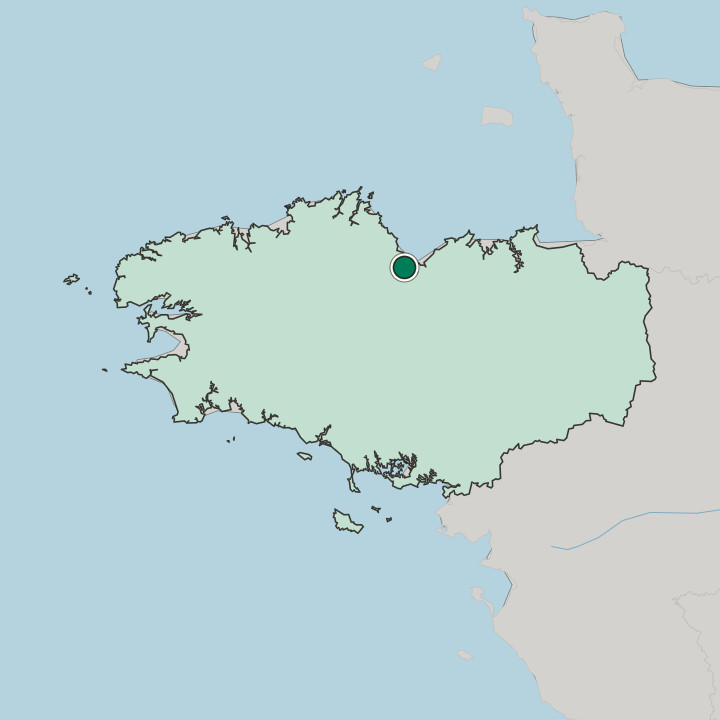
Saint-Brieuc lies in the north of Brittany, above the wide bay of Saint-Brieuc on the Channel coast. The town stands on a plateau cut by two river valleys, the Gouët and the Gouédic, that drop to the sea, with the great bay and its huge tides below and the green Breton hills rolling inland. The tide bares the wide sands.
Valleys cut down to the port.
What is the climate of Saint-Brieuc?
Saint-Brieuc has a mild, damp oceanic climate. Cool wet winters and soft warm summers hold on the coast, with sea winds and frequent rain and rare frost by the bay. The wind blows in off the sea.
Rain sweeps over the coast.
How do you get to Saint-Brieuc?
Saint-Brieuc lies on the north coast of Brittany, on the road and rail between Rennes and Brest. Fast trains and the highway run to it along the coast from Rennes, and lanes lead out to the bay and the cliffs. Boats work the tides.
Rennes lies east down the line.
Common questions
What is the best area to stay in Saint-Brieuc?
The old town: Visitors here for Saint-Étienne and the rue Fardel. The bay and port: Stays wanting Le Légué and the coast.
Good for
More cities in Bretagne
Updated October 2026