India · Uttar Pradesh
Where to Stay in Hāpur, Uttar Pradesh
Hāpur heads Hapur district on the Delhi to Lucknow road, a mandi town whose papad and steel tube travel well beyond Uttar Pradesh.
Hotel links are affiliate links: booking through them may earn us a commission, at no extra cost to you. It never affects how places are ranked. How this works


Where to stay in Hāpur
The practical side of choosing where to sleep.
Bulandshahr Road anchors the older half of the town. The old tehsil stands along it, with the telephone exchange that occupies the ground where the 1857 gallows tree grew, and the mandi lanes that handle jaggery and grain lie within an easy walk of both. Traffic is the cost.
Carts and freight work the road from before dawn, and the lanes around Kilakona and Jawahar Ganj were laid long before anyone parked a car in them. Awas Vikas and Adarsh Nagar answer that. These are laid-out colonies on the newer side of Hāpur, set back from National Highway 9, quieter at night and easier to drive into, though a good deal further from the market.
Pilgrims often choose differently again. Garhmukteshwar sits east where the Ganges runs, and the pilgrimage that draws lakhs to it every year makes Hāpur a practical base, since the city keeps beds through the year while the crowds out there come in season. Newer housing has gone up in the Hapur-Pilkhuwa Development Region, where the engineering and dental colleges sit as well.
Delhi is the fourth option, and for many it is the real one: the capital lies about 60 km west along National Highway 9, close enough that a day trip out to Hāpur costs nothing but the morning.
Find hotels in Hāpur
Direct booking searches for these neighbourhoods.
Bulandshahr Road and the old tehsil
The oldest part of Hāpur, where the tehsil wall meets the telephone exchange raised on the gallows ground of 1857, with the grain and jaggery market a few lanes off.Find hotels in Bulandshahr Road and the old tehsilQuiet nights and simple parking back from National Highway 9Awas Vikas and Adarsh Nagar
Planned colonies on the newer side of Hāpur, set away from the Delhi to Lucknow traffic, with wider streets than Kilakona or Jawahar Ganj and a longer walk to the mandi.Find hotels in Awas Vikas and Adarsh NagarPilgrims making for the Ganges at GarhmukteshwarThe Garhmukteshwar road east
The eastern way out of Hāpur towards the Ganges, taken by people on the Garhmukteshwar pilgrimage who would rather sleep in the district town than at the river.Find hotels in The Garhmukteshwar road eastHotel links are affiliate links: booking through them may earn us a commission, at no extra cost to you. It never affects how places are ranked. How this works
About Hāpur
The papad carries the name furthest.
What is Hāpur known for?
Hāpur's mandi turns over oilseed, jaggery, sugarcane, and cotton off the fields around it, while its workshops draw stainless steel pipes, tubes and hubs, then wind the paper cones and tubes the town is equally known for. The habit is old. Ain-i-Akbari lists the town as a pargana of the Delhi sarkar, assessed for the imperial treasury and made to supply infantry and cavalry, long before National Highway 9 gave the traders a faster road out.
What are the main landmarks in Hāpur?
The chief memorial is a telephone exchange. It stands on Bulandshahr Road against the wall of the old tehsil, on the spot where a peepal tree served as the gallows for Chaudhary Jabardast Khan and his supporters; the tree itself was cut down long after. Babugarh, the cavalry remount depot and farm of the British Raj, adjoins the town on the other side.
Further east the Ganges marks the district edge, and Garhmukteshwar on its bank pulls pilgrims in by the lakh each year.
What is the history of Hāpur?
The name is said to come from hapar, a word for orchard, and the town itself from the tenth century. Ain-i-Akbari records it as a pargana under the Delhi sarkar, assessed for the imperial treasury and bound to furnish infantry and cavalry. Sovereignty changed hands.
At the close of the eighteenth century Daulat Scindia granted Hāpur to his French general Pierre Cuillier-Perron, and under the British Raj that followed the town sat inside Meerut District, ringed by groves and trading in sugar, jaggery, grain, cotton, timber, bamboo, and brass and steel utensils. The 1857 revolt reached deep here. Chaudhary Jabardast Khan and Chaudhary Ulfat Khan led the villages around, backed by their friendship with Nawab Walidad Khan of Malagarh, whom Bahadur Shah had put in charge of Bulandshahr and Aligarh, and the rebels cut the wires between Hāpur and Bulandshahr.
Williams brought a detachment. With the help of Wilson, the English officer posted in the town, he took both brothers and many of their supporters, and the death sentences were carried out beside the old tehsil. The family had come from Asauda and settled in Bhanda Patti, where the descendants live still.
Hāpur keeps the memory in a fair: the Shaheed Mela has opened on 10 May every year since 1975 and runs a month, which no other town in the country does for 1857.
Where is Hāpur?
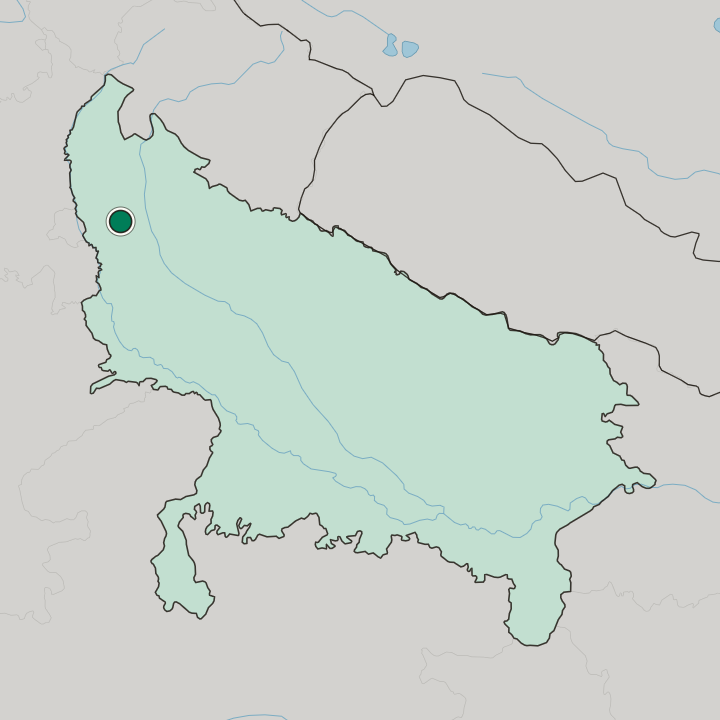
Meerut lies north of Hāpur, Bulandshahr south, Ghaziabad to the south-west, and Amroha across to the east. The Ganges draws the district's eastern boundary, while the Kali Nadi runs past the outskirts on its own line. No rock breaks the surface here.
What lies underfoot is alluvium carried down from the Himalayas, silt and fine sand mixed together, which is why wheat, sugarcane and vegetables do so well on it; the ground stands about 213 metres up, a little higher than the districts around.
What is the climate of Hāpur?
The monsoon sets the year. It arrives over Hāpur in late June and holds until the middle of September, dropping most of the rain the district gets and lifting the humidity while the cloud takes the edge off the heat. Before that comes the hard part: April to late June runs extremely hot on this plain below the Himalayas, with nothing between the town and the sun.
October warms again briefly. Then a dry, mild winter settles in from late October to the middle of March.
How do you get to Hāpur?
National Highway 9 carries Delhi to Lucknow traffic straight through the town, putting New Delhi about 60 km west by road. The railway junction does the rest. Hāpur sits inside the Delhi National Capital Region, which ties its roads to the capital's, and the district falls administratively under the Meerut commissionerate to the north.
Garhmukteshwar and the Ganges lie east of the town.
Common questions
What is the best area to stay in Hāpur?
Bulandshahr Road and the old tehsil: Walking to the jaggery mandi and the 1857 Shaheed Mela ground. Awas Vikas and Adarsh Nagar: Quiet nights and simple parking back from National Highway 9. The Garhmukteshwar road east: Pilgrims making for the Ganges at Garhmukteshwar.
More cities in Uttar Pradesh
Updated September 2026