India · Uttar Pradesh
Where to Stay in Mau, Uttar Pradesh
Mau, also called Maunath Bhanjan, is a saree-weaving town on the Tamsa and the headquarters of Mau district in eastern Uttar Pradesh.
Hotel links are affiliate links: booking through them may earn us a commission, at no extra cost to you. It never affects how places are ranked. How this works


Where to stay in Mau
Where the beds are, and what that means for the visit.
Beds here answer to business, not sightseeing. Mau is a working town of powerlooms and cloth dealers, and the rooms sit where that trade sits: in central Maunath Bhanjan, in the streets around Shahi Qatra, and out towards Mau Junction. The saree market sets the hours.
You will want the centre if the reason for the trip is cloth, whether that means the dealers, the powerloom sheds, or an appointment at the offices of Mau district, because everything on that list is inside a short walk of everything else. The station side is the practical alternative. Mau Junction and National Highway 29 both sit on that edge of the town, so a bed there suits an arrival off a late train or a drive in from Azamgarh, and it costs nothing in walking distance to the market.
Malik Tahir Pura is quieter. The lanes behind the Mazaar Malik Tahir Baba are a household district of looms rather than a lodging quarter, so beds are thin and the reason to be there is the weaving itself. Ghosi and Doharighat, out in the district, look back to Maunath Bhanjan for a room.
Plan on plain accommodation.
Find hotels in Mau
Direct booking searches for these neighbourhoods.
Central Maunath Bhanjan
The saree dealers of Maunath Bhanjan and the district administration work the same central streets, and Shahi Qatra with its Shahi Mosque stands a short walk from both.Find hotels in Central Maunath Bhanjanlate trains at Mau Junction and the National Highway 29 run to AzamgarhAround Mau Junction
Mau Junction came with the developmental push Kalpnath Rai drove after the district was carved out, and National Highway 29 passes along this edge, so arrivals by rail or road land here first.Find hotels in Around Mau Junctionthe Mazaar Malik Tahir Baba and the loom lanes behind itMalik Tahir Pura
Malik Tahir Pura took its name from the Sufi Baba Malik Tahir whose tomb stands in it, and the quarter is given over to household weaving, which leaves it long on looms and short on rooms. Lodging is scarce in this area; reserve in advance.Find hotels in Malik Tahir PuraHotel links are affiliate links: booking through them may earn us a commission, at no extra cost to you. It never affects how places are ranked. How this works
About Mau
Sarees are the trade here.
What is Mau known for?
Weaving is a centuries-old craft of the town's own artisans, and after the textile industry of Banaras and Mubarakpur faded, Mau held on as one of the last spinning and weaving hubs of eastern Uttar Pradesh. Powerlooms run in Tajopur, Shahadatpura, and Ghosi, the three small industrial areas that keep the saree trade of Maunath Bhanjan supplied. Palki Industries forms the one recognised cluster.
Cloth, not offices, carries the name of Mau district across India.
What are the main landmarks in Mau?
The tomb comes first. Mazaar Malik Tahir Baba stands in Malik Tahir Pura, holding the Sufi who stayed behind when the army of Syed Shalar Masood Ghazi turned back towards Afghanistan, and Qasim Pura carries his brother's name a short walk away. Shahi Qatra marks where Jahanara Begum built her mosque; the original is gone, and a Shahi Mosque keeps the site in use.
On the Tamsa a ghat holds a very large statue of Shankar. Kalpnath Rai left the town a stadium.
What is the history of Mau?
Archaeology puts human habitat around Mau back some fifteen centuries, when thick forest covered the whole area, and the Bhar are remembered as the earliest people along the Tamsa. In 1028 the army of Syed Shalar Masood Ghazi came to take the country and then went home to Afghanistan, leaving men behind; two of them, Baba Malik Tahir and Malik Qasim, gave their names to Malik Tahir Pura and Qasim Pura. Sher Shah Suri, who defeated Humayun, rode to Kolhuvavan to see the Sufi Syed Ahmad Wadva between 1540 and 1545, and his daughter Mahvani settled by the saint's dargah for good.
Ziyaudeen Barni's book records Akbar passing through on the road to Allahabad. Shah Jahan's daughter Jahanara Begum is held to have built a mosque at Shahi Qatra. Then the district.
Azamgarh became independent in 1932, and Mau belonged to it until the present district was carved out on 19 November 1988, with Kalpnath Rai driving the split; he is credited with the new railway station and the stadium too. Mahatma Gandhi had come to Doharighat in Ghosi Tehsil in 1939, when the town backed the freedom struggle. Cloth outlasted all of it.
Powerlooms in Mau kept working after Banaras and Mubarakpur lost their textile trade, which is why an industrial town of eastern Uttar Pradesh is still described by its looms rather than by its offices.
Where is Mau?
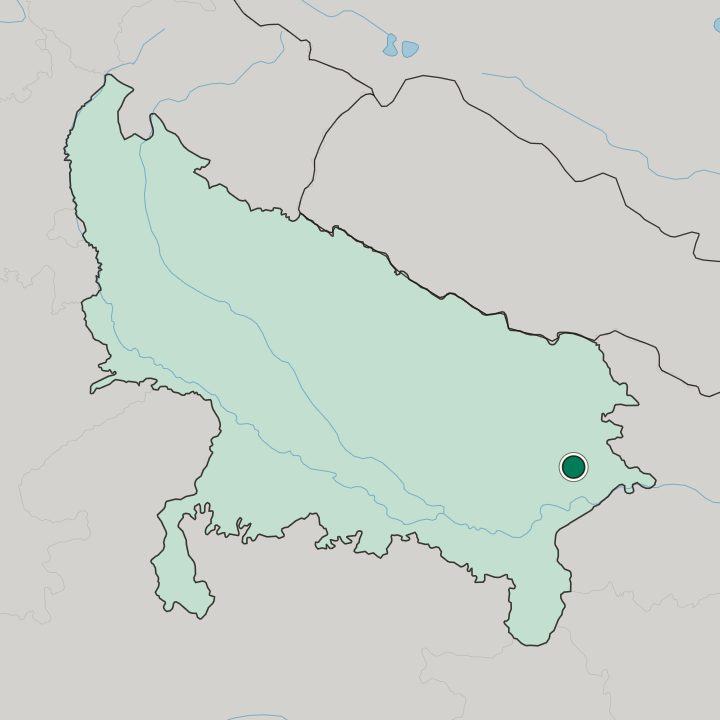
The Tamsa gives Mau its shape. The river, also called the Tons, comes down past the north of the town and the built-up ground sits along its bank, spread over roughly 39 square kilometres of level land in the eastern part of Uttar Pradesh. Azamgarh lies some 56 kilometres west; Lucknow is about 282 kilometres away to the north-west.
Madhuban sits around 40 kilometres off.
What is the climate of Mau?
The Tamsa runs low, then full. Mau sits in the subtropical band well inland from any coast, so the hot season is long and heavy before the rains come and the river rises past the ghat on the north side of the town. Looms work through all of it.
The cool weeks are short, and they are when the streets of Maunath Bhanjan are easiest to walk.
How do you get to Mau?
Trains stop at Mau Junction, the town's main station and one of the things Kalpnath Rai is credited with. National Highway 29 passes through and ties Mau into the road network of eastern Uttar Pradesh, with Azamgarh about 56 kilometres west and Lucknow far off to the north-west. Ghosi and Doharighat lie within the district.
Most arrivals come overland.
Common questions
What is the best area to stay in Mau?
Central Maunath Bhanjan: cloth dealers, the powerloom sheds, and the offices of Mau district. Around Mau Junction: late trains at Mau Junction and the National Highway 29 run to Azamgarh. Malik Tahir Pura: the Mazaar Malik Tahir Baba and the loom lanes behind it.
More cities in Uttar Pradesh
Updated September 2026