China · Shandong
Where to Stay in Dezhou, Shandong
Dezhou is a prefecture-level city in northwestern Shandong, a rail junction on the Hebei border holding the Tomb of the Sultan of Sulu.
Hotel links are affiliate links: booking through them may earn us a commission, at no extra cost to you. It never affects how places are ranked. How this works


Where to stay in Dezhou
The practical side of choosing where to sleep.
Dezhou's rooms answer to the railway junction. The crossing of the Beijing-Shanghai and Dezhou-Shijiazhuang lines is what brings most people to the city, so a bed within reach of the platforms covers the usual reason for stopping at all. Trains run early.
Anyone breaking a journey between Beijing and Shanghai, or turning off toward Shijiazhuang, will value minutes over square metres, and the rooms clustered near the tracks are the ones that make a dawn departure survivable. The Tomb of the Sultan of Sulu pulls in the other direction. It stands away from the platforms, and a visitor whose main purpose is the tomb rather than a connection should weigh a bed on that side of Dezhou against the convenience of the junction.
Distances are not trivial. Dezhou is a prefecture-level city whose administrative area runs out to the borders of Jinan, Liaocheng and Binzhou, so the address matters more than the star rating. Business travel fills much of the stock.
The city works as an industrial and trade centre for the country either side of the Hebei line, which means rooms are built for people arriving with a purpose rather than a holiday.
Find hotels in Dezhou
Direct booking searches for these neighbourhoods.
The railway junction
Dezhou exists as a hub because these two lines cross here, and a room by the platforms keeps a pre-dawn connection to a walk rather than a taxi.Find hotels in The railway junctionVisitors coming for the one heritage monument recorded in DezhouThe Tomb of the Sultan of Sulu side
The tomb stands apart from the tracks, so a bed on this side of Dezhou trades train convenience for reaching the burial site on foot. Lodging is scarce in this area; reserve in advance.Find hotels in The Tomb of the Sultan of Sulu sideTrade and industry callers working the country between Shandong and HebeiThe Hebei border edge
Dezhou's commercial weight gathers where the prefecture runs up to Hebei, which suits anyone whose appointments sit nearer Shijiazhuang than Jinan. Few places to stay nearby — book ahead.Find hotels in The Hebei border edgeHotel links are affiliate links: booking through them may earn us a commission, at no extra cost to you. It never affects how places are ranked. How this works
About Dezhou
Railways made the place.
What is Dezhou known for?
Dezhou sits at the crossing of the Beijing-Shanghai line and the Dezhou-Shijiazhuang line, which is why the city works as a transport hub for the trade area straddling the Shandong and Hebei border. The Tomb of the Sultan of Sulu carries the city's named heritage, the single monument the record fixes to Dezhou rather than to the wider prefecture.
What are the main landmarks in Dezhou?
One monument carries the name. The Tomb of the Sultan of Sulu is the heritage site Dezhou is recorded for, and it stands as the city's principal draw for anyone whose interest runs to the past rather than to the platforms. The rest of Dezhou reads as working country.
Industry, trade and the two railways shape what a visitor actually sees between Shandong and Hebei, so the tomb is the fixed point a sightseeing day is built around.
What is the history of Dezhou?
No founding year attaches to Dezhou in the record. What survives instead is a monument: the Tomb of the Sultan of Sulu, a burial site preserved in Dezhou and the one heritage place the record fixes to the city. The name it carries is not local.
A tomb bearing the title Sultan of Sulu marks Dezhou as a place that received a figure from well beyond Shandong, and that single fact says more about the city's reach than any charter would. The tomb, not a charter, anchors the city's past. Rail rewrote the map later.
The crossing of the Beijing-Shanghai and Dezhou-Shijiazhuang lines turned a town on the Hebei border into a junction, and a junction is what Dezhou has been known for since. Trade followed the tracks. The city became the economic and industrial centre for the border country between Shandong and Hebei, a role that depends less on what happened here than on what passes through.
Administration followed the traffic. Dezhou holds prefecture-level rank, with Jinan, Liaocheng and Binzhou along its own boundaries, and its record reads as the story of a crossing point rather than of a capital.
Where is Dezhou?
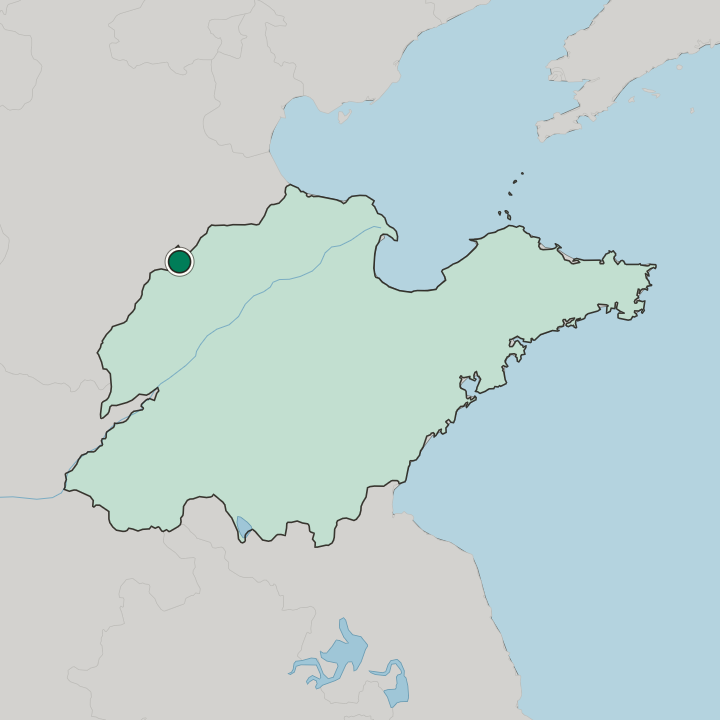
Dezhou occupies northwestern Shandong and meets the province of Hebei along its northern edge, which places a provincial boundary inside the city's own administrative reach. Three prefectures press against the rest. Jinan lies to the southeast, Liaocheng to the southwest and Binzhou to the northeast, so Dezhou is hemmed in by other prefectures rather than by any coastline or range of hills.
What is the climate of Dezhou?
No coastline enters Dezhou's record. The city is bounded by land neighbours, Jinan, Liaocheng, Binzhou and the province of Hebei, which puts it in a temperate inland setting rather than on the Shandong seaboard. Nothing here is maritime.
Anyone planning a stop off the Beijing-Shanghai railway should treat Dezhou's conditions as those of the Hebei border country rather than of a coastal Shandong city.
How do you get to Dezhou?
Two railways cross here, and that is the whole story. The Beijing-Shanghai line runs through Dezhou and the Dezhou-Shijiazhuang line strikes off it, which is why the record describes the city as a transport hub for the Shandong and Hebei border area. Rail does the heavy lifting.
Arrivals from Beijing, Shanghai or Shijiazhuang come in on the tracks, and Jinan, the provincial capital, lies against Dezhou's own boundary for onward links.
Common questions
What is the best area to stay in Dezhou?
The railway junction: Passengers changing between the Beijing-Shanghai and Dezhou-Shijiazhuang railways. The Tomb of the Sultan of Sulu side: Visitors coming for the one heritage monument recorded in Dezhou. The Hebei border edge: Trade and industry callers working the country between Shandong and Hebei.
More cities in Shandong
Updated September 2026