United States · Massachusetts
Where to Stay in Malden, Massachusetts
Malden is a Middlesex County city and a suburb of Boston, founded in 1640, keeping colonial houses such as the Peter Tufts House on its streets.
Hotel links are affiliate links: booking through them may earn us a commission, at no extra cost to you. It never affects how places are ranked. How this works


Where to stay in Malden
Where the beds are, and what that means for the visit.
Malden is somewhere to sleep more than somewhere to arrive. Rooms are taken here for nearness to Boston rather than for anything at the centre of the city itself, and the honest question is whether a traveller wants the quiet of Middlesex County or the noise of the larger place. The heritage side of the choice sits by First Parish in Malden, where the Beebe Estate and several listed houses stand within an easy walk of one another.
Families book differently. Legoland Discovery Center Boston shapes a whole category of stay in this city, and a party travelling for it cares far more about the run to its door than about which colonial house stands three streets away. Boston is the other option, and a real one.
A room in the larger city puts its restaurants and terminals at hand while reducing Malden to a short inbound journey, which suits anyone whose reason for coming has nothing to do with Middlesex County. Quiet costs less out here. Staying in Malden means a smaller street and a parking space, and the trade is eating where the suburb eats and travelling in for the rest.
The Trinity Episcopal Church end of the city is the quietest of all, well away from the through roads, and it suits sleepers who intend to spend their waking hours somewhere else entirely.
Find hotels in Malden
Direct booking searches for these neighbourhoods.
Around First Parish in Malden
The oldest civic ground of Malden lies here, with First Parish in Malden and the Beebe Estate a few streets apart and inbound Boston services leaving from the same quarter. Few places to stay nearby — book ahead.Find hotels in Around First Parish in MaldenTravellers set on the colonial house fabric Middlesex County kept standingNear the Peter Tufts House
The Peter Tufts House and the Isaac Hall House hold this side of Malden, and a room here trades restaurant choice for the quietest streets the city has. Beds are limited here, so book early.Find hotels in Near the Peter Tufts HouseFamilies whose whole trip is built around Legoland Discovery Center BostonToward Legoland Discovery Center Boston
Parties travelling for Legoland Discovery Center Boston want the shortest run to its door, and this edge of Malden gives it without paying for a central Boston address.Find hotels in Toward Legoland Discovery Center BostonHotel links are affiliate links: booking through them may earn us a commission, at no extra cost to you. It never affects how places are ranked. How this works
About Malden
Colonial fabric survives here.
What is Malden known for?
Malden carries a run of listed houses that predate almost everything around them, among them the Peter Tufts House and the Isaac Hall House, both older than the Boston suburbs that later grew over the land between. The Beebe Estate anchors the civic side and First Parish in Malden the religious one, while Legoland Discovery Center Boston draws families in from across Middlesex County.
What are the main landmarks in Malden?
Malden keeps its heritage in houses. The Peter Tufts House, the Isaac Hall House, the Henry Bradlee Jr. House, the C. Henry Kimball House, the Nathan Sawyer Cottage and the Reverend David Osgood House together make a run of listed domestic buildings unusual for a suburb of this size.
Congregations account for the remainder. First Parish in Malden, Trinity Episcopal Church and the First Baptist Church mark the older civic ground, while the Beebe Estate serves the arts and Legoland Discovery Center Boston pulls an entirely different crowd.
What is the history of Malden?
Malden was founded in 1640. That date places it among the seventeenth-century foundings of Middlesex County, early enough that the oldest quarters of the city answer to a plan laid down long before Massachusetts had any suburbs to speak of. First Parish in Malden carries the congregational thread forward from that century.
Houses do the rest of the telling. The Peter Tufts House and the Isaac Hall House survive from the colonial period, while the Reverend David Osgood House names a minister whose years spanned the town's early decades. Later money left marks of its own.
The Henry Bradlee Jr. House, the C. Henry Kimball House and the Nathan Sawyer Cottage record the era in which Malden turned from a farming town into a residential district serving Boston, each raised for a named household rather than for an institution. The Beebe Estate belongs to the same impulse.
Churches multiplied alongside the houses, and Trinity Episcopal Church and two separate First Baptist Church buildings stand as evidence that the households arriving in those decades did not all arrive from one pew. Suburb status then settled the question for good. Everything after that is Boston's story at one remove, and the city's own list of landmarks, Legoland Discovery Center Boston at one end and a colonial house at the other, reads as a record of exactly that relationship.
Where is Malden?
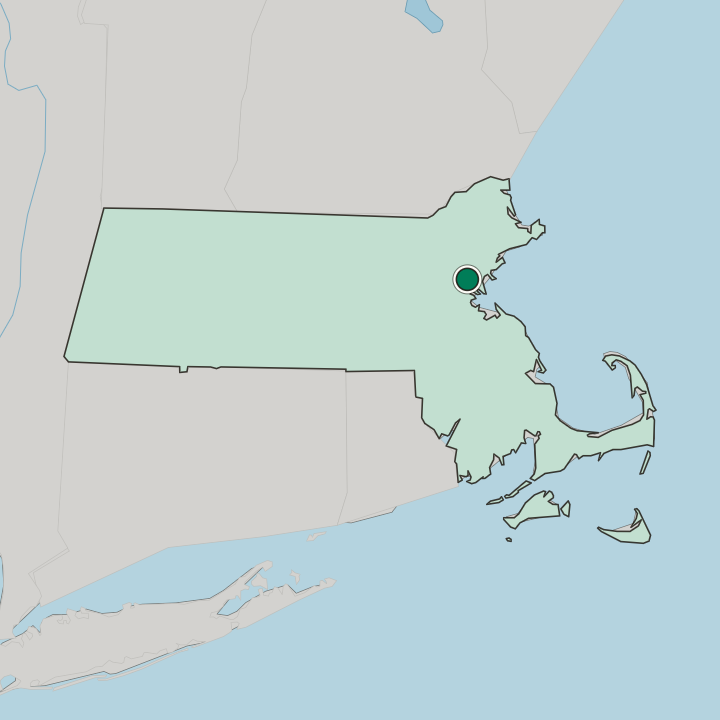
Malden takes up a small patch of ground. The city fills roughly thirteen square kilometres of Middlesex County, packed tight against the built edge of Boston, so its limits read as street lines rather than as anything the land itself draws. Housing runs to every edge.
No separate countryside belongs to Malden, and the listed properties, the Beebe Estate among them, sit inside the same continuous suburban fabric of Massachusetts as everything around them.
What is the climate of Malden?
Malden shares Boston's calendar exactly. The city lies in the temperate band of the northern hemisphere, which sets a four-season year of hard cold in January, a slow and late spring, and a humid stretch that peaks around July. Nothing local softens it.
Malden is small enough and near enough to Boston that whatever weather reaches the larger city reaches Middlesex County within the hour, so a visitor plans by the region and not by the suburb.
How do you get to Malden?
Arrival runs through Boston. Malden has no airport or long-distance terminal of its own, so travellers land in the larger city and finish the trip inward across Middlesex County, a matter of minutes rather than hours. Then the distances shrink.
First Parish in Malden, the Beebe Estate and the Peter Tufts House stand close enough together that a visitor without a car can still reach the listed buildings on foot once a room is settled.
Common questions
What is the best area to stay in Malden?
Around First Parish in Malden: Walkers who want the Beebe Estate and the old meetinghouse ground on one short circuit. Near the Peter Tufts House: Travellers set on the colonial house fabric Middlesex County kept standing. Toward Legoland Discovery Center Boston: Families whose whole trip is built around Legoland Discovery Center Boston.
Good for
More cities in Massachusetts
Updated October 2026