Germany · Nordrhein-Westfalen · Essen
Kupferdreh, Essen — Area Guide & Where to Stay
Kupferdreh is a Stadtteil in the far southeast of Essen on the Ruhr and the Baldeneysee, named for a bend the river once made where the Deilbach comes in.
Hotel links are affiliate links: booking through them may earn us a commission, at no extra cost to you. It never affects how places are ranked. How this works


Where to stay in Kupferdreh
Where visitors usually base themselves, and why.
The lake put an end to the bend. Damming the Ruhr in 1933 flooded the Kupperdrehe, the turn of nearly a hundred and eighty degrees that gave the place its name, along with the old harbour at the Deilbach mouth, and what stands there now is the Baldeneysee. The railway bridge survives.
It was built in 1872 with round arches, took its present shape during the making of the lake in 1929, was blown up in the war and rebuilt on one track, and it carries walkers rather than trains now. Byfang and Heisingen are the near neighbours.
About Kupferdreh
What are the main landmarks in Kupferdreh?
The Deilbach valley is the industrial monument. A copper smelter, the Deiler Koperhut, is documented here in 1550 and the Deilbachhammer has worked since about 1660 on the boundary with Byfang, and the valley counts as a forerunner of Ruhr industrialisation because coal, copper, iron, and zinc were all worked here in the 16th century. One railway was the first of its kind in Germany.
Friedrich Harkort's Deilthaler Eisenbahn, also called the Prinz-Wilhelm-Eisenbahn, ran horse-drawn over seven and a third kilometres from 1831 to carry coal to Nierenhof, and it was the first railway in the country run as a company. The oldest find is much older still. A stone cist about four thousand years old came to light in 1937 during the building of the former Ruhrlandkaserne.
What is the history of Kupferdreh?
The name is a dialect word for a turn. Boatmen called the sharp bend in the Ruhr at the Deilbach mouth the Kopperdreih or Kupperdrehe once the river was made navigable from 1780, and after Hinsbeck became Prussian in 1803 the Prussian cadastral survey of about 1820 wrote the hillside there as An der Kupperdrehe. Friedrich Harkort took the name for a stop.
He used it in 1831 for a halt on the Deilthaler Eisenbahn and again in 1844 when the line went over to steam and ran on to Vohwinkel, and in 1855 the station at Hinsbeck got its own postal service under the name Kupferdreh, which is when the spelling became official. Iron and cement followed the rails. The Eisenhütte Phoenix settled here in 1852 and its Kupferdreh works and blast furnaces were wound up in 1914, its slag went with Velbert lime into Portland cement at a works built here late in the 19th century, and the Kupferdreher Steinwerke were founded in 1897 to use what that works made.
The medieval ground was divided. Dilldorf was a Bauerschaft counted among the Saxon Bructeri and later belonged to the lordship of Hardenberg at Neviges, while the Frankish Honnschaften of Hinsbeck and Rodberg belonged to the imperial abbey of Werden.
Where is Kupferdreh?
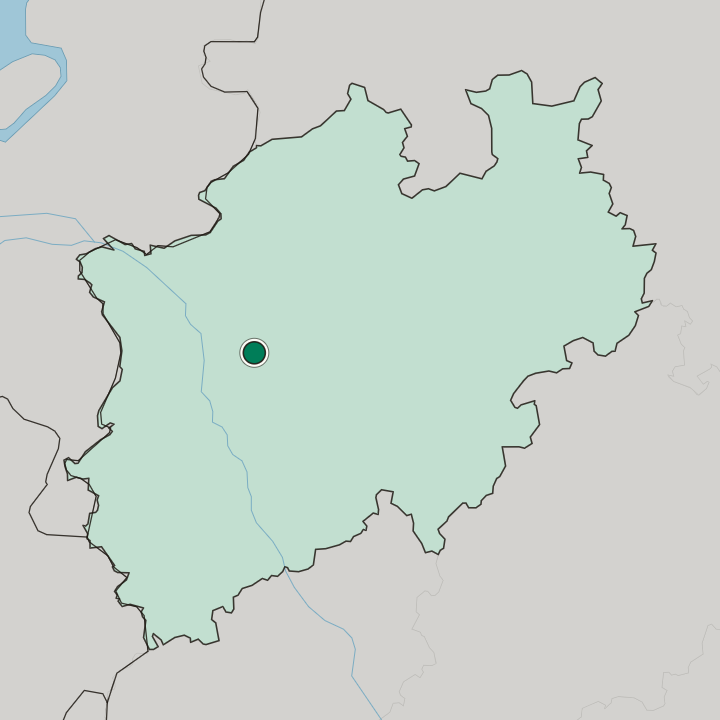
Kupferdreh sits at the southeastern corner of Essen where the Deilbach meets the Ruhr on the Baldeneysee, bordering Byfang to the northeast, Hattingen-Niederbonsfeld to the east, Velbert-Langenberg to the south, Heidhausen to the southwest and Fischlaken and Heisingen across the Ruhr to the west.
Good for
More areas in Essen
Updated September 2026