Japan · Chiba-ken
Where to Stay in Matsudo, Chiba-ken
Matsudo is a densely built city of Chiba Prefecture, Japan, standing east of Tokyo on the ground of the old Matsudo-juku post station.
Hotel links are affiliate links: booking through them may earn us a commission, at no extra cost to you. It never affects how places are ranked. How this works


Where to stay in Matsudo
How the choice of base plays out on the ground.
Rooms gather on the side of Matsudo where Matsudo-juku once stood, which is also the side that holds the Matsudo Museum and the shops. Sixty square kilometres is not a large city, and the genuinely walkable part is smaller again, so a central bed takes most of the transport problem out of a short stay. Evenings are ordinary.
Anyone using the place as a base rather than a destination will find that convenient rather than interesting, and the trade-off is that nothing about the streets outside the door demands any attention. The other logic is to stay for the neighbours. The Municipal Museum of History in Ichikawa and the Municipal Museum of Archaeology in Ichikawa lie on one side of the city and the Katsushika Shibamata Tora-san Museum sits over the boundary on the other, so a room placed toward whichever of those your day starts with saves a good deal of crossing back through dense ground.
Tokiwadaira is the alternative. That outer district, whose Tokiwadaira Taiikukan is among the buildings the city lists, trades the walk to the Matsudo Museum for quieter streets, and in a city this compact the trade costs little beyond a short ride back into the middle.
Find hotels in Matsudo
Direct booking searches for these neighbourhoods.
The old Matsudo-juku ground
The compact centre stands where the Matsudo-juku post station didFind hotels in The old Matsudo-juku groundQuiet outer rooms with a short ride into central MatsudoTokiwadaira
Residential streets out by the Tokiwadaira Taiikukan. Beds are limited here, so book early.Find hotels in TokiwadairaHotel links are affiliate links: booking through them may earn us a commission, at no extra cost to you. It never affects how places are ranked. How this works
Things to do in Matsudo
Ranked by global recognition; descriptions from Wikidata (CC0).
Museums & Galleries
3- Matsudo Museum
- 新京成鉄道模型館
- Municipal Museum of Archaeology in Ichikawa
Stadiums & Sports
3- Tokiwadaira Taiikukan
- 中央ゲートボール場
- 千駄堀暫定スポーツ広場
worth knowingacross 2 categories in Matsudo
About Matsudo
What is Matsudo known for?
Matsudo works as a tightly packed commuter city east of Tokyo, its housing pressed onto a little over sixty square kilometres and its sights mostly small, local, and indoors. The Matsudo Museum anchors the municipal collection. Past it the list runs to the Tojō Museum of History, the Showa no Mori Museum, and, over the city boundary, the Katsushika Shibamata Tora-san Museum.
Nothing here towers.
What are the main landmarks in Matsudo?
Most of what Matsudo lists is domestic in scale. The Former residence of Saitō, the Tsuchiya-ke nagayamon, and the Anbiru-ke nagayamon are houses and gates rather than palaces, kept because the farming families who built them are otherwise gone from this ground. Genroku Matsudo-mura preserves a village name.
Two municipal collections carry the rest: the Matsudo Museum for the city and the Tojō Museum of History for its own subject, with a railway model hall, the Shin-Keisei Railway Model Hall, filling an odd corner of the list.
What is the history of Matsudo?
A road came through here before a city did. Kyū-Matsudo-juku Honjin atochi-hi marks the site of the honjin, the official inn of the post station of Matsudo-juku, and that single stone accounts for the shape of the older settlement better than any building left standing. Around it lay villages.
Genroku Matsudo-mura keeps the name of one from the Genroku years, and the Matsudo-shinden 300 years memorial counts three centuries from the founding of Matsudo-shinden. Smaller markers fill in what followed. Futatsu-ido ato records a pair of wells, Sakagawa no rekishi-hi sets down the story of the Sakagawa, and the Taishō kinen saka no hi is a commemorative stone of the Taishō era, so the record here is a scatter of inscriptions rather than a single preserved quarter.
Matsudo was established in 1943. From that point the growth was quick and it was residential, filling in every gap between the old villages until Matsudo became the continuous built-up ground it is now, close enough to Tokyo for the city to work largely as somewhere people live rather than somewhere they visit. Gates such as the Tsuchiya-ke nagayamon survive inside that fabric.
They read as fragments, kept deliberately, of the farmland the housing replaced.
Where is Matsudo?
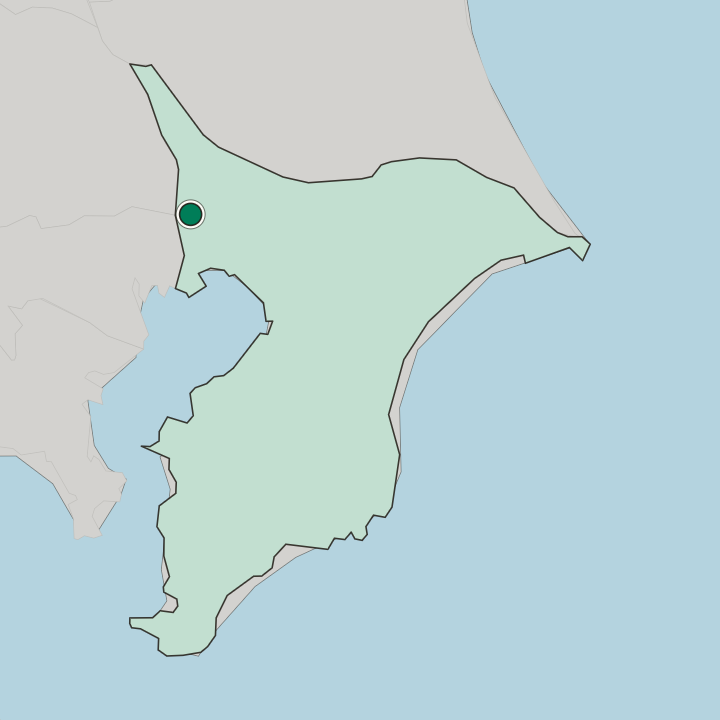
Sixty square kilometres carry the whole of Matsudo, a small footprint for a city of Chiba Prefecture built as closely as this one, with housing rather than farmland running to the boundary on every side. Ichikawa is close by. The Sakagawa runs through the record of the place, commemorated by a stone of its own, and Tokiwadaira and the other outer districts fill the ground between the centre and the city limits. Tokyo begins a short way beyond the edge.
What is the climate of Matsudo?
The temperate year of the northern hemisphere applies. Cold arrives at the turn of the year, heat in the middle of it, and between those two poles Matsudo offers the ordinary comfort of a city where almost every listed sight has a roof over it. Museums do not mind rain.
A wet afternoon at the Matsudo Museum or the Tojō Museum of History costs a visitor nothing at all.
How do you get to Matsudo?
Matsudo stands east of Tokyo. Rail is how nearly everyone comes and goes, and among the buildings the city lists is a railway model hall, the Shin-Keisei Railway Model Hall, which says something about how central the trains are to a place of this kind. Walking covers the centre.
The Municipal Museum of Archaeology in Ichikawa and the Katsushika Shibamata Tora-san Museum both sit outside the city limits, so each is a short ride rather than a stroll.
Common questions
What is the best area to stay in Matsudo?
The old Matsudo-juku ground: Short stays walking to the Matsudo Museum. Tokiwadaira: Quiet outer rooms with a short ride into central Matsudo.
Good for
More cities in Chiba-ken
Updated October 2026