
Turkey
Malatya, Turkey — Towns & Travel Guide
Malatya is a province of eastern Turkey, the apricot capital where the Arslantepe mound records one of the world's earliest states.
Hotel links are affiliate links: booking through them may earn us a commission, at no extra cost to you. It never affects how places are ranked. How this works


Towns & cities in Malatya
One town here has its own guide — it links to where to stay.

 Turkey
Malatya
Malatya is a city of eastern Turkey on the upper Euphrates, the apricot capital of the world, set near the ancient mound of Arslantepe.Where to stay →
Hotel links are affiliate links: booking through them may earn us a commission, at no extra cost to you. It never affects how places are ranked. How this works
About Malatya
Apricots made the name.
What is Malatya known for?
Malatya grows the lion's share of Turkey's dried apricots, and the sweet Hacıhaliloğlu variety from these orchards travels the world. The province also holds Arslantepe, a tell on the Malatya plain that UNESCO added to its World Heritage list for tracing the birth of the state. North of the modern city stands Battalgazi, the walled old town whose Seljuk-era Great Mosque fell in the 2023 earthquake.
The Euphrates runs along the eastern edge, pooled behind the Karakaya Dam.
Where is Malatya?
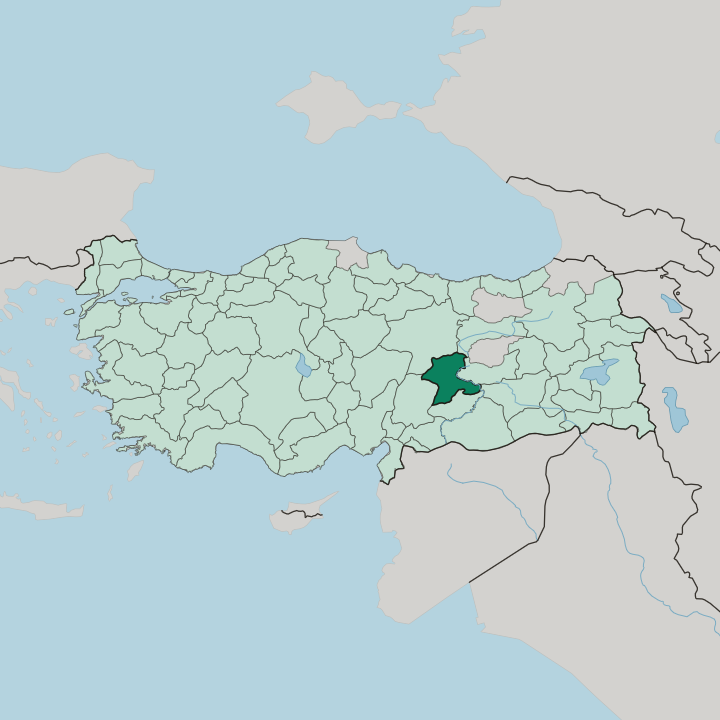
Malatya lies in eastern Turkey, in the western reach of the Eastern Anatolia Region. The province floor is a broad plain near 950 metres, opened where several valleys run together. Beyond the apricots, grain and sugar beet share the fields.
Ridges of the Anti-Taurus, the northeastern arm of the Taurus Mountains, close it in on almost every side, so the land climbs from orchard flats to bare crests within a short drive. Rivers cut down off those slopes. The plain itself stays dry, yet snowmelt and springs feed the apricot orchards that carpet the flat ground below the city.
Water defines the eastern edge. The Euphrates runs down that side of the province, its flow held in a long reservoir behind the Karakaya Dam, and across the water sits Elazığ. The Tohma valley threads in from the northwest to join that river.
Adıyaman lies over the mountains to the south, while Sivas adjoins the plateau to the west. Arslantepe's tell rises from the plain as well, a reminder of how long people have farmed here. The land is worked ground first, mountains second.
What is Malatya like?
Apricots set the rhythm of the year here. Come high summer, the fruit is picked, split, and laid on reed mats and rooftops to dry across the plain, and the sulphured golden halves are Malatya's signature export. A festival marks the harvest.
Kitchens fold the fruit into pilaf and stuff it with clotted cream, roadside stalls sell it dried by the sack, and even the bitter kernels get pressed for oil. The orchards flavour ordinary life. The table leans on grilled meat and wheat.
Malatya claims its own kebab, and dried pulses, bulgur, and the parcel-wrapped kağıt kebabı fill out the local repertoire. Deep layers of people sit under the modern province. Hittites called the mound Milid, Rome garrisoned it, and Armenian, Kurdish, and Turkish communities shaped the towns that came after, so the everyday culture carries more than one inheritance.
Turkish is the common tongue. The province sent İsmet İnönü to parliament, and the university on the edge of the hub city carries his name and fills it with students.
What is the history of Malatya?
Malatya's story starts on the mound. Hittites held a town called Milid here, and Rome later built the fortress city of Melitene around a stationed legion. The walled settlement that became Battalgazi carried the site through Byzantine, Seljuk, and Ottoman rule, and its Great Mosque went up under a Seljuk sultan in 1224.
In 2023 an earthquake brought it down. The present city is younger. Townspeople shifted south to the gardens of Aspuzu in 1838 and built Malatya afresh on the open plain.
What is the climate of Malatya?
The mountains dictate the weather. Ringed by the Anti-Taurus arm of the Taurus Mountains and cut off from the sea, the Malatya plain keeps a cold semi-arid pattern, with hot, dry summers and cold winters that dust the plain with snow and bury the ridges. Most rain comes in winter and spring.
A late frost is the orchardist's dread, since a cold snap over the blossom can thin the apricot harvest before it sets. Summer bakes the plain dry.
How do you get to Malatya?
For most travellers, Malatya begins at the airport. Malatya Erhaç Airport lies out on the plain west of the city, linked to the centre by shuttle and taxi, and it carries the main domestic connections to Ankara and the coast. Trains matter here too.
The city sits on the long eastern line, where the Ankara sleepers to Lake Van and beyond stop on their way through, alongside links to Elazığ, Sivas, and Diyarbakır. Intercity coaches cover the rest.
Common questions
What is the best area to stay in Malatya?
Malatya: the province's working base. Battalgazi: Seljuk walls and the old capital. The Malatya plain and Arslantepe: the UNESCO mound and orchard country.
Good for
More regions in Turkey
Updated October 2026