United States
Delaware, United States — Towns & Travel Guide
Delaware is the second-smallest state in the United States, the first to ratify the Constitution, on the Delmarva Peninsula's Atlantic edge.
Hotel links are affiliate links: booking through them may earn us a commission, at no extra cost to you. It never affects how places are ranked. How this works


Towns & cities in Delaware
One town here has its own guide — it links to where to stay.
 United States
Wilmington
Brick rowhouses climb the slopes of Wilmington, the largest city in Delaware, United States, known for the Delaware Art Museum and its DuPont legacy.Where to stay →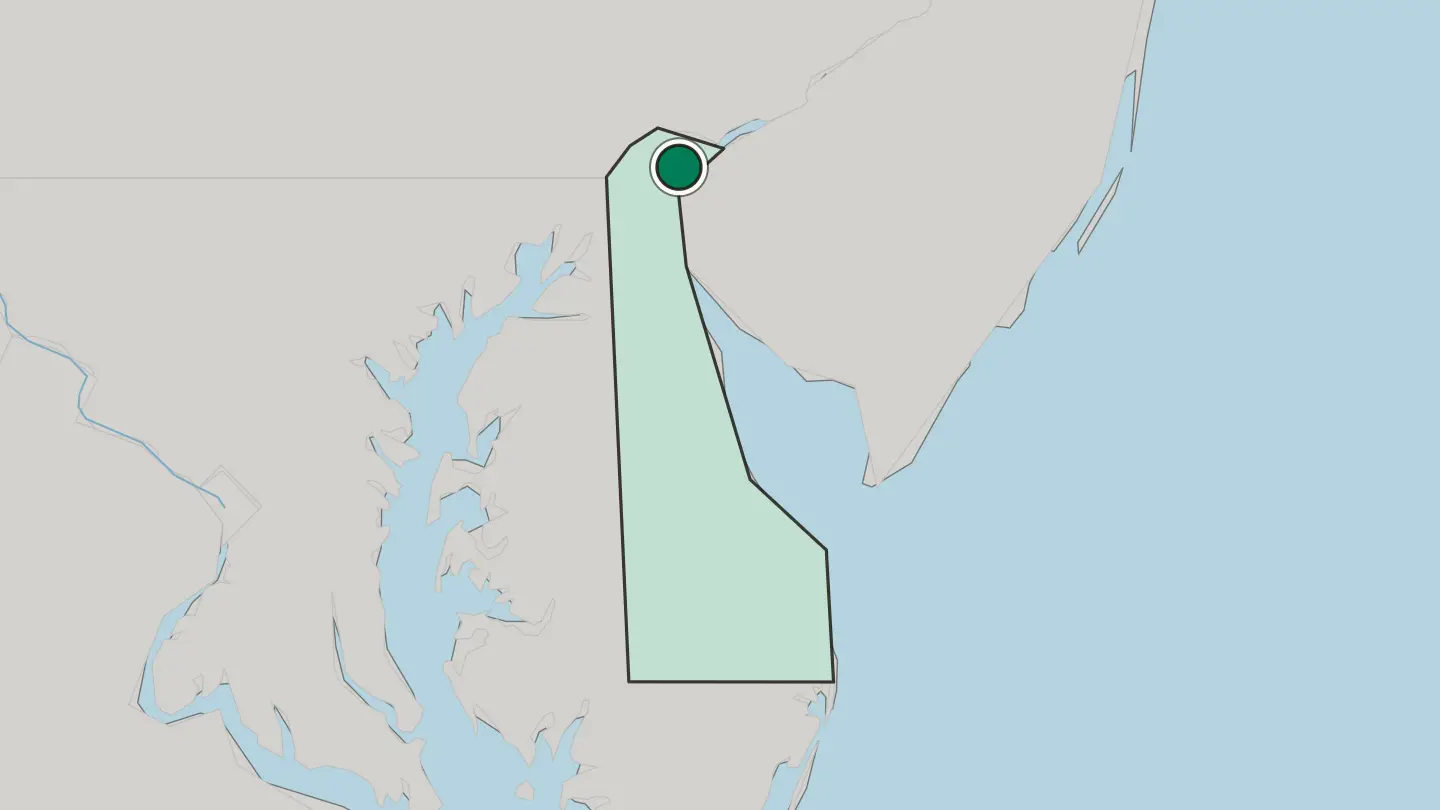
Hotel links are affiliate links: booking through them may earn us a commission, at no extra cost to you. It never affects how places are ranked. How this works
About Delaware
What is Delaware known for?
Delaware wears its nickname plainly: the First State, first of the thirteen to ratify the United States Constitution in 1787. That vote still defines it. Beyond the history, most visitors come for the Atlantic beaches at Rehoboth Beach and the quieter bay town of Lewes, or for Wilmington, the old chemical-industry city where the DuPont company milled gunpowder on Brandywine Creek.
The state charges no sales tax, which pulls shoppers across its borders.
Where is Delaware?
Delaware occupies the northeastern corner of the Delmarva Peninsula, on the mid-Atlantic coast of the United States. It is the second-smallest state, and it splits into just three counties: New Castle in the north, Kent in the middle, and Sussex in the south. Maryland wraps around its western and southern sides. Pennsylvania closes off the north, while the Delaware River and Delaware Bay separate it from New Jersey to the northeast. The open Atlantic Ocean forms the eastern shore.
Water does most of the bordering here. The land itself stays low and flat for nearly its entire length. Almost all of Delaware lies on the Atlantic coastal plain, a broad sweep of sand, marsh, and farmland that barely rises above the tide.
Only the far north tilts upward into the rolling Piedmont near Wilmington, at the confluence of the Christina River and Brandywine Creek. The highest ground in the whole state, a spot called Ebright Azimuth, reaches under 450 feet. One border quirk stands out.
The line with Pennsylvania is drawn as the Twelve-Mile Circle, a true arc swung from the cupola of an old courthouse, and the only circular state boundary in the country. To the west, past the fields, the Nanticoke River drains toward Chesapeake Bay.
What is Delaware like?
The DuPont company built a chemical empire on Brandywine Creek, and the founding family's old estates ring Wilmington with gardens and museums. Powder mills, mansions, and libraries sit along the water. That legacy makes the north feel formal and green, a country of manicured grounds and old money.
Culture here leans quiet. The south tells a looser story. Summer belongs to the beaches, where Rehoboth Beach fills its boardwalk and Dogfish Head first poured beer as a small brewpub.
Inland, Sussex County runs on poultry and soybeans, its barns feeding processors up and down the peninsula. Newark keeps a college-town beat around the University of Delaware and its Blue Hens. English is the everyday language, spoken with the flat vowels of the mid-Atlantic.
Add the stock-car roar at Dover and the tax-free stores along the highways, and the picture rounds out. Both halves share one point of pride, the First State that ratified the Constitution before anyone else. It is a small state that contains a lot.
What is the history of Delaware?
Long before Europe arrived, the Lenape lived along the Delaware River and its creeks. New Sweden changed that. Swedish and Finnish settlers built Fort Christina at what became Wilmington in 1638, the first lasting European foothold on the river, before the Dutch and then the English took the colony in turn.
For a century the land sat as the "Three Lower Counties" tied to Pennsylvania. Independence set it apart. On the seventh of December in 1787, Delaware ratified the United States Constitution ahead of every other state, and the First State had its name.
What is the climate of Delaware?
Delaware sits in a weather borderland, humid and subtropical toward the south, cooler and more continental in the north. The Atlantic Ocean and Delaware Bay soften the edges. Summers turn hot and sticky, broken by hard afternoon thunderstorms that build over the coastal plain.
Winters split the state in two: cold enough for real snow around Wilmington, milder and greener down at Lewes near the bay. Rain falls through every season. Nor'easters and the odd Atlantic hurricane still test the shore.
How do you get to Delaware?
Delaware has no major airport of its own, so most travellers fly into Philadelphia and drive or train south. It is close. Amtrak's Northeast Corridor threads through the northern state, stopping at Wilmington and Newark on the fast run between Washington and New York.
Interstate 95 carries the traffic down the same northern strip. Reaching the beaches means leaving the rail behind for a car or a DART bus toward Rehoboth Beach and Lewes. From New Jersey, the Cape May-Lewes Ferry crosses the mouth of Delaware Bay straight to the sand.
Common questions
What is the best area to stay in Delaware?
Wilmington: the corporate and garden north. Dover: the central capital and speedway. Rehoboth Beach: boardwalk beach days. Lewes: quiet bayside and cape. Bethany Beach: family Quiet Resorts sand.
Good for
More regions in United States
Updated October 2026