United States · North Carolina
Where to Stay in Huntersville, North Carolina
Huntersville is a Mecklenburg County town north of Charlotte, where old farmsteads and Presbyterian churchyards sit inside the metropolitan spread.
Hotel links are affiliate links: booking through them may earn us a commission, at no extra cost to you. It never affects how places are ranked. How this works


Where to stay in Huntersville
Where the beds are, and what that means for the visit.
Huntersville is somewhere to sleep, not somewhere to see. A room here answers the Charlotte metropolitan area rather than the town itself, and travellers who choose it are usually trading a downtown address for something quieter fourteen miles up the road. That trade suits you if the trip runs on a car and the days end at a golf course or a speedway rather than a city block.
Everything here assumes driving. Hopewell Presbyterian Church and Cemetery and the Ramah Presbyterian Church and Cemetery mark the older settlement pattern that the subdivisions grew around. NorthStone Country Club anchors one end of the town's leisure ground, and Metrolina Speedway the other, which is a fair summary of what a night in Huntersville is for.
The town covers a wide spread of ground. Old ground survives between them. Holly Bend, the Beaver Dam Plantation House, and the Albert McCoy Farm sit among the landmarks that a visitor with a morning free can work into a loop before turning back toward Charlotte.
Charlotte remains the fallback for anyone wanting a city evening, since the drive south covers only fourteen miles and returns the same night without difficulty.
Find hotels in Huntersville
Direct booking searches for these neighbourhoods.
Near NorthStone Country Club
NorthStone Country Club sets the tone at this end of Huntersville, and the drive south to Charlotte stays short.Find hotels in Near NorthStone Country ClubRace nights and trips that run entirely on a carThe Metrolina Speedway side
Metrolina Speedway draws the town's event traffic, and rooms on this side are built around parking rather than pavements.Find hotels in The Metrolina Speedway sideCity evenings that a Mecklenburg County suburb cannot supplyCharlotte instead
Charlotte lies fourteen miles south, close enough to sleep there and still reach Holly Bend in the morning.Find hotels in Charlotte insteadHotel links are affiliate links: booking through them may earn us a commission, at no extra cost to you. It never affects how places are ranked. How this works
Things to do in Huntersville
Ranked by global recognition; descriptions from Wikidata (CC0).
Churches & Religious Sites
3- Hopewell Presbyterian Church and Cemetery Heritage
- Ramah Presbyterian Church and Cemetery Heritage
- St. Mark's Episcopal Church Heritage
Stadiums & Sports
3- Metrolina Speedway
- NorthStone Country Club
- T. Henry Wilson, Jr. Field
Landmarks & Notable Places
8- Beaver Dam Plantation House Heritage
- Holly Bend Heritage
- Albert McCoy Farm Heritage
- Chairman Blake House Heritage
- Dr. Walter Pharr Craven House Heritage
Show 3 more →
- Benjamin W. Davidson House Heritage
- Thomas and Latitia Gluyas House Heritage
- John F. Ewart Farm Heritage
worth knowingacross 3 categories in Huntersville
About Huntersville
Charlotte set the pace here.
What is Huntersville known for?
Huntersville spent most of its life as a small crossroads town, and the metropolitan spread coming up from Charlotte turned it into one of the larger municipalities of North Carolina without erasing the farm names on its landmark list. Racing left a mark too. Metrolina Speedway carries the motorsport side, while NorthStone Country Club and the Hopewell Presbyterian Church and Cemetery show how differently the town's ground has been used.
What are the main landmarks in Huntersville?
Farmhouses and churchyards make up most of the list. Holly Bend, the Beaver Dam Plantation House, the Chairman Blake House, the Thomas and Latitia Gluyas House, and the Albert McCoy Farm survive from the rural Mecklenburg County that preceded the suburbs. Two Presbyterian congregations hold ground.
Hopewell Presbyterian Church and Cemetery and Ramah Presbyterian Church and Cemetery keep their burial grounds, and Huntersville Colored High School stands among the landmarks as a record of the era of segregated schooling. Metrolina Speedway is the outlier.
What is the history of Huntersville?
Huntersville began small. The record kept by its landmarks is agricultural before it is anything else, with the Beaver Dam Plantation House, the Albert McCoy Farm, and Holly Bend all pointing back to a countryside of farms rather than a town of streets. Congregations came with the farms.
Hopewell Presbyterian Church and Cemetery and Ramah Presbyterian Church and Cemetery anchored the settlement pattern of this part of Mecklenburg County, and both remain on the landmark list alongside the farms. Huntersville Colored High School belongs to the same century of small-town life, its name a plain record of how schooling was divided. Growth came up from Charlotte.
Suburban expansion in the Charlotte metropolitan area reached fourteen miles north and made Huntersville one of the larger municipalities in North Carolina, working out its own sphere of influence at the top of Mecklenburg County. Metrolina Speedway and NorthStone Country Club belong to that later town rather than the older one, the leisure ground of a place whose farms became its landmarks. Both sit inside the same town limits.
Huntersville keeps the two records at once, the church cemeteries and the plantation house on one side, the speedway and the country club on the other.
Where is Huntersville?
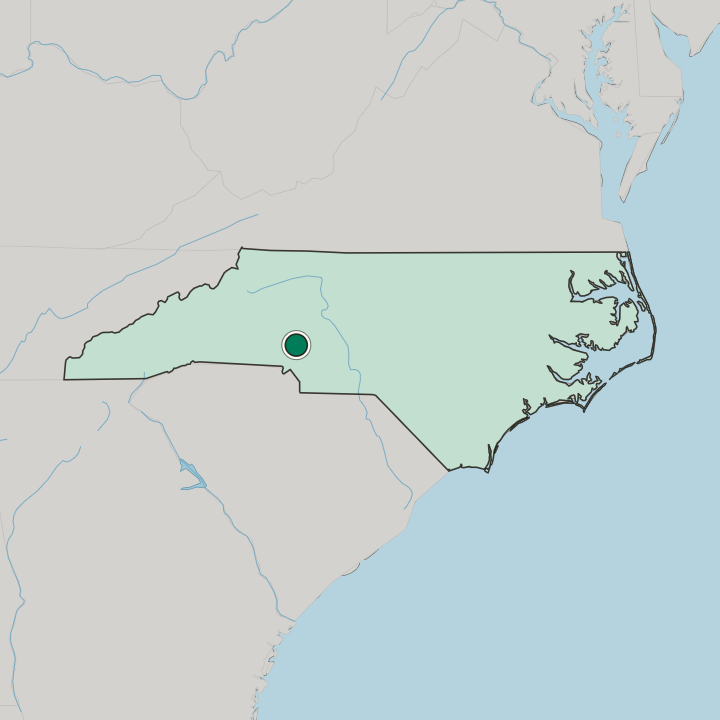
Huntersville lies fourteen miles north of Charlotte. The town occupies the upper part of Mecklenburg County, and its limits cover a wide spread of ground that the Charlotte metropolitan area has filled in from the south. Little separates the two.
Huntersville reads as the northern edge of the built-up area rather than a town with open country between itself and the city.
What is the climate of Huntersville?
Seasons here run the full swing. Huntersville shares the weather of Charlotte, an inland town in the temperate band where summer heat builds without a coast to break it and winter arrives without a mountain wall to hold it. Outdoor months run long, which is why the golf ground at NorthStone Country Club and the open ground at Metrolina Speedway both suit the warm half of the year.
How do you get to Huntersville?
Charlotte is the arrival point. Huntersville sits fourteen miles north of the city inside the same metropolitan area, so nearly every visitor reaches it by road after arriving in Charlotte rather than by any route of its own. Mecklenburg County traffic runs north and south through the town, which puts the rest of the metropolitan area within an easy drive of Huntersville.
Getting anywhere from Huntersville takes little time.
Common questions
What is the best area to stay in Huntersville?
Near NorthStone Country Club: Golf days and quiet nights outside Charlotte. The Metrolina Speedway side: Race nights and trips that run entirely on a car. Charlotte instead: City evenings that a Mecklenburg County suburb cannot supply.
Good for
More cities in North Carolina
Updated September 2026