China · Guangdong
Where to Stay in Qingyuan, Guangdong
Qingyuan is a prefecture-level city on the Bei River in Guangdong, China, the province's largest division by land area.
Hotel links are affiliate links: booking through them may earn us a commission, at no extra cost to you. It never affects how places are ranked. How this works


Where to stay in Qingyuan
The practical side of choosing where to sleep.
Beds sit in the urban core. Qingcheng and Qingxin form the only continuously built-up part of Qingyuan, and a room almost anywhere else in the prefecture means mountain roads and long drives before the day can start. The administrative side and the Bei River frontage both fall in Qingcheng, so most arrivals end up on that half.
Qingxin adjoins it. The split matters less than the distance to everything outside the two districts, which is considerable given how much land the prefecture covers. Highway 107 is the practical hinge.
Rooms near that road put Guangzhou, Foshan and the Pearl River Delta within a direct run south, which is the reason many visitors are in Qingyuan at all. Sightseeing pulls the other way: the Huiguang Pagoda and the Qingtang Site are the two named sights, and a bed chosen for them trades some of that road access for a shorter local trip. Shaoguan lies east and northeast of the prefecture, Zhaoqing south and southwest. Nothing further out matches the two districts for beds, so travellers heading toward Hunan or the Guangxi Zhuang Autonomous Region on the northern borders generally sleep in Qingcheng and drive out early.
Find hotels in Qingyuan
Direct booking searches for these neighbourhoods.
Qingcheng
The half of the urban core that carries the prefecture's administration, closest to the Bei River and to the Huiguang PagodaFind hotels in QingchengLonger stays willing to hop into Qingcheng for meals and errandsQingxin
The second urbanized district of Qingyuan, adjoining Qingcheng inside the same continuous stretch of buildingFind hotels in QingxinDrivers running between Guangzhou, Foshan and the mountain country toward HunanThe Highway 107 approach
The edge of the built-up districts nearest Highway 107, the direct link down to the Pearl River Delta. Lodging is scarce in this area; reserve in advance.Find hotels in The Highway 107 approachHotel links are affiliate links: booking through them may earn us a commission, at no extra cost to you. It never affects how places are ranked. How this works
About Qingyuan
What is Qingyuan known for?
Qingyuan spreads over more ground than any other prefecture-level division in Guangdong, and its built-up core sits on the Bei River with mountain country closing in beyond the Qingcheng and Qingxin districts. Cantonese is the everyday speech. Highway 107 runs the city straight down to Guangzhou and the Pearl River Delta.
Heritage here is named rather than numerous: the Huiguang Pagoda and the Qingtang Site.
What are the main landmarks in Qingyuan?
Two names carry the sightseeing. Huiguang Pagoda is the one most often given for Qingyuan, and it stands as the city's own entry rather than something borrowed from Guangzhou or Foshan down the river. The Qingtang Site is the other, archaeological rather than architectural.
Beyond the pair, what the prefecture offers is mountain country rather than monuments, spread across the largest land area of any prefecture-level division in Guangdong.
What is the history of Qingyuan?
The older spelling was Tsingyun. That name reached English first, and the modern Qingyuan replaced it as a change of romanization rather than of the place, which has sat on the Bei River through both. The Qingtang Site holds the older layer.
That archaeological place is one of two heritage entries recorded for the city, and it puts settlement along this stretch of the river well before the administrative boundaries that frame the prefecture. Huiguang Pagoda is the other entry. Speech records the pull south.
Cantonese is the primary spoken language of Qingyuan, as it is in Guangzhou and Foshan, and that shared tongue points to a long association with the Pearl River Delta rather than with Hunan or the Guangxi Zhuang Autonomous Region across the northern borders. The modern shape is administrative. Qingyuan is organised as a prefecture-level city whose urbanized part is Qingcheng and Qingxin, with a rural remainder attached that makes it the largest such division in Guangdong by land area.
Shaoguan, Zhaoqing, Guangzhou and Foshan hold the other sides of that boundary, and Highway 107 has kept the southern one open.
Where is Qingyuan?
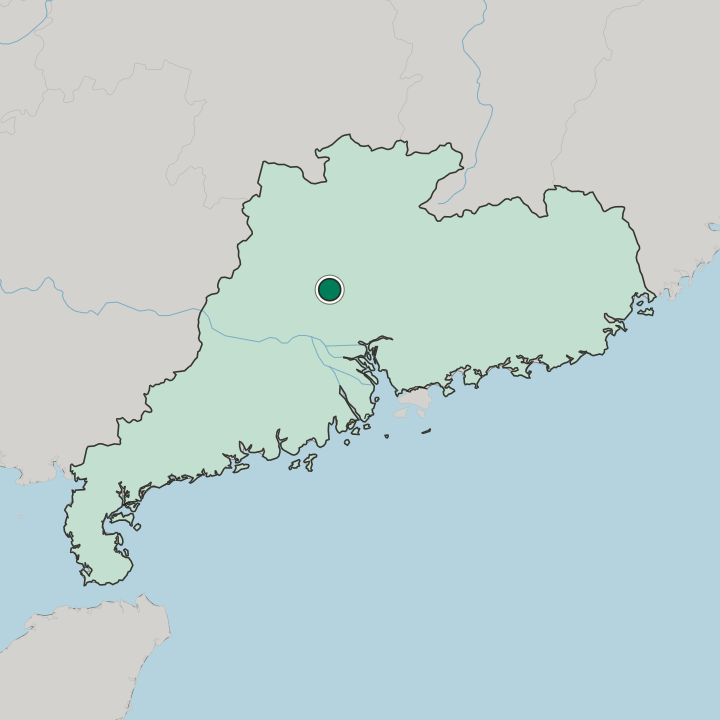
Mountains ring the built-up part. Qingyuan covers more ground than any other prefecture-level division in Guangdong, reaching from the Bei River up to the borders it shares with Hunan and the Guangxi Zhuang Autonomous Region. Guangzhou and Foshan lie south, Shaoguan east and northeast, Zhaoqing south and southwest.
Water and hills split it into a low, connected southern end and high country the other way.
What is the climate of Qingyuan?
The year here is subtropical. Qingyuan sits in the northern hemisphere away from the coast, sharing its warm band with Guangzhou, Foshan and the rest of the Pearl River Delta down Highway 107. Mountains break it up locally.
Height changes more than the calendar does, since Qingcheng and Qingxin sit low beside the Bei River while the prefecture climbs toward Hunan and the Guangxi Zhuang Autonomous Region.
How do you get to Qingyuan?
Highway 107 does the work. The road runs Qingyuan's urban core straight down to Guangzhou and the Pearl River Delta, which is the connection that matters for anyone arriving from the south rather than over the mountains. Shaoguan borders it east and northeast, Zhaoqing south and southwest, so an overland approach crosses one of those neighbours.
Foshan sits south as well. Beyond the northern rim lie Hunan and the Guangxi Zhuang Autonomous Region.
Common questions
What is the best area to stay in Qingyuan?
Qingcheng: Arrivals wanting the Bei River frontage and Qingyuan's administrative offices on one side of the river. Qingxin: Longer stays willing to hop into Qingcheng for meals and errands. The Highway 107 approach: Drivers running between Guangzhou, Foshan and the mountain country toward Hunan.
Good for
More cities in Guangdong
Updated September 2026