Spain · Comunitat Valenciana
Where to Stay in Orihuela, Comunitat Valenciana
A walled Valencian Community city under the Castle of Orihuela, with the Colegio de Santo Domingo and a long line of monasteries below it.
Hotel links are affiliate links: booking through them may earn us a commission, at no extra cost to you. It never affects how places are ranked. How this works



Where to stay in Orihuela
The practical side of choosing where to sleep.
The old city sits inside the walls. A room among the streets that Orihuela Walls once closed puts the Colegio de Santo Domingo, the Church of the Santas Justa y Rufina and the Museo Diocesano de Arte Sacro within a few minutes of the door. Everything there is walkable.
Visitors here for the monastic buildings should stay in this quarter, since the Monasterio de la Santísima Trinidad and the Convent and church of Saint Ann in Orihuela stand on the same ground. Above it the castle ground rises. Castle of Orihuela looks down on the roofs, and beds on that side trade convenience for the climb and the view back over the walled quarter.
The slope is steep. Drivers handle the gradient better than walkers, and the Museo Arqueológico Comarcal de Orihuela sits back down among the streets. The municipality reaches a long way out.
Its 365 square kilometres take in country well beyond the walled city, and rooms out there suit drivers who want space, parking and a quiet road at the end of the day rather than the monastic streets. Distances grow quickly. The Casa-Museo de Miguel Hernández and the Museo Didáctico e Interactivo de Ciencias de Orihuela stay behind in the centre, which is the argument against going too far.
Find hotels in Orihuela
Direct booking searches for these neighbourhoods.
Inside the Orihuela Walls
The Church of the Santas Justa y Rufina and the Museo Diocesano de Arte Sacro stand within the old walled quarterFind hotels in Inside the Orihuela WallsViews back over the walled quarter from under the Castle of OrihuelaThe castle slope
The climb to the Castle of Orihuela starts at the door, with the Museo de la Muralla (Orihuela) below it. Few places to stay nearby — book ahead.Find hotels in The castle slopeDrivers wanting space in the 365 square kilometres beyond the wallsThe outer municipality
Country beyond the walled city leaves the Casa-Museo de Miguel Hernández a drive awayFind hotels in The outer municipalityHotel links are affiliate links: booking through them may earn us a commission, at no extra cost to you. It never affects how places are ranked. How this works
Things to do in Orihuela
Ranked by global recognition; descriptions from Wikidata (CC0).
Museums & Galleries
3- Museo de la Semana Santa Heritage
- Museo de la Muralla (Orihuela)
- Museo Didáctico e Interactivo de Ciencias de Orihuela
Churches & Religious Sites
7- Church of the Santas Justa y Rufina, Orihuela Heritage
- Church of Saint James the Great Heritage
- Real Monasterio de la Visitación de Santa María Heritage
- Monastery of San Sebastián, Orihuela Heritage
- Iglesia de San Agustín de Orihuela Heritage
Show 2 more →
- Convent and church of Saint Ann in Orihuela Heritage
- Monasterio de la Santísima Trinidad Heritage
Castles & Historic Sites
3- Colegio de Santo Domingo Heritage
- Castle of Orihuela Heritage
- Orihuela Walls Heritage
worth knowingacross 3 categories in Orihuela
About Orihuela
Walls and a castle define the frame.
What is Orihuela known for?
Orihuela Walls and the Castle of Orihuela carry the defensive record, the Museo de la Muralla (Orihuela) sets out that line, and the Colegio de Santo Domingo heads a religious list running to well over a dozen entries. Museums are unusually many. Museo Diocesano de Arte Sacro, Museo de la Semana Santa, Museo de las Fiestas de la Reconquista and the Casa-Museo de Miguel Hernández cover sacred art, holy week, the Reconquista festivities and one local name.
What are the main landmarks in Orihuela?
Religion dominates the register. Colegio de Santo Domingo, the Real Monasterio de la Visitación de Santa María, the Monasterio de la Santísima Trinidad, the Monastery of San Sebastián and the Iglesia de San Agustín de Orihuela stand alongside the Church of Saint James the Great and the Church of the Santas Justa y Rufina. Defence supplies the rest.
Castle of Orihuela and Orihuela Walls hold that end, with the Museo de la Muralla (Orihuela) attached to the line itself.
What is the history of Orihuela?
No founding year is attached to the city. What the record holds instead is a defensive line: Orihuela Walls and the Castle of Orihuela, the pair that fixed the shape of the place. Stone outlasts paper here.
Museo de la Muralla (Orihuela) and the Museo Arqueológico Comarcal de Orihuela hold what survives of the earliest periods. Religious houses followed. Colegio de Santo Domingo heads them, and the Real Monasterio de la Visitación de Santa María, the Monasterio de la Santísima Trinidad, the Monastery of San Sebastián and the Convent and church of Saint Ann in Orihuela filled the same walled quarter over a long stretch of centuries.
Parishes came with them. The Church of Saint James the Great, the Church of the Santas Justa y Rufina and the Iglesia de San Agustín de Orihuela are the ones still standing on the list. The city keeps its own commemorations.
Museo de la Semana Santa and the Museo de las Fiestas de la Reconquista record two annual observances, while the Museo Diocesano de Arte Sacro holds the church treasure that the monastic centuries left. One house is kept for a name. Casa-Museo de Miguel Hernández belongs to that later record, and the Museo Didáctico e Interactivo de Ciencias de Orihuela is the newest entry of all.
Where is Orihuela?
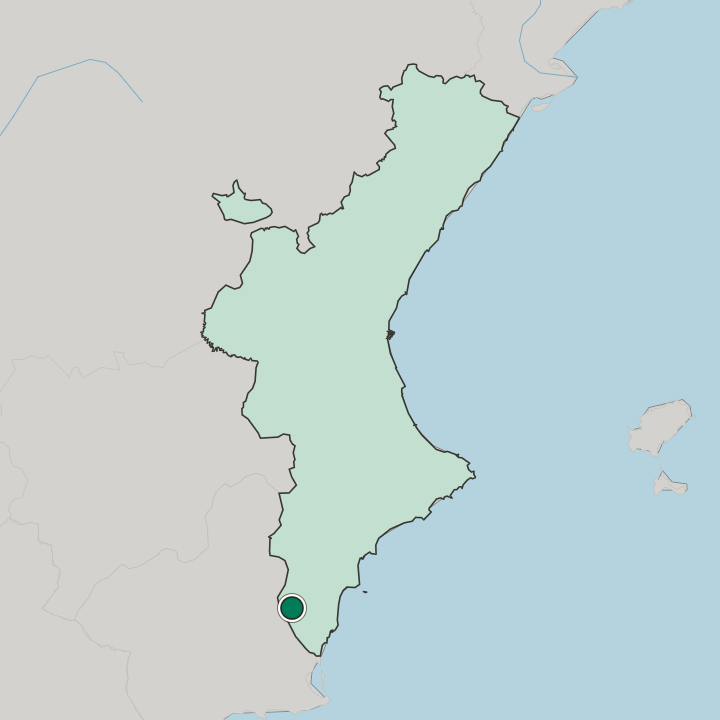
The municipality is very large. Orihuela covers about 365 square kilometres of the Valencian Community, so most of that territory lies outside the walled city entirely, in country that the Castle of Orihuela once watched over. Its old quarter is another matter, small and dense.
Orihuela Walls enclose a quarter small enough to cross on foot, with the Colegio de Santo Domingo and the Church of the Santas Justa y Rufina inside it and the castle ground rising directly above.
What is the climate of Orihuela?
The castle hill takes the weather first. Orihuela sits in the temperate band, and the wide country of the municipality warms through the middle of the year while the walled streets below the Castle of Orihuela hold their shade longer than the open ground does. Stone helps.
Thick walls of the kind the Colegio de Santo Domingo and the Monasterio de la Santísima Trinidad were built with keep interiors cooler than the streets outside.
How do you get to Orihuela?
The walled quarter is the destination. Once inside it, the Colegio de Santo Domingo, the Museo Diocesano de Arte Sacro and the Church of Saint James the Great are close enough together that walking is the only sensible way to move. The castle is a climb.
Everything beyond the walls, out in the 365 square kilometres the municipality carries, belongs to a car rather than to a morning on foot.
Common questions
What is the best area to stay in Orihuela?
Inside the Orihuela Walls: Monastery-and-museum days beside the Colegio de Santo Domingo. The castle slope: Views back over the walled quarter from under the Castle of Orihuela. The outer municipality: Drivers wanting space in the 365 square kilometres beyond the walls.
Good for
More cities in Comunitat Valenciana
Updated October 2026