Spain · Comunitat Valenciana
Where to Stay in Paterna, Comunitat Valenciana
Paterna stands beside Valencia in the Comunitat Valenciana, a ceramics town of cave dwellings marked by the Tower of Paterna.
Hotel links are affiliate links: booking through them may earn us a commission, at no extra cost to you. It never affects how places are ranked. How this works


Where to stay in Paterna
The practical side of choosing where to sleep.
The Tower of Paterna fixes the old centre. A room within sight of it puts the Museu de Ceràmica de Paterna, the Church of Puríssima Concepció and the cave dwellings cut into the banks below the town inside a few minutes on foot, which is the whole case for staying in Paterna itself rather than in the city next door. Rooms in Paterna are few.
The town carries commuters rather than travellers, and its accommodation follows that pattern, so the choice on offer is narrower than the size of the municipality suggests. Quart de Poblet is the first alternative. The Santuari de Sant Onofre de Quart de Poblet gives that neighbour a fixed point of its own, and a bed there keeps the same short run into Valencia while swapping the tower's immediate streets for a quieter address.
Manises answers a different interest. The Museo de Cerámica de Manises makes it the obvious base for anyone whose subject is the glazed ware rather than the caves, and Burjassot and Mislata complete the ring with the Church of San Juan de Ribera in Burjassot and the Church of Our Lady of Angels, Mislata. Distances stay small throughout.
The Valencia Bioparc and the Museum of Natural History of the University of Valencia both lie over the boundary in Valencia, close enough that none of these choices cuts a visitor off from them, so the decision comes down to street noise and a parking space rather than to being stranded.
Find hotels in Paterna
Direct booking searches for these neighbourhoods.
Around the Tower of Paterna
The tower and the Church of Puríssima Concepció anchor the oldest streets, and the banks holding the cave dwellings begin a few minutes below them. Rooms are few around here — worth securing early.Find hotels in Around the Tower of PaternaQuieter nights within the same short run into ValenciaQuart de Poblet
The Santuari de Sant Onofre de Quart de Poblet gives this neighbour its own fixed point, and beds there sit off Paterna's tower streets.Find hotels in Quart de PobletAnyone whose subject is the glazed ware rather than the cavesManises
The Museo de Cerámica de Manises sets the theme of this municipality, with Burjassot and Mislata and their parish churches closing the ring around it.Find hotels in ManisesHotel links are affiliate links: booking through them may earn us a commission, at no extra cost to you. It never affects how places are ranked. How this works
Things to do in Paterna
Ranked by global recognition; descriptions from Wikidata (CC0).
Museums & Galleries
1- Museu de Ceràmica de Paterna
Churches & Religious Sites
8- Santuari de Sant Onofre de Quart de Poblet Heritage
- Church of Saint Michael Heritage
- iglesia de San Pedro Heritage
- Church of San Juan de Ribera in Burjassot Heritage
- Church of Sacred Heart, Burjassot Heritage
Show 3 more →
- Church of Puríssima Concepció Heritage
- Church of the Holy Heart Heritage
- Church of Our Lady of Angels, Mislata Heritage
Castles & Historic Sites
2- Tower of Paterna Heritage
- Armenian Genocide memorial, Mislata
Landmarks & Notable Places
1- Torre de la Casa Palacio de los Boíl Heritage
worth knowingacross 4 categories in Paterna
About Paterna
Paterna is known for its caves.
What is Paterna known for?
The cave dwellings cut into the banks below the town are what the name is attached to outside the province of Valencia, together with its role as a bedroom community of Valencia. Ceramics run a close second. The Museu de Ceràmica de Paterna keeps the record of a glazing trade that the Museo de Cerámica de Manises carries on across the municipal line, while the Moors and Christians celebration ends in the Cordà.
What are the main landmarks in Paterna?
The Tower of Paterna stands over everything else. Torre de la Casa Palacio de los Boíl gives the municipality a second tower, the Church of Puríssima Concepció and the Church of Saint Michael carry the parish weight, and the Museu de Ceràmica de Paterna keeps the glazed ware indoors. A memorial sits apart from these.
The Paterna Memorial holds that ground, while the Valencia Bioparc, the Museum of Natural History of the University of Valencia and the Museo de Cerámica de Manises all lie just beyond the municipal boundary.
What is the history of Paterna?
Ask when Paterna was founded and the record answers with silence. The evidence of its age is architectural instead: the Tower of Paterna is the oldest thing anyone points to, and the cave dwellings cut into the banks below the town represent a way of living on this ground that owes nothing to a charter. Defence came later.
Torre de la Casa Palacio de los Boíl repeats the tower form in a second building, and the Church of Puríssima Concepció and the Church of Saint Michael mark the parish structure that followed it. Clay gave the district its trade. The Museu de Ceràmica de Paterna and the Museo de Cerámica de Manises together hold the record of a glazing industry that worked across this group of municipalities and carried both names well beyond the province of Valencia.
Devotion built outward as well. The Santuari de Sant Onofre de Quart de Poblet, the Church of San Juan de Ribera in Burjassot and the Church of Our Lady of Angels, Mislata show the same programme continuing in each neighbouring municipality. Memory has its own site.
The Paterna Memorial belongs to a register apart from the churches and the towers, and the Moors and Christians celebration, whose closing Cordà is the event the local calendar turns on, keeps an older observance in active use.
Where is Paterna?
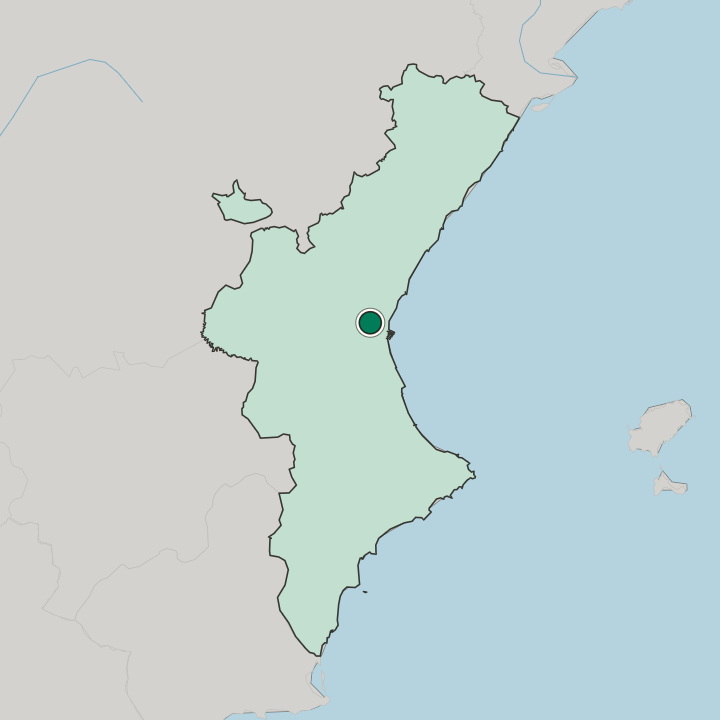
Paterna covers about 44 square kilometres. That is a modest footprint for a municipality on the edge of Valencia, and it is why the built-up ground runs straight into Quart de Poblet, Manises, Burjassot and Mislata with almost nothing open between them. Only the map marks where Paterna ends.
What relief the municipality has belongs to the banks the cave dwellings are cut into, and past them the territory of Paterna gives way to its neighbours in the province of Valencia rather than to open country.
What is the climate of Paterna?
The temperate band sets the terms. Paterna lies in the northern hemisphere inside that band, so the year divides into a warm half and a cooler one without either running to an extreme that would change how the town is used. Seasons are legible.
A dwelling cut into a bank holds its temperature better than a room raised above ground, and that is a property the cave dwellings below the town share.
How do you get to Paterna?
Arrival runs through Valencia. Paterna works as a bedroom community of that city, so the movement the roads here are built for is the daily one in and out of it rather than anything long-distance. Neighbours press right up to it.
Quart de Poblet, Manises, Burjassot and Mislata all adjoin the municipality, which makes an approach from any of them a matter of crossing a boundary rather than covering ground, and the Tower of Paterna is the mark to steer by on the last stretch.
Common questions
What is the best area to stay in Paterna?
Around the Tower of Paterna: Visitors who want the Museu de Ceràmica de Paterna and the cave dwellings on foot. Quart de Poblet: Quieter nights within the same short run into Valencia. Manises: Anyone whose subject is the glazed ware rather than the caves.
Good for
More cities in Comunitat Valenciana
Updated October 2026