
Kenya
Mombasa, Kenya — Towns & Travel Guide
Mombasa is Kenya's main seaport, a Swahili island town on the Indian Ocean where Fort Jesus guards a coral-stone Old Town.
Hotel links are affiliate links: booking through them may earn us a commission, at no extra cost to you. It never affects how places are ranked. How this works


Towns & cities in Mombasa
One town here has its own guide — it links to where to stay.
 Kenya
Kenya
Mombasa
Fort Jesus guards the harbour at Mombasa, a coastal port city in southeastern Kenya on the Indian Ocean, known for its old town and coral coast.Where to stay →
Hotel links are affiliate links: booking through them may earn us a commission, at no extra cost to you. It never affects how places are ranked. How this works
About Mombasa
Two things define Mombasa: the sea and the port.
What is Mombasa known for?
Kilindini Harbour runs 45 to 55 metres deep, and the container ships and oil tankers that berth there make the city the main sea outlet for Kenya and the countries inland. Fort Jesus rises above the harbour mouth, a Portuguese fortress turned museum with World Heritage listing. Beyond it lies Old Town, a lattice of Swahili and Omani houses fronted by carved doors.
Beaches draw the rest. Nyali and Bamburi run north of the island along the reef and the warm Indian Ocean.
Where is Mombasa?
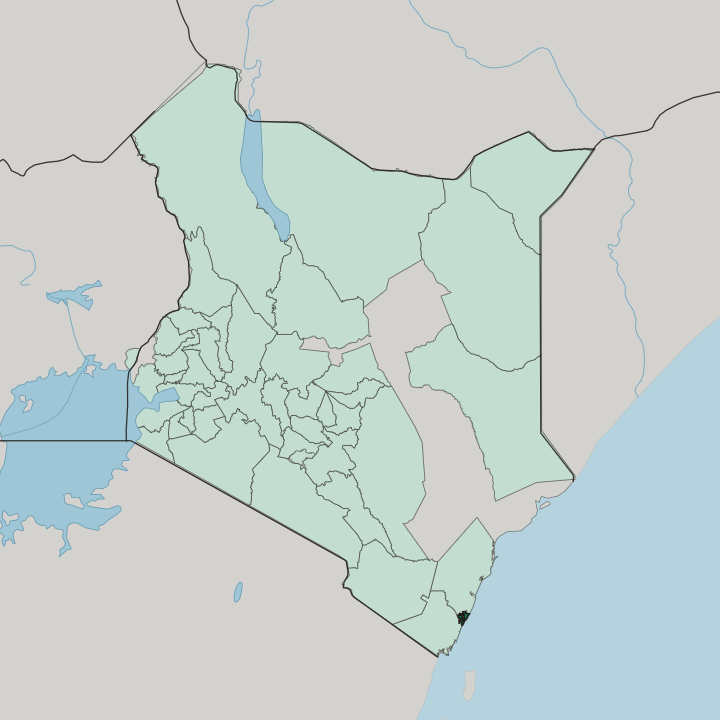
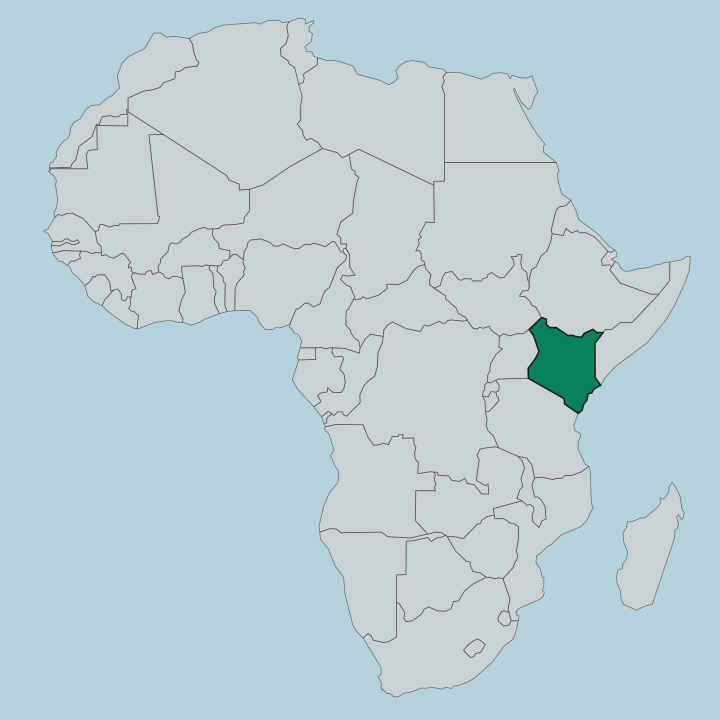
Mombasa lies on Kenya's Indian Ocean coast, toward the southern end of the country's shoreline. The heart of it is Mombasa Island, a low coral platform of roughly three by five kilometres, ringed by water on every side. Tudor Creek curls around the north of the island; the deep channel of Kilindini and Port Reitz cuts in from the south.
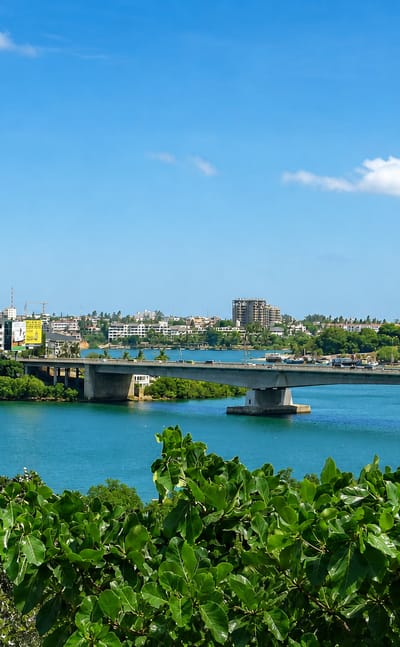
Between them the old town sits on solid coral rag. Three links tie the island to the mainland. The Nyali Bridge crosses the creek to the north, the Makupa Causeway carries the road and railway in from the west, and the Likoni Ferry shuttles across the harbour mouth to the south.
The county spreads onto the mainland around that island. Nyali and Kisauni run north toward Kilifi County; Likoni and the road to Kwale County lie south across the ferry; the industrial west holds Changamwe, the oil terminals, and the airport at Port Reitz. Inland the land climbs gently from the shore into low coral hills, none of them high.
Reefs and mangrove line the creeks. Offshore the water is warm. The Indian Ocean sets the terms here, and the monsoon that crosses it has carried dhows to these creeks for a thousand years.
What is Mombasa like?
Mombasa is the anchor of Swahili culture on the coast. That culture grew out of the sea. For centuries the monsoon carried Arab, Persian, and Indian traders to these creeks, and their languages, faith, and cooking fused with the Bantu-speaking coast to make something new.
Swahili is the result, a Bantu language threaded with Arabic that became the common tongue of the whole East African seaboard. Most of the city is Muslim. The call to prayer sets the rhythm of Old Town, where carved wooden doors, narrow lanes, and coral-rag houses recall Zanzibar and Lamu more than upcountry Kenya.
Food tells the same story of exchange. Coconut, cardamom, and cloves flavour the rice and seafood, and the Indian traders who settled here left biryani, samosas, and bhajias on every menu. Behind the coast live the Mijikenda, nine related peoples whose sacred kaya forests are guarded as ancestral ground.
Dhows still work the harbour. Some carry cargo, some carry tourists out over the reef, but the triangular sail is the same one that first brought this city its world. Between the mosque, the market, and the sea, Mombasa feels closer to the Indian Ocean than to Nairobi.
What is the history of Mombasa?
Mombasa has been a trading port for more than a thousand years, one of the string of Swahili city-states that grew wealthy on the monsoon trade. Vasco da Gama reached it in 1498, and the Portuguese seized the harbour soon after, raising Fort Jesus over the entrance between 1593 and 1596. Control then changed hands again and again.
Omani Arabs took the fort after a siege that ended in 1698, and it passed through Arab, Swahili, and British hands before Britain made the coast part of its East African holdings in 1895. Mombasa became the seat of its own county in 2013.
What is the climate of Mombasa?
Mombasa is hot and humid the year round, a tropical coast with little seasonal swing in temperature. The monsoon runs the calendar instead of the thermometer. From about November to March the dry Kaskazi blows in from the north-east, the hottest and clearest stretch of the year.
Then the wind reverses. The Kusi comes cool and wet off the Indian Ocean from April to October, and the long rains it brings soak April, May, and early June. A shorter rainy spell returns around November.
The sea stays warm enough for swimming in every month.
How do you get to Mombasa?
Most long-haul visitors land at Moi International Airport, west of the island at Port Reitz, with flights from the Gulf and Europe as well as Nairobi. The other main arrival is the train. The Madaraka Express runs on the standard-gauge line from Nairobi to a terminus at Miritini, retracing the old railway route inland in under five hours.
Cruise ships still tie up at the port. Once past arrivals, the Makupa Causeway and the Nyali Bridge carry road and rail onto the island, and the Likoni Ferry crosses south toward the beaches of Kwale County.
Good for
More regions in Kenya
Updated October 2026