Kenya
Kisii, Kenya — Towns & Travel Guide
Kisii is a green, hilly county in south-western Kenya, the highland heartland of the Abagusii and their soapstone carvers at Tabaka.
Hotel links are affiliate links: booking through them may earn us a commission, at no extra cost to you. It never affects how places are ranked. How this works


Towns & cities in Kisii
How the towns here differ, and where visitors usually base themselves.
Kisii town is the base. It is the commercial hub of the Gusii Highlands, second only to Kisumu among the towns of the old Nyanza, and nearly all of the county's beds sit within it. The surrounding ridges are deep farming country, thinly served by hotels.
Go out to Tabaka for the soapstone workshops, or south into the Gucha valley, then sleep back in town. You want Kisii town for a first stay.
About Kisii
Kisii is soapstone country.
What is Kisii known for?
From the quarries at Tabaka in the south, Abagusii carvers cut and polish the soft, pale stone into bowls, animals and figures that reach markets far beyond Kenya. The county is also one of the country's densest farming districts, its ridges packed with smallholdings of bananas, tea, coffee, and finger millet. Kisii town, the commercial hub, sits at the centre of it all.
Rain falls most of the year, and the hills stay green.
Where is Kisii?
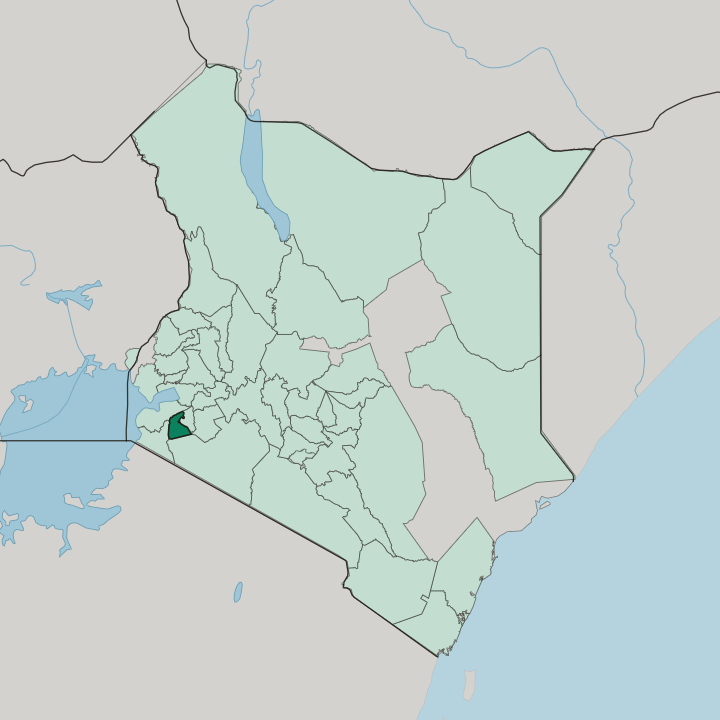
Kisii sits in south-western Kenya, inland from the eastern shore of Lake Victoria. Little of it is flat. The land is a maze of steep ridges and narrow valleys, the Gusii Highlands, rising well above the lake basin.
It is one of the smallest of the country's counties by area, yet one of the most densely settled and farmed, its slopes worked in a patchwork of tiny holdings. Ground climbs past 1,700 metres across much of the county, and hills such as Sameta and Nyamasibi stand higher still. Deep red soils cover the ridges.
Water drains west off these ridges toward Lake Victoria. The Gucha River, which the Luo call the Kuja, gathers the county's streams and runs south-west through Migori County, joining the Migori River before it reaches the lake. Smaller rivers feed it from every valley.
Kisii town stands near the middle of the county, on the ridge road that carries traffic up from Kisumu. Nyamira County adjoins Kisii to the north-east, sharing the same tea-and-banana highlands, while Migori County lies to the south-west on the way down toward the border with Tanzania. Every road here climbs and drops.
What is Kisii like?
Kisii is the homeland of the Abagusii, a Bantu people who settled these highlands centuries ago and farm them intensively. Their language is Ekegusii. It is spoken across the county and the neighbouring hills, and most sermons, radio and market bargaining still run in it.
The Abagusii built their name on the land and on stone. Farms are small and worked by hand, growing bananas, finger millet, tea and coffee on the wet slopes. Land is scarce, and every holding shrinks as it passes down the generations.
The county's signature craft is soapstone carving. At Tabaka, in the south, families quarry the soft pink-and-grey rock and cut it into bowls, plates, animals, and chess sets that are traded across Kenya and shipped abroad. Music runs through Gusii life too.
The obokano, a large eight-string lyre, carries the old songs at weddings and funerals. Village life is close-knit, the ridges dotted with homesteads, churches and small trading centres rather than big towns. Schooling is prized here, and the county sends teachers and clerks across the whole country.
People here farm hard.
What is the history of Kisii?
The Abagusii moved into these highlands over several centuries, pushed up from the Lake Victoria plains by drier weather and by pressure from Luo and Maasai neighbours. British rule arrived late. A colonial station was pegged out at Kisii town in 1907, and German troops from Tanganyika briefly seized it in 1914, early in the First World War.
Kisii County itself is new. It was carved out as one of Kenya's forty-seven counties in 2013, when the country replaced its old provinces with devolved county governments.
What is the climate of Kisii?
Height makes the weather here. Kisii sits high above the Lake Victoria basin, cooler and far wetter than the lakeshore, with soft green hills the year round. Rain comes in two seasons, the long rains from March to June and the short rains from September to November, and little of the calendar is truly dry.
Days are mild rather than hot. Mornings on the ridges can turn cold and misty before the sun burns through.
How do you get to Kisii?
The highway is Kisii's front door. Most travellers come overland, by bus or matatu, on the tarmac that runs some 300 kilometres west from Nairobi and climbs into the hills. Kisumu, the nearest city with an airport, lies about 120 kilometres to the north-west, down toward Lake Victoria.
The same highway carries on south through Migori to the Tanzanian border. There is no scheduled airport in the county, only a small airstrip at Suneka just west of the town.
Common questions
What is the best area to stay in Kisii?
Kisii town: a first base in the Gusii Highlands. Tabaka: the soapstone carving workshops. Ogembo: the Gucha valley in the county's south. Keroka: the tea ridges on the Nyamira border.
Good for
More regions in Kenya
Updated September 2026