Russia
Ryazan Oblast, Russia — Towns & Travel Guide
Ryazan Oblast spreads along the middle Oka in Central Russia, its capital Ryazan a river city southeast of Moscow.
Find your area →


Towns & cities in Ryazan Oblast
One town here has its own guide — it links to where to stay.
 Russia
Ryazan’
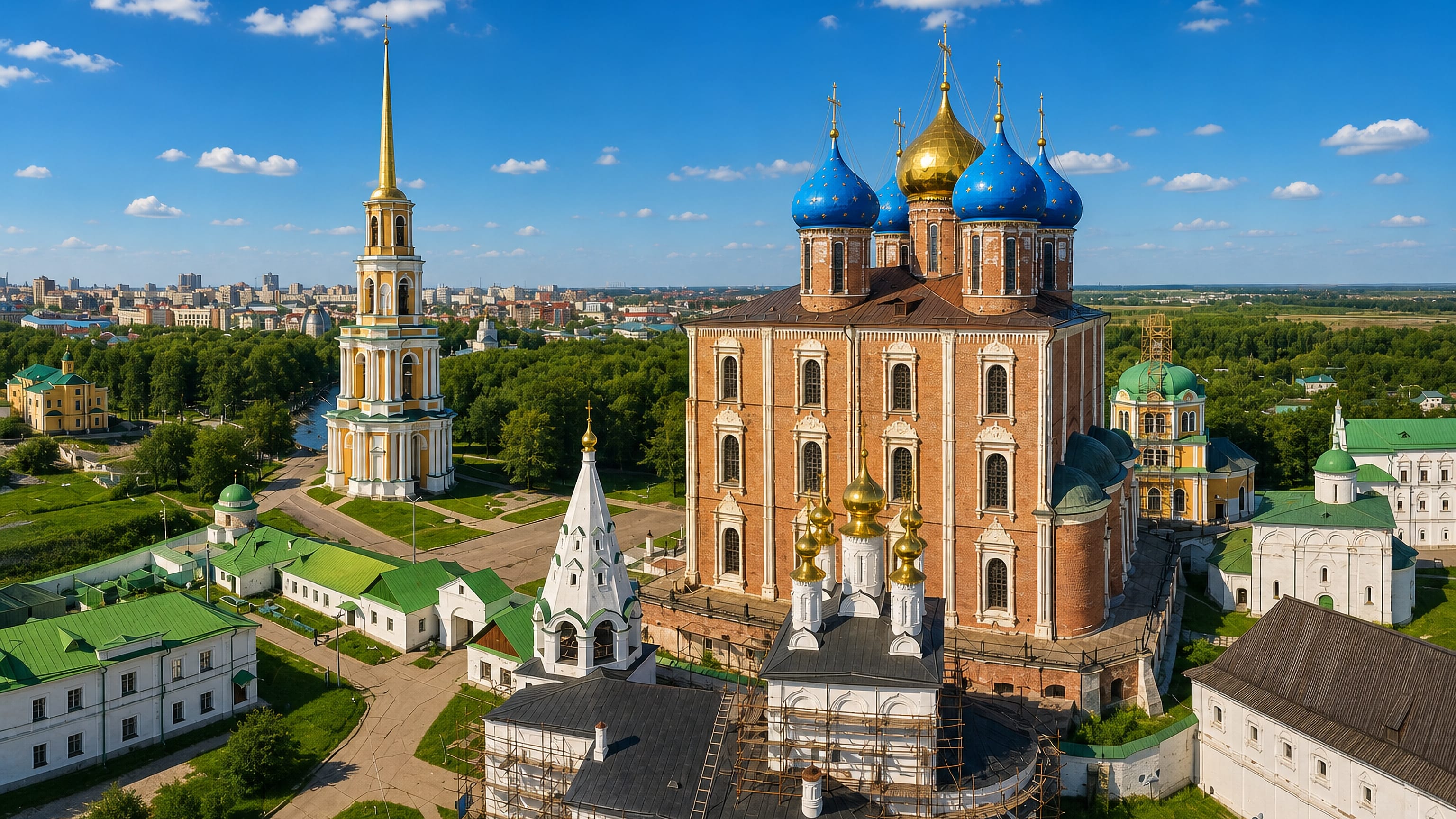
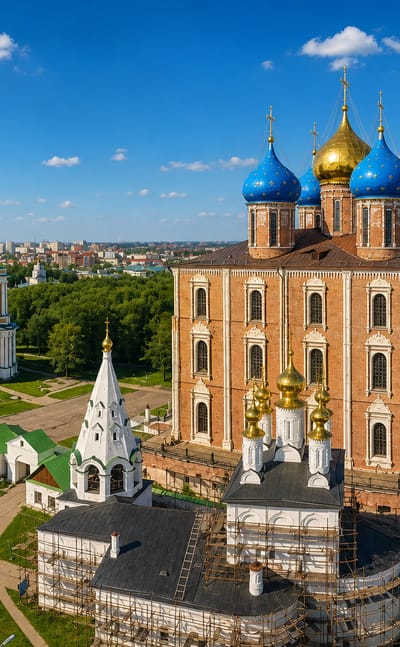
White walls and gold domes rise over Ryazan, an old city in Ryazan Oblast with its Cathedral of the Dormition and the Church of the Nativity of Christ.Where to stay →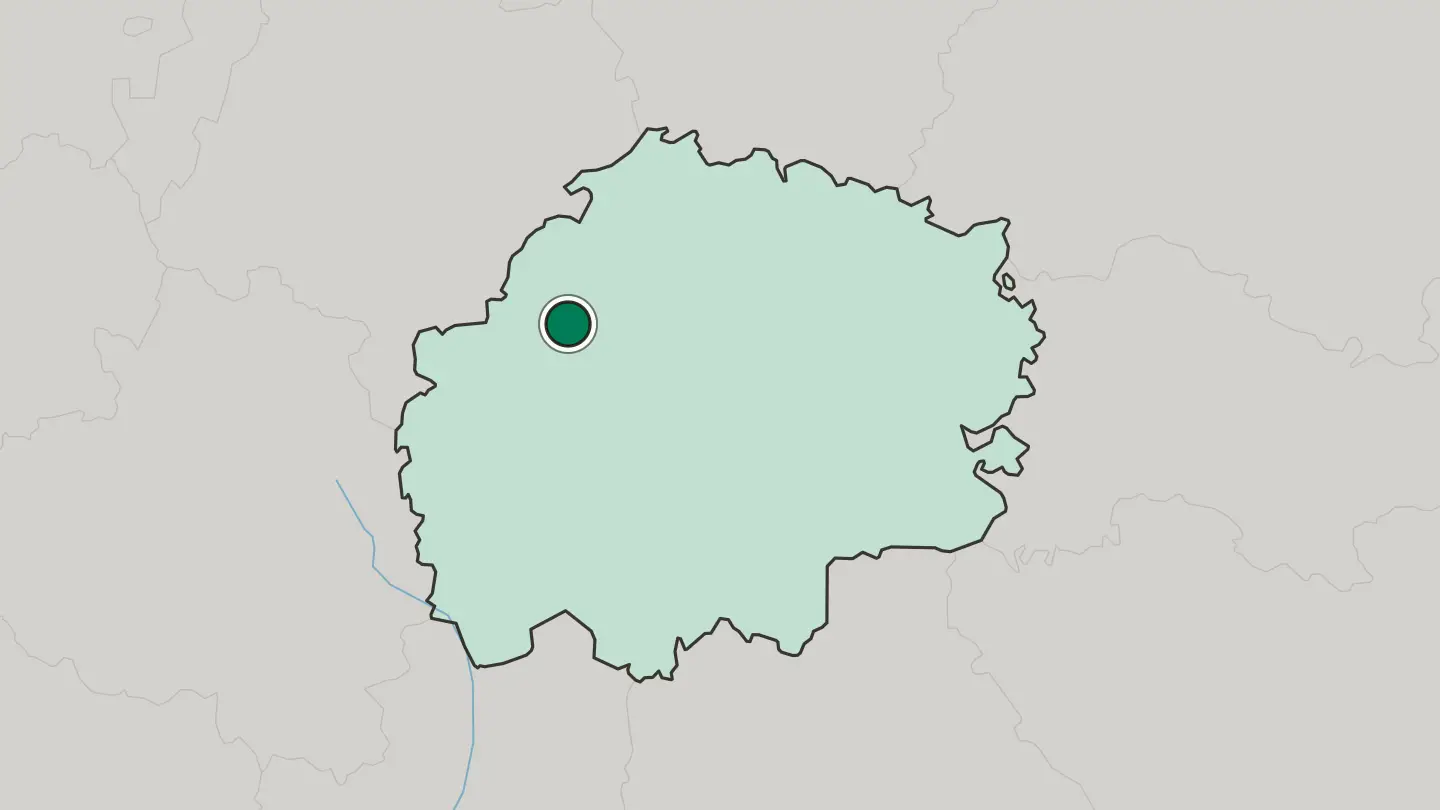
About Ryazan Oblast
The Oka defines it.
What is Ryazan Oblast known for?
This region south of Moscow is known for the river and the country it waters, and for the poet Sergei Yesenin, born at Konstantinovo on the Oka's high bank. Its capital, Ryazan, keeps a white-stone kremlin above the water, crowned by the Dormition Cathedral that the architect Yakov Bukhvostov raised in Naryshkin baroque at the close of the seventeenth century. North of the river the Meshchera Lowlands run into pine forest and marsh, protected in the Oka Nature Reserve, where breeding centres raise European bison and cranes.
Where is Ryazan Oblast?
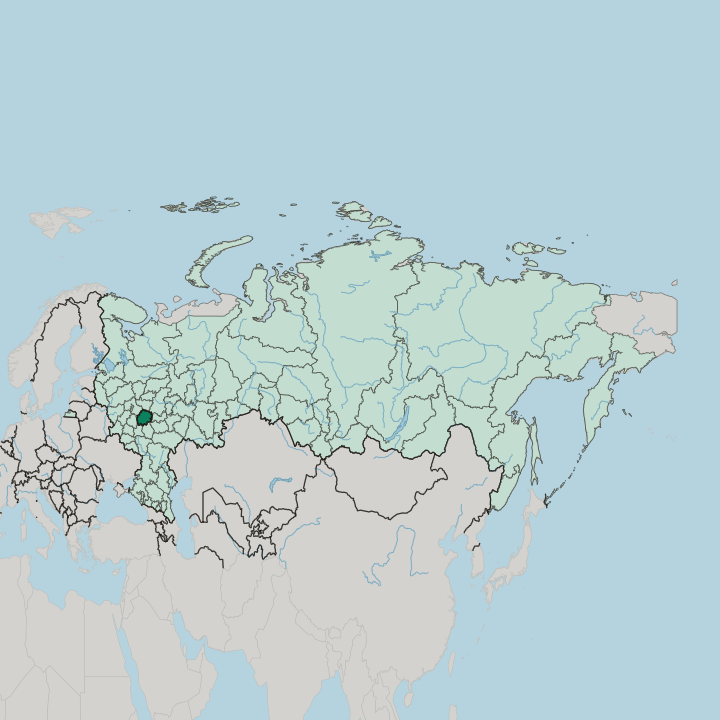
Ryazan Oblast sits in Central Russia, southeast of Moscow, on the flat expanse of the Russian Plain. The land is low. Nothing here rises much above three hundred metres, and the terrain rolls gently between the Central Russian Upland to the west and the Volga uplands to the east.
The Oka is the axis of it all, the largest right tributary of the Volga, curving northeast across the region and past the capital before it turns toward Nizhny Novgorod. North of the Oka lies the Meshchera Lowlands, a broad belt of reed marsh, peat bog, and mixed forest of oak, pine, spruce, and birch that reaches over the border into Vladimir Oblast. South and east of the river the country opens into farmland on the darker soils.
The Oka gathers its own tributaries as it goes. The Pra drains the Meshchera wetlands from the north, and the Moksha joins from the southeast near Kasimov, downstream of the capital. Eight regions ring the oblast in all, from Moscow Oblast in the northwest around to Tambov Oblast in the south, and the whole of it drains, by way of the Oka, into the Volga and on toward the Caspian.
What is Ryazan Oblast like?
Ryazan Oblast reads as deep Russian country, Orthodox and rural at its core, with the Oka running through its self-image. Sergei Yesenin is the region's presiding spirit. Born in the village of Konstantinovo on a bluff above the river, the poet wove the Meshchera meadows, birch stands, and slow water into some of the best-loved verse in the Russian language, and his family estate is kept as a museum where poetry festivals still gather each summer.
Faith is written into the landscape as firmly as the river is. The Russian Orthodox Church shapes the calendar and the skyline, from the Dormition Cathedral over the Ryazan kremlin to monasteries like Solotcha set among the northern pines. Kasimov breaks the pattern.
The town carries a Tatar layer unusual for this stretch of Central Russia, a former khanate where mosque and minaret stand among merchant houses above the Oka, its own quiet counterweight to the Orthodox grain of the rest. Folk craft survives in the smaller towns. The everyday texture is villages, market squares, and the river, more than any single monument, and the region's own people run from the physiologist Ivan Pavlov to the mathematician Andrey Markov, both sons of this ground.
What is the history of Ryazan Oblast?
Old Ryazan came first. This land was the heart of the medieval Principality of Ryazan, and its first capital stood on the Oka near present-day Spassk until the Mongol invasion sacked and abandoned it in 1237, one of the earliest towns to fall in that campaign. The seat then shifted upstream to Pereyaslavl-Ryazansky, the fortress that grew into the modern capital and took the name Ryazan by order of Catherine the Great in 1778.
The oblast itself is a Soviet creation, drawn up as an administrative region in 1937. Old walls and older ground still mark the country between.
What is the climate of Ryazan Oblast?
The climate is moderately continental. Winters are cold and snowy, with January hovering well below freezing and the Oka locked under ice, while July runs warm enough for the Meshchera lakes to draw swimmers. Snow covers the ground for a good part of the year.
Rain and snow together bring around five hundred millimetres across the seasons, spread evenly rather than falling in one wet spell, and spring floods swell the Oka as the northern marshes thaw. Autumn arrives grey and early over the forests.
How do you get to Ryazan Oblast?
Most travellers come from Moscow. The capital lies about two hundred kilometres to the northwest, and the usual approach is by rail from Moscow's Kazansky station, where an express reaches Ryazan in under three hours and the slower suburban elektrichka takes closer to four. The M5 federal highway runs the same corridor for those driving.
Turlatovo, the small airstrip southeast of the capital, carries no scheduled flights, so the region has no airport of its own worth the name. From Ryazan, road and river both fan out to Kasimov and the Meshchera north.
Common questions
What is the best area to stay in Ryazan Oblast?
Ryazan: the kremlin and the river museums.
More regions in Russia
Updated September 2026