China · Zhejiang
Where to Stay in Jinhua, Zhejiang
Jinhua sits inland between Hangzhou and Lishui, a prefecture whose register runs to carved family halls. Shangshan anchors its deep past.
Hotel links are affiliate links: booking through them may earn us a commission, at no extra cost to you. It never affects how places are ranked. How this works


Where to stay in Jinhua
How the choice of base plays out on the ground.
The two urban districts are the obvious base, and they are where the beds concentrate. Jinhua City Museum sits there with Tianning Temple close by, and everything else in the prefecture is a day trip out from that centre, which is the argument for staying put rather than moving on each night. Dongyang is the alternative worth the change of bed.
Rooms there put the Residence of the Lu Family and the Burial Mounds of Dongyang within reach of a single morning's driving. Yiwu makes a third option, with Yiwu Huangshan Bamian Hall as the reason to walk its streets. Pujiang suits a slower stay again, its museum and the surrounding valleys asking for time rather than a fixed schedule. Anyone travelling for the carved halls and ancestral temples should expect to drive between them, since the register spreads across the whole prefecture rather than clustering in one old quarter, and the distances add up over a few days.
Book near the Jinhua districts for transport. Choose Dongyang or Yiwu for the buildings themselves. The Yushan Tea Plantation and Guyue Bridge fill the gaps between the towns.
Find hotels in Jinhua
Direct booking searches for these neighbourhoods.
Jinhua urban districts
Jinhua City Museum and Tianning Temple sit in the built-up districts, the easiest base for day trips out.Find hotels in Jinhua urban districtsCarved timber at the Lu family residenceDongyang
The Residence of the Lu Family and the Burial Mounds of Dongyang lie within one morning of each other.Find hotels in DongyangAn overnight stop by Yiwu Huangshan Bamian HallYiwu
Yiwu Huangshan Bamian Hall gives the town its landmark and its reason for a night on the way through.Find hotels in YiwuSlow days built around the Pujiang MuseumPujiang
Pujiang Museum and the valley country around it reward a stay measured in days rather than hours.Find hotels in PujiangHotel links are affiliate links: booking through them may earn us a commission, at no extra cost to you. It never affects how places are ranked. How this works
Things to do in Jinhua
Ranked by global recognition; descriptions from Wikidata (CC0).
Museums & Galleries
2- Pujiang Museum
- Jinhua City Museum
Castles & Historic Sites
2- Shangshan Heritage
- Relics of Tiedian Kiln Heritage
Landmarks & Notable Places
1- Guyue Bridge Heritage
worth knowingacross 3 categories in Jinhua
About Jinhua
Ancestral halls give the prefecture its character.
What is Jinhua known for?
The Residence of the Lu Family in Dongyang and the Zheng Yimen Ancient Buildings show what carpenters here could do with timber, and the Kong Family Ancestral Temple in Juxi keeps a lineage hall of its own. Temples fill in around them. Yanfu Temple and Tianning Temple carry the register's temple entries, while the Yushan Tea Plantation works the slopes above.
What are the main landmarks in Jinhua?
Bridges, halls and pagodas share the register. Guyue Bridge and Tongzhou Bridge cross the water, the Pagoda of Longde Temple and the Falong Temple Pillar Column stand on their own, and Shangshan holds the excavated ground. Kilns count too.
The Relics of Tiedian Kiln record potting, while the Pujiang Museum and Jinhua City Museum hold what the digs produced.
What is the history of Jinhua?
Shangshan is where the record starts, excavated ground that pushes settlement in this valley back well beyond the temples and halls that followed. Burial Mounds of Dongyang belong to the same deep layer. Potting came next, and the Relics of Tiedian Kiln mark an industry that worked local clay long before any of the surviving timber was cut.
Bridges followed the trade. Guyue Bridge and Tongzhou Bridge carried the roads that tied the valley towns to one another. Lineage built the rest.
Kong Family Ancestral Temple in Juxi, Shangzuci, the Xu Ancestral Hall at Shinantang and the Zheng Yimen Ancient Buildings are all family architecture, put up by clans with the means to build in carved timber and the intention to be remembered for it. Yanfu Temple, Tianning Temple and the Pagoda of Longde Temple carry the religious line through the same centuries. Two later episodes are marked as well: the Site of King Shiwang's Residence of the Taiping Heavenly Kingdom and the Taiwan Volunteers Memorial both appear on the register.
Old Residences in Ziweishan, Shijiazhuang Huating, Qijiating and Jiqingtang round out a list built almost entirely from houses.
Where is Jinhua?
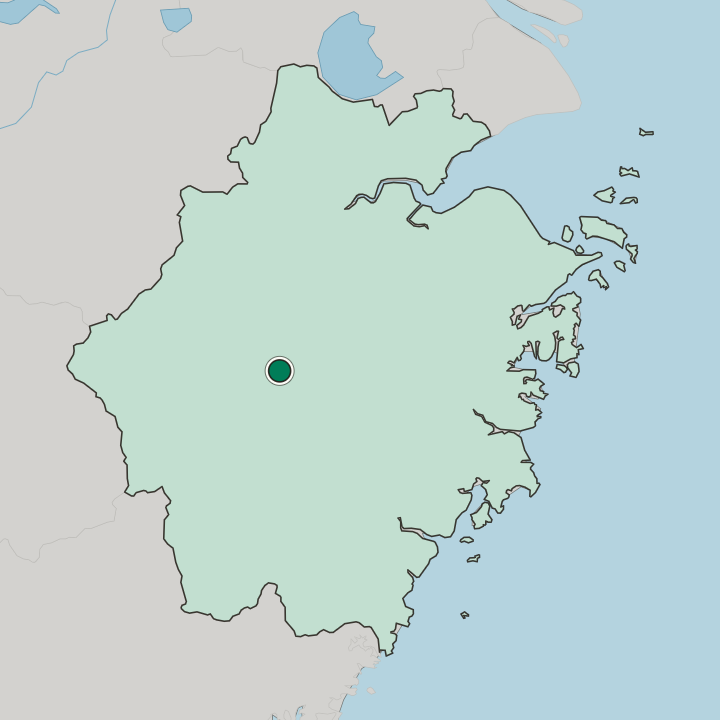
Valley ground, with slopes above. Jinhua borders Hangzhou to the northwest, Quzhou to the southwest, Lishui to the south, Taizhou to the east and Shaoxing to the northeast, which places it inland among neighbours rather than on any coast. Slopes carry tea at Yushan.
Rivers run between the towns, crossed at Guyue Bridge and Tongzhou Bridge, and the flat land along them holds most of the settlement.
What is the climate of Jinhua?
The valley does the work here, trapping summer heat between the hills so that the middle of the year turns hot and heavy, with rain falling in long subtropical spells rather than as brief showers. Jinhua's winter does not linger. Cold arrives without much snow, and the slopes at Yushan hold mist on the tea longer than the flat ground below keeps it.
How do you get to Jinhua?
Hangzhou lies northwest and provides the main link in. Roads from that side drop into the Jinhua valley, and the same corridor carries on toward Quzhou in the southwest, so arriving from either direction is straightforward. Shaoxing sits northeast, Taizhou east and Lishui south.
Inside the prefecture, expect to change vehicles for Dongyang, Yiwu or Pujiang, because the listed halls sit in separate towns rather than along one route.
Common questions
What is the best area to stay in Jinhua?
Jinhua urban districts: Museum mornings with Tianning Temple nearby. Dongyang: Carved timber at the Lu family residence. Yiwu: An overnight stop by Yiwu Huangshan Bamian Hall. Pujiang: Slow days built around the Pujiang Museum.
Good for
More cities in Zhejiang
Updated September 2026