Germany · Nordrhein-Westfalen
Where to Stay in Lünen, Nordrhein-Westfalen
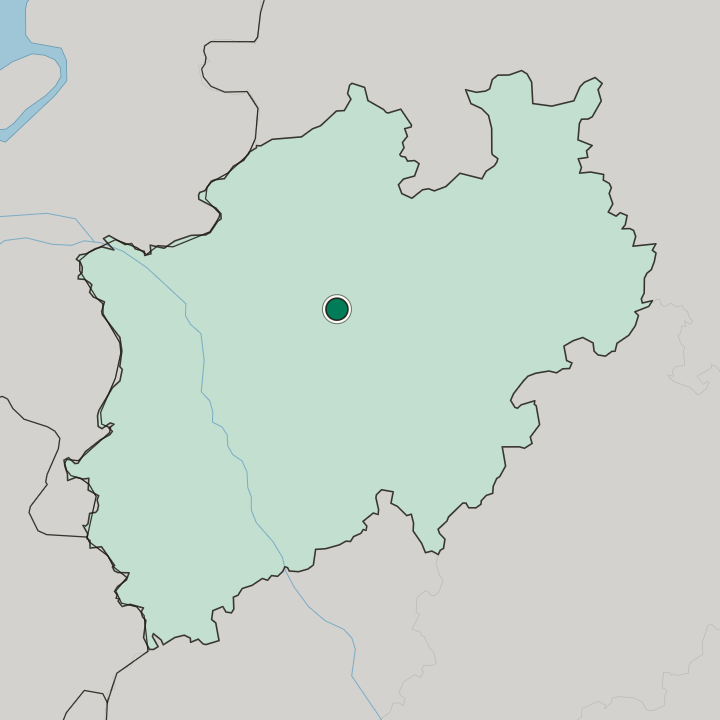
Lünen is the largest town of the Kreis Unna, standing on both banks of the Lippe north of Dortmund, first recorded in 890 and granted town rights in 1341.
Hotel links are affiliate links: booking through them may earn us a commission, at no extra cost to you. It never affects how places are ranked. How this works


Where to stay in Lünen
Where the beds are, and what that means for the visit.
The town is small enough to ignore districts. No Stadtteil sits more than about five kilometres from the centre, and the cycle routes between them run mostly free of cars, so where you sleep matters less here than in a town of the same size elsewhere. The middle is the obvious base.
The Stadtkirche St. Georg, the Pfarrkirche St. Marien and the surviving half-timbered houses on Roggenmarkt and Silberstraße all stand within a few streets of the ZOB and the Persiluhr where the town buses call. Away from the centre the character changes. Altlünen in the north still reads as Münsterland farm country, with the Bauernschaften Alstedde, Nordlünen and Wethmar behind it, while Brambauer in the southwest and Lünen-Süd along the canal are miners' ground, and Beckinghausen sits out east on the Werne boundary where the Romans once kept a camp on the Lippe.
Two Radstationen rent wheels. One stands behind the cinema at Im Hagen and the other on the station forecourt at Münsterstraße, which is the practical answer to a town whose distances are short and whose paths are good.
Things to do in Lünen
Ranked by global recognition; descriptions from Wikidata (CC0).
Museums & Galleries
1- Ziegelei Siegeroth Heritage
Churches & Religious Sites
7- St. Marien Heritage
- St. Georg Heritage
- Herz-Jesu-Kirche Heritage
- Christuskirche (Lünen) Heritage
- Herz Mariä Heritage
Show 2 more →
- St. Joseph Heritage
- Kirche Hl. Familie Heritage
Castles & Historic Sites
1- Beckinghausen Heritage
Stadiums & Sports
1- Rundsporthalle Lünen
worth knowingacross 4 categories in Lünen
About Lünen
Coal made Lünen and then left it.
What is Lünen known for?
The last colliery shut in 1992, and what the industry left behind is on show rather than at work, from the Zeche Minister Achenbach winding tower that Luigi Colani rebuilt in 1995 into the Colani-Ei to the Preußenhafen with its Mohr crane and the Ziethenstraße miners' terraces in Lünen-Süd. Gardens took the tips. The Landesgartenschau of 1996 was laid out on former colliery and farm land at Lünen-Horstmar, and the Seepark it left behind is free to walk into.
Bicycles are the other reputation. Lünen was a founding member of the working group for cycle-friendly towns in North Rhine-Westphalia, and the Leezenpatt crosses the town north to south along six kilometres of old colliery railway.
What are the main landmarks in Lünen?
Two churches carry the older town. The Stadtkirche St. Georg is a late-Gothic hall church of the 14th century with a winged altar of about 1470 and a ceiling painting of the Fall and the Last Judgement of about 1520, and the neo-Gothic Pfarrkirche St. Marien of 1894 to 1896 keeps a font of 1270 and a Marian pilgrimage image of 1260 from the church it replaced. One castle survives and one does not.
Schloss Schwansbell was built between 1872 and 1875 as a Westphalian moated house, its water ringing a small garden island rather than the building, and its park of trumpet trees and robinias is open to walk in, while Haus Buddenburg at Lippholthausen came down in 1977 and privet hedges now trace its plan. The mill outlasted them both. The Schlossmühle at Lippholthausen, the late-Baroque half-timbered watermill of the Buddenburg estate of 1760, was saved by a local campaign and takes events now, and the Colani-Ei, the Mohr crane at the Preußenhafen and the Ziethenstraße terraces make up the industrial half of the list.
Memory has its own places. A Holocaust memorial by Gerd Lebjedzinski stands at the Lippe bridge on Langestraße for the pogrom of 1938, and a stone at the Protestant community centre on Stadttorstraße marks the synagogue of 1811 that was destroyed with it.
What is the history of Lünen?
The Romans came first. They kept a camp on the Lippe at what is now the Beckinghausen Ortsteil, and the settlement that became Lünen appears in a document in 890 before taking town rights in 1341. Iron arrived before coal.
The Gewerkschaft Eisenhütte Westfalia was founded in 1826 as the industrialisation of the Ruhr reached the Lippe, and mining followed it, turning a Westphalian market town into a Ruhr one. The pits ran for a century and a half. Zeche Minister Achenbach at Brambauer and Zeche Preußen at Lünen-Süd left their marks on the map, the Harpener Bergbau AG built the fifty-two brick houses of the Ziethenstraße for the Preußen miners in 1898, and the Bahnhof Preußen was put there to move coal and men.
The last one closed in 1992. Four years later the Landesgartenschau turned the colliery ground at Horstmar into the Seepark, and in 2009 a biogas plant made Lünen the first town anywhere to draw power from a public utility running on animal waste, up to 6.6 MW of it.
Where is Lünen?
Two waterways cross the town. The Lippe runs through the middle, taking in the Seseke where it arrives, and the Datteln-Hamm-Kanal cuts west to east across the south with the Stadthafen and the Preußenhafen on it. Only the canal carries ships.
The Lippe through the centre is not navigable, so the barge traffic that supplies the power stations and works keeps to the canal, and the Preußenhafen doubles as a rest stop for people travelling by small boat. The Stadtteile spread wide and stay close. Altlünen holds the northern farmland with Alstedde, Nordlünen and Wethmar, Gahmen sits between the canal and the A 2, Horstmar has the Seepark and the Horstmarer Loch, and Niederaden and Beckinghausen mark the southeast and east boundaries toward Kamen and Werne.
What is the climate of Lünen?
Lünen sits in the temperate band. That means a year without extremes at either end, grey and wet more often than hard-frozen in winter, and warm without heat through the summer. Rain is the constant.
The cycle network the town is proud of is the thing most affected, since the Leezenpatt and the Römer-Lippe-Route are pleasant in a drizzle and miserable in a downpour, and the Seepark has little shelter. A waterproof earns its place in the bag.
How do you get to Lünen?
The Hauptbahnhof is the simplest way in. It sits on Münsterstraße with the VKU service centre and a Radstation on the forecourt, and the town buses run from the ZOB by the Persiluhr on a clock-face timetable. Two motorways feed the town.
Traffic from Waltrop comes off at the Lünen and Selm junction onto the dual carriageway that runs north through town toward Selm, Olfen, Werne and Münster, while traffic from Kamen and Bergkamen turns onto the L 654 and arrives in the southern centre. Dortmund Airport lies about twenty kilometres off. Anyone arriving under their own steam has a choice of the Römer-Lippe-Route from Wesel, the Emscher Park Radweg along the Datteln-Hamm-Kanal, the Seseke-Weg down from Bönen, or the Jakobsweg between Osnabrück and Wuppertal on foot.
Good for
More cities in Nordrhein-Westfalen
Updated October 2026