Germany · Nordrhein-Westfalen
Where to Stay in Wuppertal, Nordrhein-Westfalen
Wuppertal hangs the Schwebebahn above its valley, the oldest monorail anywhere, in a Bergisches Land city assembled from five towns in 1929.
Hotel links are affiliate links: booking through them may earn us a commission, at no extra cost to you. It never affects how places are ranked. How this works


Where to stay in Wuppertal
Where you base yourself shapes the visit — here's the character of each area.

 WuppertalGermanyFirst visits built around the Von der Heydt Museum
Elberfeld
Elberfeld gathers the Von der Heydt Museum, the Christuskirche and the site of Burg Elberfeld into one centre under the SchwebebahnElberfeld →WuppertalGermanyGuests coming for the Friedrich Engels House and the Gemarker KircheBarmen
Barmen keeps the Engels birthplace and the Gemarker Kirche on its own side of the valley, a Schwebebahn ride from ElberfeldBarmen →WuppertalGermanySteinbeck
Steinbeck is a corner of Elberfeld in Wuppertal grown from three farms, now the ground at Bahnhof Wuppertal-Steinbeck on the Düsseldorf-Elberfeld railway.Where to stay → WuppertalGermany
Nützenberg
Two towers stand in Nützenberg: the Von-der-Heydt-Tower and the Weyerbusch Tower. Both are in Wuppertal.Where to stay →WuppertalGermanyKüllenhahn
Küllenhahn is a residential quarter of Wuppertal's Cronenberg borough, most of it Burgholz state forest. It covers 4.85 square kilometres.Where to stay → WuppertalGermany
Lichtenplatz
Lichtenplatz is one of ten quarters of Wuppertal's Barmen Stadtbezirk, holding Lichtscheid, the city's highest point, and once written Hochbarmen.Where to stay →WuppertalGermanyVarresbeck
Varresbeck is a quarter of Wuppertal, and its two named sites are Sankt Bonifatius and the Wallburg in Sonnborn.Where to stay →WuppertalGermanyHahnerberg
Hahnerberg is a Wuppertal district holding five named sites, among them Jasperskotten, Tippelskotten and the Friedrichshammer.Where to stay →WuppertalGermanySonnborn
Hammerstein Manor and the Bayer-Sportpark Wuppertal are the two entries in Sonnborn's record. It is a small quarter.Where to stay →WuppertalGermanyHatzfeld
Three churches and a memorial to air-raid victims sit in Hatzfeld, a compact district of Wuppertal. The Hatzfelder Kirche names it.Where to stay →WuppertalGermanyRonsdorf
Elias Eller founded Ronsdorf for the Zionites; a town charter followed in 1745. It joined Wuppertal in 1929.Where to stay → WuppertalGermany
Lüntenbeck
Lüntenbeck is a Wuppertal district of barely more than a square kilometre, with the Markuskirche the one landmark on its record.Where to stay →All neighbourhoods (16)
 WuppertalGermany
Cronenberg
Once a town of the Rhine Province in its own right, Cronenberg covers 21.5 square kilometres of Wuppertal. The Nöllenhammer stands here.Where to stay →WuppertalGermanyTesche
Tesche is a Wuppertal district on the Deutsche Fußball Route NRW, with the Jahn-Denkmal and the Gebhardgebäude also among its sites.Where to stay → WuppertalGermany
Rauental
Rauental is a small Wuppertal quarter that shares its name with Haus Rauental and keeps the Bandweberei und Museum Kafka among its landmarks.Where to stay →WuppertalGermanyLangerfeld
Langerfeld is a borough of Wuppertal whose entire monument record consists of four churches. The Alte Kirche Langerfeld heads it.Where to stay →Hotel links are affiliate links: booking through them may earn us a commission, at no extra cost to you. It never affects how places are ranked. How this works
Find hotels in Wuppertal
Direct booking searches for these neighbourhoods.
Cronenberg and Ronsdorf
Cronenberg and Ronsdorf sit on the heights that the valley towns climb to, with parking where Elberfeld has none. Few places to stay nearby — book ahead.Find hotels in Cronenberg and RonsdorfLonger stays in one of the 1929 towns rather than the middleVohwinkel
Vohwinkel joined Wuppertal in the same merger and still runs its own centre well clear of the Von der Heydt Museum crowds. Few places to stay nearby — book ahead.Find hotels in VohwinkelHotel links are affiliate links: booking through them may earn us a commission, at no extra cost to you. It never affects how places are ranked. How this works
Things to do in Wuppertal
Ranked by global recognition; descriptions from Wikidata (CC0).
Museums & Galleries
3- Von der Heydt Museum
- Skulpturenpark Waldfrieden
- Fuhlrott-Museum
Churches & Religious Sites
8- Sankt Laurentius Heritage
- Protestant Cemetery Church, Wuppertal Heritage
- Alte reformierte Kirche Elberfeld Heritage
- Gemarker Kirche Heritage
- Unterbarmer Hauptkirche Heritage
Show 3 more →
- Alte Kirche Wupperfeld Heritage
- Alte lutherische Kirche am Kolk Heritage
- Lutherkirche Heritage
Castles & Historic Sites
6- Burg Elberfeld Heritage
- Nöllenhammer Heritage
- Hundsschüppe Heritage
- Jasperskotten Heritage
- Tippelskotten Heritage
Show 1 more →
- Friedrichshammer Heritage
Stadiums & Sports
1- Bayer-Sportpark Wuppertal
Landmarks & Notable Places
3- Wuppertal Schwebebahn Heritage
- Friedrich Engels House Heritage
- Fernmeldeturm Wuppertal-Küllenhahn
worth knowingacross 5 categories in Wuppertal
About Wuppertal
Track overhead, not underfoot.
What is Wuppertal known for?
The Wuppertal Schwebebahn is the oldest monorail system anywhere and works as transport rather than as a preserved curiosity, which is why it reads as an ordinary commute to everyone who lives along it. Friedrich Engels was born here. The Friedrich Engels House marks the birthplace of the Communist Manifesto's co-author, while the Von der Heydt Museum and the Skulpturenpark Waldfrieden hold the art that the city is otherwise known for.
What are the main landmarks in Wuppertal?
The Schwebebahn outranks everything. Beyond it the Elisenturm, the Toelle-Tower and the Fernmeldeturm Wuppertal-Westfalenweg claim the heights, and the Skulpturenpark Waldfrieden sets sculpture among the trees above the valley. Churches come in quantity.
Sankt Laurentius, Sankt Suitbertus, the Lutherkirche, the Pauluskirche, the Erlöserkirche, the Lukaskirche, the Diakoniekirche and the Kirche Herz Jesu divide the parishes between them. Die starke Linke and the Elberfelder Armenpflegedenkmal stand in the street.
What is the history of Wuppertal?
The city is younger than its towns. Elberfeld, Barmen, Ronsdorf, Cronenberg and Vohwinkel merged in 1929 under the name Barmen-Elberfeld, and only in 1930 did the joined municipality take the name Wuppertal that it has carried since. Burg Elberfeld came far earlier.
Its site records the seat that governed one of those towns while the others were still villages on the surrounding heights. Industry paid for the result. Friedrich Engels grew up in Barmen and the Friedrich Engels House keeps the birthplace of the Communist Manifesto's co-author, a reminder that this valley's factories shaped nineteenth-century argument as much as they shaped nineteenth-century wealth.
Poor relief left its own monument. The Elberfelder Armenpflegedenkmal commemorates the welfare system organised on the Elberfeld side. Protestant history runs deep in Barmen, where the Gemarker Kirche stands, and the Bibelmuseum, the Diakoniekirche and the Protestant Cemetery Church continue that thread across the merged city.
The Schwebebahn belongs to the same industrial confidence. Its overhead track was built when a crowded valley floor left no room for a conventional railway, and it has outlived every monorail built after it. The Von der Heydt Museum and the Fuhlrott-Museum collect what the era left behind.
Where is Wuppertal?
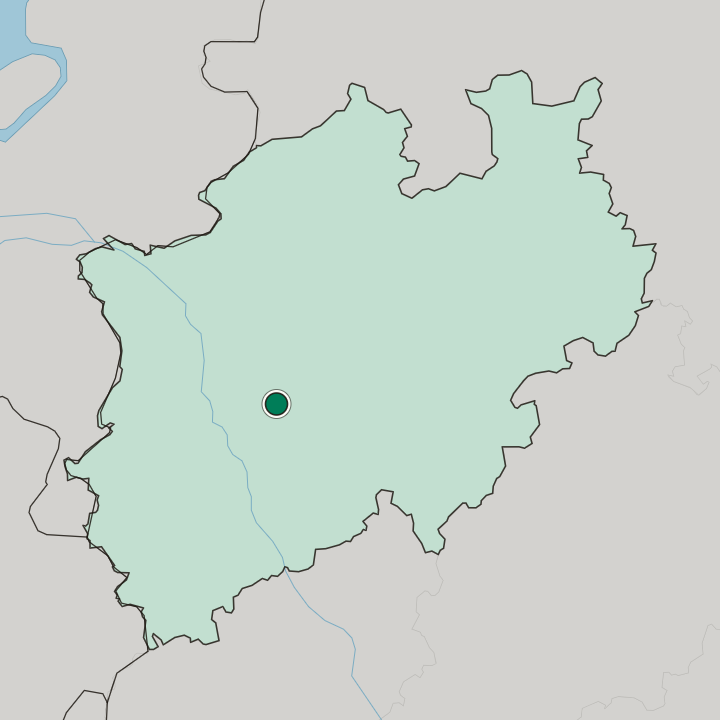
A narrow valley carries the built-up spine, with Elberfeld and Barmen strung along it and the Schwebebahn following the same line overhead. Ridges rise on both sides. Ronsdorf, Cronenberg and Vohwinkel sit up on that higher ground, which is how roughly 168 square kilometres of Bergisches Land ends up feeling like several towns rather than one.
The Elisenturm takes the view.
What is the climate of Wuppertal?
Temperate the whole year through. The valley floor and the ridges above Cronenberg and Ronsdorf sit at different heights, so the hill quarters run a shade cooler than the streets beneath the Schwebebahn. Wet days are no obstacle.
The Von der Heydt Museum, the Fuhlrott-Museum and the Bibelmuseum absorb them without difficulty.
How do you get to Wuppertal?
Wuppertal is the largest city of the Bergisches Land, so approaches come in from the surrounding hill country and drop to the valley floor where Elberfeld and Barmen sit. The Schwebebahn takes over from there. Its overhead track links the merged towns along the valley, which is usually faster than driving between Vohwinkel and the centre.
Ronsdorf and Cronenberg need the road.
Common questions
What is the best area to stay in Wuppertal?
Elberfeld: First visits built around the Von der Heydt Museum. Barmen: Guests coming for the Friedrich Engels House and the Gemarker Kirche. Cronenberg and Ronsdorf: Drivers wanting ridge air over Schwebebahn stops. Vohwinkel: Longer stays in one of the 1929 towns rather than the middle.
Good for
More cities in Nordrhein-Westfalen
Updated October 2026