Spain · Andalusia · Córdoba
Ollerías, Córdoba — Area Guide & Where to Stay
Ollerías is a barrio on the north edge of Córdoba's Distrito Centro, where the Avenida de las Ollerías runs on the line of the old Axerquía wall.
Hotel links are affiliate links: booking through them may earn us a commission, at no extra cost to you. It never affects how places are ranked. How this works


Where to stay in Ollerías
Where visitors usually base themselves, and why.
Ollerías runs along the north edge of Córdoba's walled centre, where the Avenida de las Ollerías carries the traffic and the lanes behind it stay quiet. The Glorieta de la Fuensantilla marks its east end. Calle Puerta del Colodro and the Cuesta de San Cayetano run narrow off it.
The Mezquita-Catedral, the Alcázar de los Reyes Cristianos and the Puente romano all lie south of here, through Santa Marina and the older parishes of the Distrito Centro. Choose it for the Axerquía wall.
Things to do in and around Córdoba
Ranked by global recognition; descriptions from Wikidata (CC0).
Museums & Galleries
3- Museo Arqueológico de Córdoba Heritage
- Museo Julio Romero de Torres Heritage
- Museum of Fine Arts of Córdoba Heritage
Churches & Religious Sites
8- Mosque-Cathedral of Cordoba UNESCO
- Iglesia de San Lorenzo Mártir Heritage
- Iglesia de Santa Marina de Aguas Santas Heritage
- Iglesia de San Pablo Heritage
- Iglesia de San Nicolás de la Villa Heritage
Show 3 more →
- Iglesia de San Pedro Apóstol Heritage
- church of San Miguel Heritage
- Iglesia de la Magdalena Heritage
Castles & Historic Sites
3- Alcázar de los Reyes Cristianos Heritage
- Puente romano Heritage
- Templo romano calle Claudio Marcelo Heritage
Landmarks & Notable Places
1- Torre de la Calahorra Heritage
worth knowingacross 4 categories in and around Córdoba
About Ollerías
What are the main landmarks in Ollerías?
Ollerías keeps a brick chimney and a buried gate. The Chimeneón de Carbonell, a neomudéjar stack raised in 1903 by Adolfo Castiñeyra Boloix for the San Antonio oil works, rises over the Plaza de la Flor del Olivo and was kept when the ground around it was rebuilt. Excavation under the Plaza del Colodro in 2009 uncovered the footings of the Puerta del Colodro and a run of the Axerquía wall beside it.
The square shows them still. The Jardín del Santo Cristo gives the barrio its garden and a street name.
What is the history of Ollerías?
Ollerías grew along the north wall of the Axerquía, the eastern town that spread outside Córdoba's Muslim medina and took its name from the Arabic word for east. Álvaro Colodro, an almogávar from Cobeña, climbed that wall on 24 January 1236. He spoke Arabic, surprised the sentries and threw them out to the field below, and the Christian conquest of the city followed. A gate rose on the spot afterwards.
The Puerta del Colodro was rebuilt more than once, opened and shut with each epidemic, and pulled down in 1882.
Where is Ollerías?
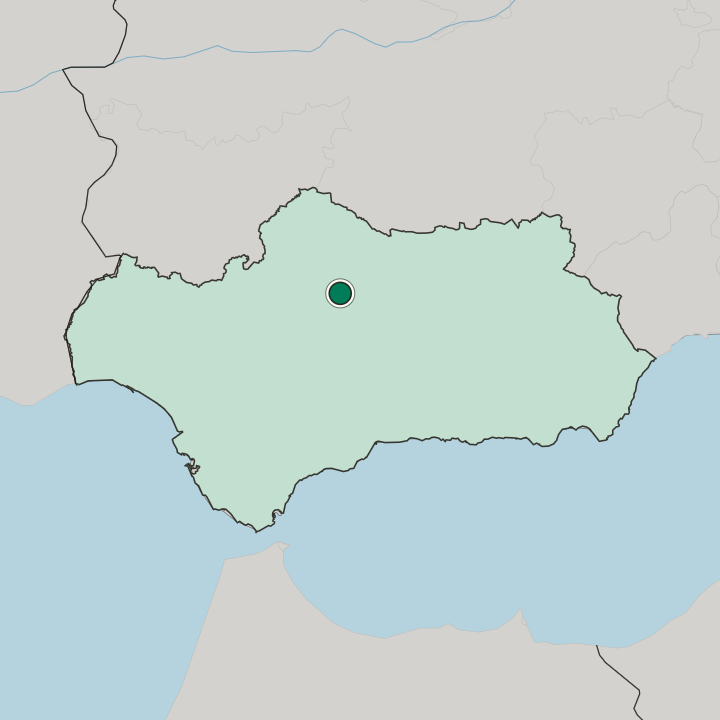
Ollerías takes the northern strip of Córdoba's Distrito Centro, between El Carmen, Zumbacón-Gavilán, Santa Marina, and Campo de la Merced-Molinos Alta.
Good for
More areas in Córdoba
Updated October 2026