Germany · Lower Saxony
Where to Stay in Osnabrück, Lower Saxony
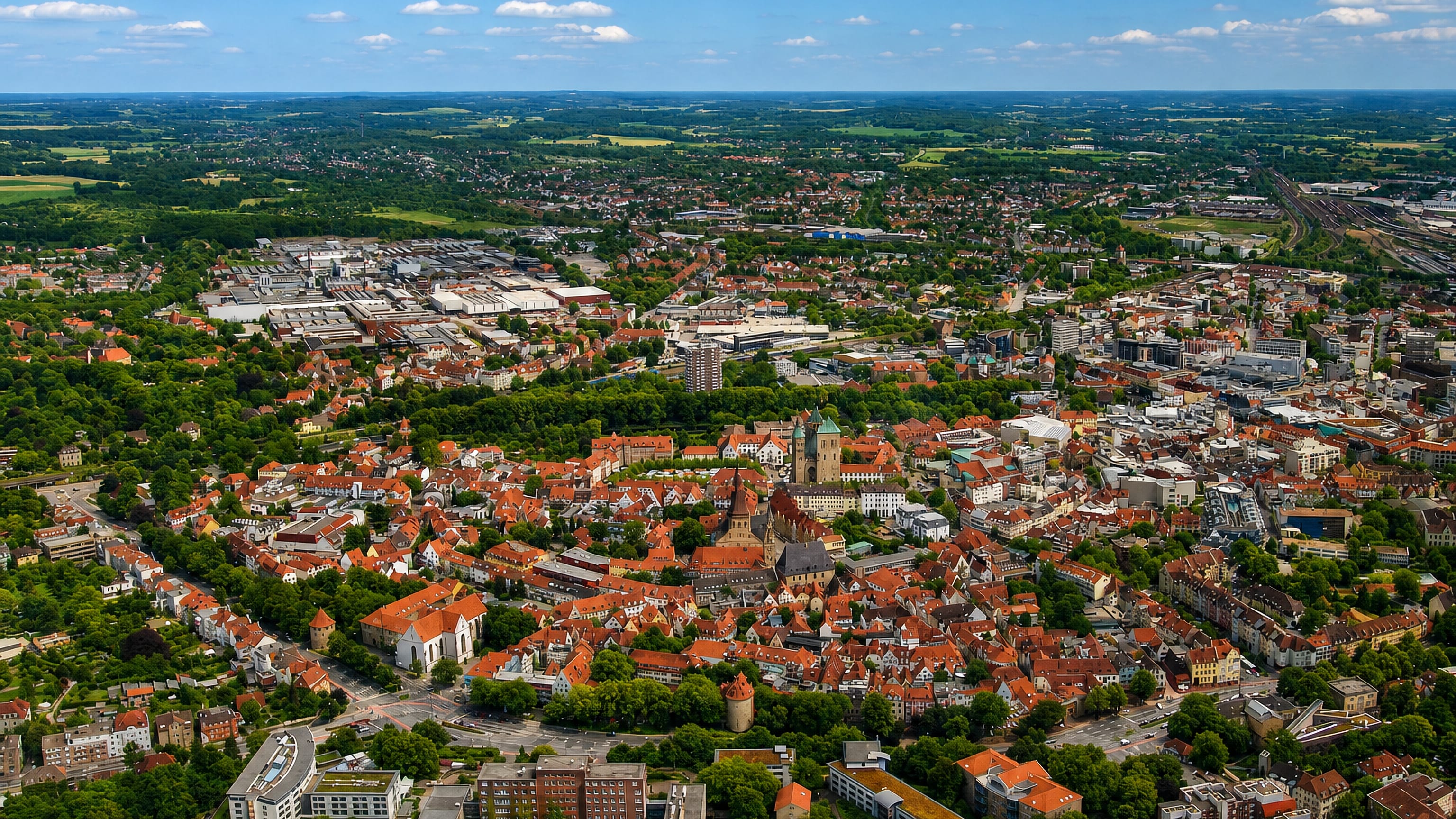
Osnabrück dates from 780 and stands on the Hase, in a valley between the Wiehen Hills and the Teutoburg Forest, under St. Peter's Cathedral.
Hotel links are affiliate links: booking through them may earn us a commission, at no extra cost to you. It never affects how places are ranked. How this works



Where to stay in Osnabrück
The right area depends on your trip — here's what each neighbourhood is best for.

 OsnabrückGermany
Nahne
Nahne is the smallest of Osnabrück's districts by head-count, just under five square kilometres in the south of the city, with the Zoo Osnabrück on it.Where to stay →OsnabrückGermanyVoxtrup
Voxtrup lies in the south-east of Osnabrück, a district of roughly eleven square kilometres with two parish churches and housing between them.Where to stay →Hotel links are affiliate links: booking through them may earn us a commission, at no extra cost to you. It never affects how places are ranked. How this works
Find hotels in Osnabrück
Direct booking searches for these neighbourhoods.
The Altstadt around St. Peter's Cathedral
St. Peter's Cathedral, St. Mary's Church and the Kulturgeschichtliches Museum Osnabrück stand inside the reconstructed Altstadt, the shortest-walking part of the city.Find hotels in The Altstadt around St. Peter's CathedralVisitors planning a day on the Felix Nussbaum Haus and the Kunsthalle OsnabrückBy the Felix Nussbaum Haus
The Felix Nussbaum Haus and the Erich Maria Remarque-Friedenszentrum give this side of Osnabrück its own reason to stay, quite apart from the cathedral.Find hotels in By the Felix Nussbaum HausQuieter stays on the rise towards Kloster GertrudenbergThe Gertrudenberg slope
Kloster Gertrudenberg stands on the high ground above the Hase, and a room up there swaps the Altstadt crowds for a slower street.Find hotels in The Gertrudenberg slopeFamilies whose day runs on Zoo OsnabrückTowards Zoo Osnabrück
Zoo Osnabrück takes a whole day, and a bed on that side of Osnabrück removes the return trip across the Hase valley.Find hotels in Towards Zoo OsnabrückHotel links are affiliate links: booking through them may earn us a commission, at no extra cost to you. It never affects how places are ranked. How this works
Things to do in Osnabrück
Ranked by global recognition; descriptions from Wikidata (CC0).
Museums & Galleries
3- Felix Nussbaum Haus
- Kunsthalle Osnabrück
- Villa Schlikker
Churches & Religious Sites
3- St. Johann Heritage
- Bergkirche (Osnabrück) Heritage
- Heilig-Kreuz-Kirche Heritage
Castles & Historic Sites
2- Petersburg (Osnabrück)
- Ehrenmal auf dem Straßburger Platz
worth knowingacross 3 categories in Osnabrück
About Osnabrück
What is Osnabrück known for?
St. Peter's Cathedral holds the centre. Two museums carry personal names: the Felix Nussbaum Haus and the Erich Maria Remarque-Friedenszentrum. The Altstadt is a reconstruction.
Over two thirds of Osnabrück was destroyed in World War II, and the old town was rebuilt afterwards to designs faithful to the original medieval architecture. Zoo Osnabrück sits apart from all of it.
What are the main landmarks in Osnabrück?
Four churches stand within a short walk of each other. St. Peter's Cathedral is the largest, and St. Johann sits in the same quarter. St. Katharinen and St. Mary's Church complete the group, while the Heilig-Kreuz-Kirche and the Bergkirche lie further out.
Museums answer them. The Felix Nussbaum Haus, the Kunsthalle Osnabrück, the Stadtgalerie and the Naturwissenschaftliches Museum Osnabrück cover art and natural history, while the Domschatz- und Diözesanmuseum Osnabrück keeps the cathedral treasury. Darker sites sit among them: the Bucksturm, the Hexenwahn exhibition and the Gestapokeller Memorial.
Kloster Gertrudenberg stands above.
What is the history of Osnabrück?
Osnabrück dates itself to 780. St. Peter's Cathedral and the Domschatz- und Diözesanmuseum Osnabrück preserve the ecclesiastical line that follows from that date, and the monastic houses came after it: the Benedictine monastery Osnabrück, the Barfüßerkloster Osnabrück and Kloster Gertrudenberg. Petersburg belongs to the same older layer.
St. Katharinen and St. Johann belong to the same church network. The Bucksturm and the Hexenwahn exhibition hold the darker end of that early record, which the church museums pass over. World War II broke the city.
Over two thirds of Osnabrück was destroyed, and the Altstadt that visitors walk through was eventually rebuilt to designs faithful to the original medieval architecture rather than replaced with something new. The Gestapokeller Memorial and the Villa Schlikker keep the record of those years, and the Ehrenmal auf dem Straßburger Platz serves as the city's formal memorial. Two names carry the rest.
The Felix Nussbaum Haus and the Erich Maria Remarque-Friedenszentrum give Osnabrück its twentieth-century reckoning, one as a collection and the other as a centre named for peace. The Bergkirche and the Heilig-Kreuz-Kirche stand outside that old core, further from the cathedral than the reconstruction reached. Zoo Osnabrück carries none of that.
Where is Osnabrück?
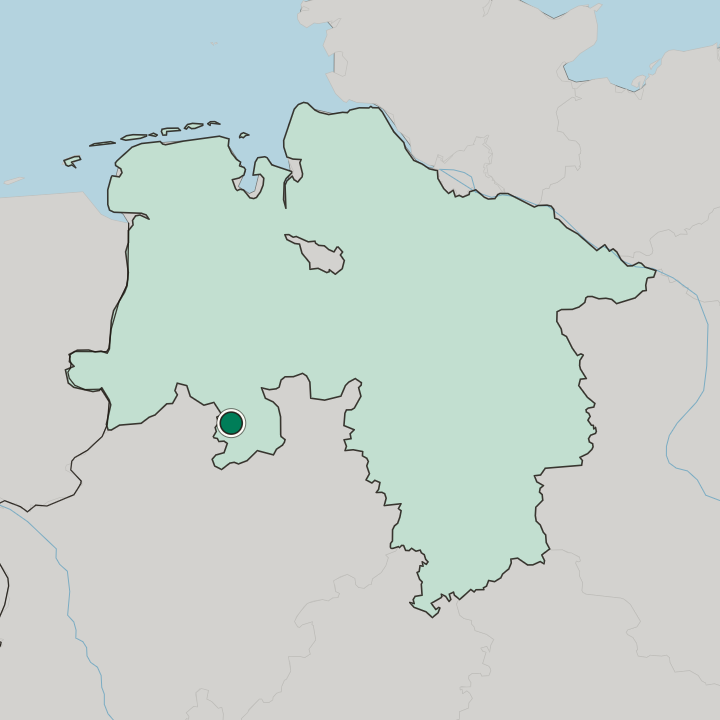
A valley holds the city. The Wiehen Hills stand on one side and the northern tip of the Teutoburg Forest on the other, so Osnabrück is penned between two ranges rather than spread across open ground. The Hase runs through the middle, and the old streets follow the low ground beside it.
Space is limited.
What is the climate of Osnabrück?
The Wiehen Hills and the Teutoburg Forest do the work here. Air crossing them settles into the Hase valley, which tends to hold cloud over the city longer than over the ridges on either side. Snow is not the theme.
Osnabrück sits in the temperate band, so the useful planning rule is layers and a rain jacket rather than any expectation of extremes at either end of the year.
How do you get to Osnabrück?
The valley does the routing. Roads and rails follow the gap between the Wiehen Hills and the Teutoburg Forest, which is the natural line through, and they deliver traffic close to the Altstadt. Inside the city the old town walks easily, with St. Peter's Cathedral, St. Katharinen and the Kulturgeschichtliches Museum Osnabrück inside one loop.
Zoo Osnabrück is the exception. It lies outside that loop, as do Kloster Gertrudenberg and the Bergkirche, and reaching them takes a bus or a car.
Common questions
What is the best area to stay in Osnabrück?
The Altstadt around St. Peter's Cathedral: Guests who want St. Peter's Cathedral and the rebuilt Altstadt at the door. By the Felix Nussbaum Haus: Visitors planning a day on the Felix Nussbaum Haus and the Kunsthalle Osnabrück. The Gertrudenberg slope: Quieter stays on the rise towards Kloster Gertrudenberg. Towards Zoo Osnabrück: Families whose day runs on Zoo Osnabrück.
Good for
More cities in Lower Saxony
Updated October 2026