Algeria
Djanet, Algeria — Towns & Travel Guide
Djanet is an oasis town in the Algerian Sahara, the base for treks into the Tassili n'Ajjer and its prehistoric rock art.
Hotel links are affiliate links: booking through them may earn us a commission, at no extra cost to you. It never affects how places are ranked. How this works


Towns & cities in Djanet
How the towns here differ, and where visitors usually base themselves.
Almost everyone bases themselves in Djanet itself, the oasis town strung along the Oued Idjeriou where the palm groves and the three old villages of El Mihan, Azelouaz and Adjahil sit above the wadi. From there the desert takes over. Nights in the Tadrart Rouge or the Erg Admer mean a bivouac under the stars, not a room, with the sleeping done in Tuareg camps pitched among the dunes and the sandstone arches.
Guides supply the tents, the food and the camels. Book the oasis first.
About Djanet
Rock art made this corner of the Sahara famous.
What is Djanet known for?
Djanet sits at the southwest edge of the Tassili n'Ajjer, a sandstone plateau whose caves and cliffs hold thousands of prehistoric paintings and engravings left by the herders and hunters who lived here when the desert was green. The oasis is the launching point for every expedition onto that plateau and south into the red dunes of the Tadrart Rouge. Kel Ajjer Tuareg guides run the camel and jeep routes out of town.
Little of this is signposted.
Where is Djanet?
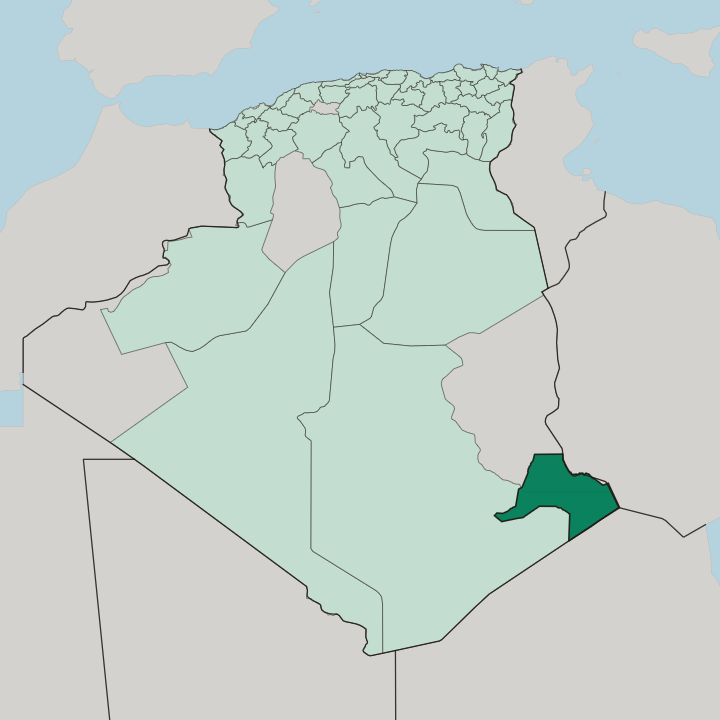
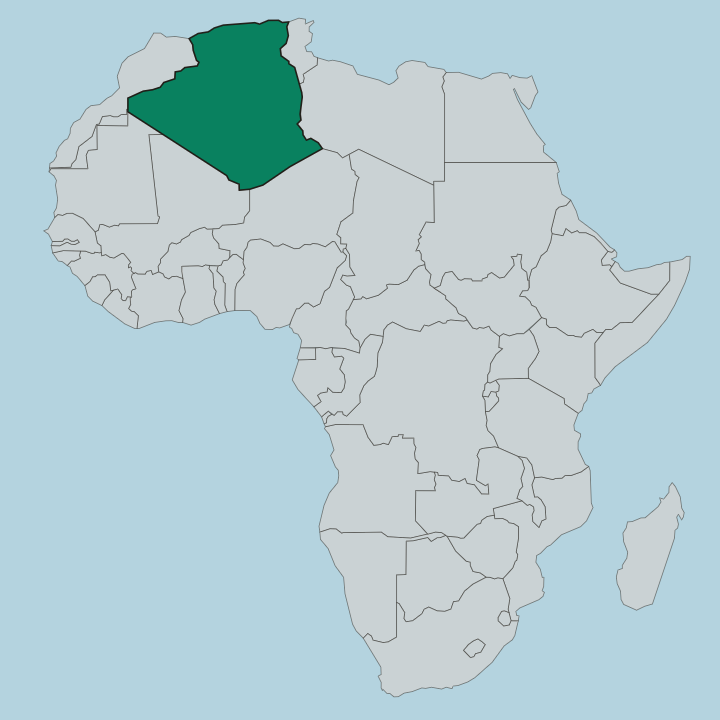
Djanet lies deep in the south-east of Algeria, in the Saharan corner where its borders bend toward Libya and Niger. The town fills a valley cut by the Oued Idjeriou, an intermittent wadi that drains the western flank of the Tassili n'Ajjer and keeps the palm groves alive through the dry months. To the west the ground gives way to the Erg Admer, a sea of dunes.
To the east and north rise the sandstone walls of the plateau. The nearest town of any size is Illizi, some 412 km north across open desert, and the provincial capital sits far from anywhere. This is remote country.
The Tassili n'Ajjer itself is a plateau of eroded sandstone, weathered into pinnacles, natural arches and stone forests that look almost lunar. South of the oasis the rock turns deep red in the Tadrart Rouge, where dunes pour between the crags. Djanet sits high, well above a thousand metres, so its nights turn cold while the surrounding Sahara stretches flat and low in every direction. Algiers and the Mediterranean coast lie a long way north, most of a continent away by road.
Few roads cross this emptiness. The desert is the setting, the plateau the reason to come, and the oasis the one green thread running through both.
What is Djanet like?
Djanet is a Tuareg town, and the Kel Ajjer confederation gives it its character. Their language is Tamasheq, written in the old Berber alphabet of tifinagh, and the men still wear the indigo veil that stained the skin of earlier caravan traders. Camels remain part of daily life, not just tourism.
Much of the year turns on the date harvest in the palm groves and on the movement of herds. The old villages of El Mihan and Azelouaz keep their mud-brick ksour and their rivalries. That last point is not idle.
Each year the two communities meet for the Sebeiba, a ritual of drumming and sword dance held in the dry bed of the oasis and inscribed by UNESCO as intangible heritage. Music carries the rest of the culture. Poetry set to the one-string imzad fiddle, sung verse and the slow rhythm of the desert all belong here.
And behind everything stands the rock art of the Tassili n'Ajjer, painted by people who herded cattle across a green Sahara long before the Tuareg came, a heritage the town has made its own. Tea is poured three times, strong then mild. Hospitality is the rule, not the exception.
What is the history of Djanet?
People have lived off this oasis since the Sahara last ran green, when the herders who painted the Tassili n'Ajjer still drove cattle across grassland. The town itself is younger. Kel Ajjer Tuareg founded Djanet in the Middle Ages, on the desert margins rather than the main caravan roads, which kept it beyond European knowledge for centuries.
A French column under Captain Touchard reached it in 1905, the first to do so, and the Kel Ajjer fought the occupation hard through the years that followed. The desert kept its distance either way.
What is the climate of Djanet?
Djanet has a hot desert climate, dry almost to the bone. Summer days on the Erg Admer turn brutal, and few travellers come between late spring and early autumn. Winter is the season here.
Days stay warm and clear, but the thin high-desert air lets the heat escape after dark, and nights on the open sand can drop toward freezing. Rain is rare and sudden, enough on a handful of days to send water down the Oued Idjeriou. Higher ground on the Tassili n'Ajjer catches a little more of it than the dunes.
How do you get to Djanet?
Most people fly. Djanet Inedbirene Airport sits just outside town, and Air Algérie links it to Algiers and other northern cities, cutting a journey that would otherwise cross most of the Sahara by road. The overland route from the north runs for days across empty desert, and few travellers take it.
Once on the ground, everything runs through local Tuareg agencies. Guides meet arrivals at the airport, handle the plateau permits and drive straight out toward the Tadrart Rouge or the Tassili n'Ajjer. No one explores this desert alone.
Common questions
What is the best area to stay in Djanet?
Djanet oasis town: the base camp for every Tassili trip. Tadrart Rouge: red dunes and sandstone arches by camel. Erg Admer: the sand sea just west of the oasis. The Tassili plateau: multi-day rock-art treks on foot.
More regions in Algeria
Updated September 2026