Thailand
Changwat Phrae, Thailand — Towns & Travel Guide
Phrae is a quiet teak-country province in upper northern Thailand, set in the Yom River valley between forested mountain ranges.
Hotel links are affiliate links: booking through them may earn us a commission, at no extra cost to you. It never affects how places are ranked. How this works


Towns & cities in Changwat Phrae
How the towns here differ, and where visitors usually base themselves.
Most visitors sleep in Phrae town, and the choice splits between the old quarter and the newer grid by the river. The moated old town sits within a short walk of the teak mansions, with Vongburi House and Khum Chao Luang a few lanes apart. Old-quarter rooms are few.
Most guesthouses cluster by the river in the newer town. The riverside new town holds most of the guesthouses, the markets, and the bus terminal on the east bank of the Yom River. West of the town, forest bungalows in Wiang Kosai National Park sit below the Phi Pan Nam ridges for travellers who want a night among the hills rather than the streets.
About Changwat Phrae
Phrae made its name in teak.
What is Changwat Phrae known for?
Through the 19th-century timber boom, British and Burmese firms felled the province's forests and floated the logs down the Yom River, and the trade paid for the ornate teak mansions that still line the old town. Two of them stand as museums: Vongburi House and the former royal residence Khum Chao Luang. The province is also known for Mo Hom, a deep indigo cotton cloth woven and dyed here for generations, and for Wat Phra That Cho Hae, whose gilded Lan Na chedi crowns a hill east of the town.
Where is Changwat Phrae?
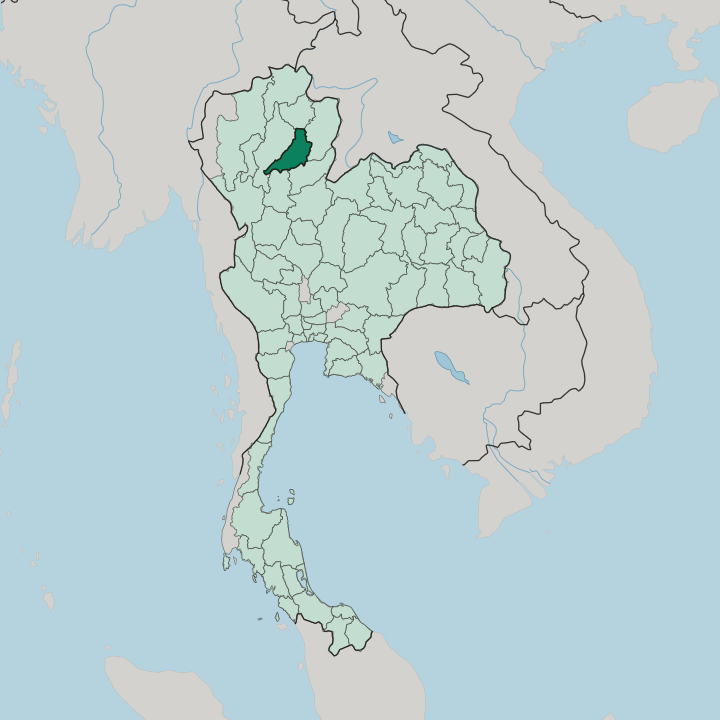
Phrae lies in upper northern Thailand, folded into the valley of the Yom River. Mountains wall it on both sides. The Phi Pan Nam Range runs down the western edge, and the Phlueng Range rises along the east, leaving the towns and rice land strung along the river between them.
Forest covers close to two-thirds of the province, one of the highest shares in the north, and much of it is the teak and mixed deciduous woodland that made the region's fortune. The provincial town sits on the east bank of the Yom, low in the valley floor. Five provinces ring Phrae. Phayao lies to the north, Nan to the east, Uttaradit to the south-east, Sukhothai to the south-west, and Lampang to the west, so the province touches no coast and no border.
Bangkok is a long haul south, roughly 555 kilometres by road, while Chiang Mai lies to the north-west over the ranges. The Yom itself drains southward out of the province toward the central plains, one of the four northern rivers that feed the Chao Phraya. That river valley is the reason a town grew here at all.
What is Changwat Phrae like?
Phrae belongs to the old Lan Na world, and its culture leans north rather than toward Bangkok. People here speak Kham Mueang, the northern Thai dialect, alongside standard Thai. The signature craft is Mo Hom, the deep-indigo cotton dyed and stitched in the weaving village of Ban Thung Hong just outside the town, and the plain blue work shirts have become a marker of the province worn well beyond it.
Temple building followed the Lan Na style too, with tiered wooden roofs and gilded chedi rather than the forms of the central plains. Teak shaped the rest. The timber money of the 19th century raised the carved mansions of the old town, and their fretwork gables and wide verandas remain the province's signature look.
Faith centres on Wat Phra That Cho Hae, whose gilded chedi draws pilgrims to a spring fair each year, when the hill east of the town fills with worshippers. Food follows the northern table, with sticky rice, nam phrik, and Lan Na curries rather than the coconut dishes of the south. It is a quiet, inward culture.
Much of it survives because the province stayed off the main tourist trail.
What is the history of Changwat Phrae?
The valley was settled long before the Thai states, with roots in the Mon kingdom of Haripunchai. It entered the Lan Na kingdom in 1443, when King Tilokaraj drew it in during his campaigns toward Nan. Then came teak.
The 19th-century timber boom pulled in British and Burmese firms and thousands of Shan labourers, and the wealth remade the town in carved wood. That upheaval boiled over in 1902, when Shan rebels stormed Phrae and killed the royal commissioner before troops from Bangkok crushed the revolt and pulled the province firmly into the Siamese state.
What is the climate of Changwat Phrae?
Phrae keeps the north's three seasons. The hot months from March to May bake the valley floor, then the southwest monsoon brings the rains from May into October and greens the forests along the Phi Pan Nam Range. Cool, dry weather settles in from November to February.
Nights turn genuinely cold then in the hills, though the sheltered valley stays milder than the open uplands. Late in the dry season the air can thicken with haze, as farmers across the north burn off their fields before the rains return.
How do you get to Changwat Phrae?
Most reach Phrae overland. Long-distance buses grind up Route 101 from Bangkok and down from the northern cities, an overnight haul either way. The nearest train stops at Den Chai, a station on the Northern Line some 24 kilometres from the town, where arrivals switch to a minibus or songthaew for the last stretch.
Phrae Airport handles a short domestic hop from Bangkok for those short on time. Once here, the compact old town is easy on foot, and rented motorbikes cover the temples and hills beyond it.
Common questions
What is the best area to stay in Changwat Phrae?
Phrae old town: the teak-mansion walking loop. The riverside new town: hotels and onward buses. Wiang Kosai and the western hills: national-park nights.
Good for
More regions in Thailand
Updated September 2026