
Algeria
Annaba, Algeria — Towns & Travel Guide
Annaba anchors Algeria's north-eastern coast, a Mediterranean port beside the Roman ruins of Hippo Regius, close to the Tunisian border.
Hotel links are affiliate links: booking through them may earn us a commission, at no extra cost to you. It never affects how places are ranked. How this works


Towns & cities in Annaba
One town here has its own guide — it links to where to stay.

 Algeria
Annaba
Annaba is a city of northeast Algeria on the Mediterranean, an old port beside Roman Hippo, where Saint Augustine was bishop, his basilica on the hill.Where to stay →
Hotel links are affiliate links: booking through them may earn us a commission, at no extra cost to you. It never affects how places are ranked. How this works
About Annaba
Two things define Annaba: steel and antiquity.
What is Annaba known for?
It is Algeria's third city and leading industrial centre, anchored by the El Hadjar steel complex south of town and one of the country's busiest Mediterranean ports. Beneath it all lies Hippo Regius, the Numidian and Roman city where Augustine served as bishop, its ruins watched over by the hilltop Saint Augustin Basilica. The Edough forests and Gulf beaches do the rest.
Where is Annaba?
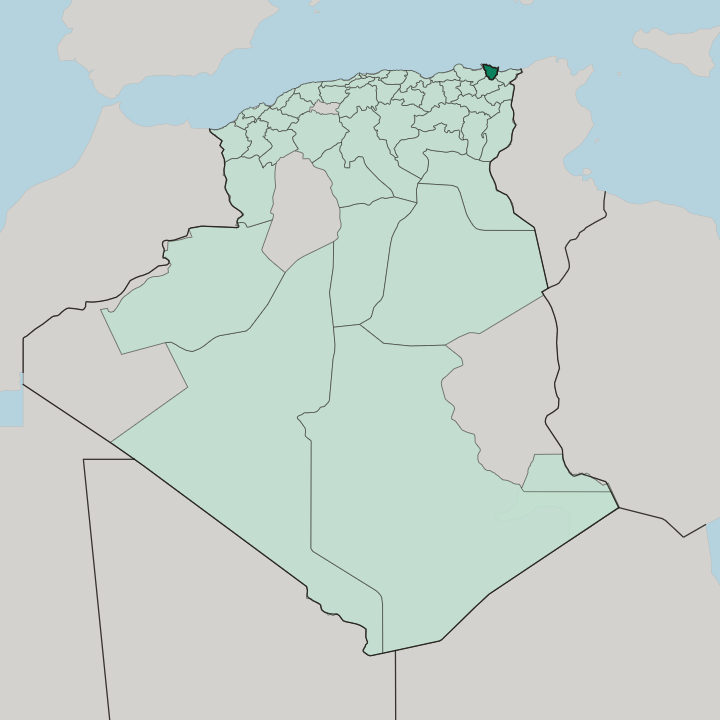
Annaba sits in the far north-east of Algeria, hard against the Mediterranean and only a short drive from the Tunisian border. It is one of Algeria's smallest provinces, a compact wedge of coast and mountain well east of Algiers. El Tarf lies to the east, Skikda to the west, and Guelma inland to the south, while the sea closes the northern edge. The provincial capital, also called Annaba, stands on a broad natural harbour.
That bay, the Gulf of Annaba, opens between two headlands. Cap de Garde shelters it to the north-west and Cap Rosa marks its far eastern end. Behind the city the land climbs fast.
The Edough massif, the eastern tip of the Tell Atlas, rises straight from the shore in cork-oak and chestnut forest to a little over a thousand metres at its highest. Between the mountains and the sea runs a fertile lowland, and it is the Seybouse River that drains it, winding down from the interior to meet the Mediterranean just south of the city near the ruins of Hippo Regius. The coast itself is mostly low and sandy, strung with the beaches of the gulf.
Green hills, a working shore, and a river plain sit within a few kilometres of one another here.
What is Annaba like?
Annaba wears its layers openly. Long before the French renamed it Bône, this was Hippo Regius, a Numidian royal seat and Roman city, and later the see of Augustine, whose writing carried the town's name across the Christian world. The old medina and its Arab-Islamic quarters sit a short walk from the arcaded boulevards the French colonial builders left behind.
At the heart of it runs the Cours de la Révolution, a broad promenade shaded by plane trees, its cafés and kiosks the social centre of the city. Daily life leans on the sea and the port. Arabic is the everyday language, laid over deep Amazigh roots and mixed with the French that colonial rule left in common use.
This is a working, industrial city rather than a resort, and it feels like one, with steel and shipping as much a part of its identity as its ruins. Yet the Saint Augustin Basilica still draws Christian pilgrims to the hill above Hippo, and the beaches fill through the long summer. Food is Mediterranean and North African at once.
Grilled fish comes off the gulf, and couscous, coffee, and mint tea fill the table.
What is the history of Annaba?
The Phoenicians founded a trading post here around the 12th century BC, and it grew into Hippo Regius, a royal city of the Numidian kings before Rome absorbed it. Augustine served as its bishop from 396 until 430, dying as the Vandals besieged the walls. They sacked it soon after.
Arab, then Ottoman rule followed, the latter from 1533, and the port took the name Bône under the French, who seized it in 1832. It became Algerian again at independence.
What is the climate of Annaba?
Annaba has a hot-summer Mediterranean climate. Summers are long, hot, and dry, with rain almost unheard of from July into August, when the beaches of the gulf are at their busiest. The wet season runs the other way.
From late autumn into winter the rain arrives, feeding the cork-oak forests of the Edough massif, and the days stay mild rather than cold thanks to the sea. Spring and autumn are warm and settled, the easiest time to climb into the hills.
How do you get to Annaba?
Most visitors reach Annaba by air. Rabah Bitat Airport, the former Les Salines field, lies just south of the city and takes international flights, most of them from France. Overland, the coastal railway and the national roads tie Annaba to Constantine and on to Algiers, some 600 km to the west.
The Tunisian border is close enough to cross by road. From the airport it is a short run into the centre and the seafront.
Common questions
What is the best area to stay in Annaba?
Annaba city centre: the Cours de la Révolution and the old port. The Gulf beaches: seafront days at Rizzi Amor and Djenane el Bey. Seraïdi: cork-oak mountain air above the bay. Hippo Regius: the Roman ruins and Saint Augustin Basilica.
Good for
More regions in Algeria
Updated September 2026