
China · Sichuan
Where to Stay in Chengdu, Sichuan
Teahouses and old temples fill Chengdu, capital of Sichuan on its fertile plain, a long-settled city known for the Du Fu Thatched Cottage.
Hotel links are affiliate links: booking through them may earn us a commission, at no extra cost to you. It never affects how places are ranked. How this works


Where to stay in Chengdu
The right area depends on your trip — here's what each neighbourhood is best for.

 ChengduChina
Jinjiang District
Grey-tiled lanes wrap Daci Temple at Taikoo Li in Jinjiang District, a central quarter of Chengdu east of the Jin River, known for Chunxi Road.Where to stay →ChengduChinaQingyang District
Qingyang District covers the western side of old Chengdu, taking its name from the Taoist Qingyang Palace and holding Du Fu Thatched Cottage.Where to stay →ChengduChinaWuhou District
Wuhou District holds the southwest of inner Chengdu, named for the Temple of Marquis Wu, where Liu Bei's tomb and Zhuge Liang's shrine share one compound.Where to stay →ChengduChinaChenghua District
Chenghua District spreads north-east of Chengdu's old core, a district of Sichuan's capital known for Dongjiao Memory and the Tianfu Panda Tower.Where to stay →ChengduChinaJinniu District
Jinniu District takes its name from the stone oxen of a Qin road legend, a central district of Chengdu holding Yongling and the Tianfu Art Park.Where to stay →ChengduChinaErxianqiao Subdistrict
Stone cut like the Shu mountains fronts the Chengdu Natural History Museum in Erxianqiao Subdistrict, a district of Chengdu around a geology university.Where to stay →ChengduChinaXipu Subdistrict
Metro Line 2 shares its island platforms with the Chengdu-Dujiangyan railway at Xipu station, in Xipu Subdistrict, eastern Pidu District, Chengdu.Where to stay →ChengduChinaShuangliu District
Old banyans shade the main street at Huanglongxi in Shuangliu District, a southern district of Chengdu that has held an airfield since 1938.Where to stay →ChengduChinaXindu District
Baoguang Temple's thirteen-tier pagoda leans west over Xindu District, a suburban district in northern Chengdu, known for Gui Lake and its osmanthus.Where to stay →ChengduChinaPidu District
Pidu District is a suburban district of Chengdu, known across Sichuan for its doubanjiang and, before that, for its tobacco.Where to stay →ChengduChinaLongquanyi District
Peach orchards climb the Longquan Mountain slopes above Longquanyi District, a suburban district of Chengdu known for Luodai and its car plants.Where to stay →ChengduChinaWenjiang District
Earthen ramparts of the Yufu Village Site ridge the fields of Wenjiang District, a western suburb of Chengdu that was a prefectural seat until 1983.Where to stay →ChengduChinaQingbaijiang District
Container trains for Europe start at Chengxiang station in Qingbaijiang District, a suburban district of Chengdu known for the Xiuchuan Academy.Where to stay →ChengduChinaXinjin District
Earth ramparts faced in river pebbles survive at Baodun in Xinjin District, a district of Chengdu known for the Ming murals of Guanyin Temple.Where to stay →ChengduChinaChengdu Hi-Tech Industrial Development Zone
Metro Line 1 runs beneath Tianfu Avenue in Chengdu Hi-Tech Industrial Development Zone, a Chengdu district known for Tianfu Software Park.Where to stay →Hotel links are affiliate links: booking through them may earn us a commission, at no extra cost to you. It never affects how places are ranked. How this works
Find hotels in Chengdu
Direct booking searches for these neighbourhoods.
Old centre
The Chengdu Museum and the Temple of Marquis Wu sit close to the teahouse lanes at the heart of the Sichuan plain city.Find hotels in Old centreQuieter streets by a working Buddhist templeWenshu Monastery quarter
The gardens and incense of the Wenshu Monastery give a calmer base north of the busiest centre of Chengdu.Find hotels in Wenshu Monastery quarterHotel links are affiliate links: booking through them may earn us a commission, at no extra cost to you. It never affects how places are ranked. How this works
Things to do in Chengdu
Ranked by global recognition; descriptions from Wikidata (CC0).
Museums & Galleries
3- Du Fu Thatched Cottage Heritage
- Chengdu Museum
- Sichuan Museum
Churches & Religious Sites
2- Temple of Marquis Wu, Chengdu Heritage
- Wenshu Monastery Heritage
Castles & Historic Sites
3- Shi'erqiao Site Heritage
- Donghuamen Site Heritage
- Fugan Temple
Stadiums & Sports
2- Chengdu University of TCM Wenjiang Campus Gymnasium
- Sichuan Provincial Gymnasium
worth knowingacross 4 categories in Chengdu
About Chengdu
What is Chengdu known for?
Chengdu is known as the historic capital of Sichuan, set on a broad fertile plain. Its easygoing teahouse culture and old temples draw visitors, and the city keeps a run of famous sites: the Du Fu Thatched Cottage, where the poet lived, the Temple of Marquis Wu, and the Wenshu Monastery. The Chengdu Museum and the Sichuan Museum hold the region's antiquities.
It is the largest city of the province and its long-standing seat.
What are the main landmarks in Chengdu?
Chengdu's landmarks reach deep into its past. The Du Fu Thatched Cottage keeps the garden home of the great poet, while the Temple of Marquis Wu honours a famous statesman of the Three Kingdoms era. Among the old streets, the Wenshu Monastery and the Fugan Temple remain working Buddhist grounds.
Three collections, the Chengdu Museum, the Sichuan Museum, and the Chengdu Art Museum, gather the region's antiquities, and the Shi'erqiao Site preserves ancient timber remains beneath the modern city. The West Pearl Tower marks the skyline.
What is the history of Chengdu?
Chengdu is one of the long-settled cities of ancient China. Standing on the fertile plain of Sichuan, it grew where good farming land and sheltered ground let a city hold its place across dynasty after dynasty, so that its name and its site have stayed constant for a very long time. The Shi'erqiao Site and the Donghuamen Site show how far back the settled ground reaches.
People never left this plain. The city's past runs through its temples and gardens. The Temple of Marquis Wu honours a statesman of the Three Kingdoms era, a period Chengdu played a central part in, and the Du Fu Thatched Cottage marks where the great poet settled and wrote during his years in the region.
Buddhist life left the Wenshu Monastery and the Fugan Temple among the old streets. The collections of the Sichuan Museum and the Chengdu Museum draw those threads together, keeping the record of a plain city that has been a provincial capital and cultural centre through most of recorded Chinese history.
Where is Chengdu?
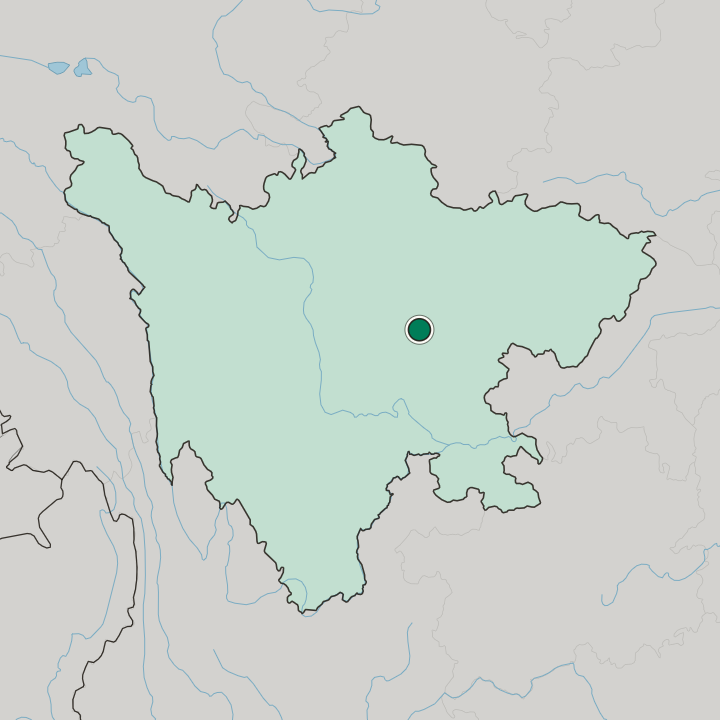
Chengdu lies at the centre of the fertile Sichuan plain, a broad lowland basin ringed by high country. The flat, well-watered ground made the plain one of the great farming regions of the interior, and the city grew as its natural hub, sheltered by the mountains that close the basin on its far edges. Rivers thread the plain.
Fed by channels running down off the surrounding heights, the level ground around Chengdu has been irrigated and farmed for a very long span, giving the city a soft, green setting well away from any coast.
What is the climate of Chengdu?
Chengdu has a mild, humid climate softened by its sheltered place on the Sichuan plain. The ring of high country around the basin holds in moisture and keeps out the harshest cold, so winters stay cool rather than bitter and the air runs damp and often overcast through much of the year. Grey skies are common here.
Because the surrounding mountains trap cloud over the plain, the city sees little strong sun, and mist and haze settle over Chengdu far more often than its inland setting alone would suggest.
How do you get to Chengdu?
Chengdu sits at the hub of the Sichuan plain, long the gateway into the western interior. Rail lines and roads converge on the capital of Sichuan from every direction, crossing the flat basin and climbing the mountains that ring it to reach the rest of the region. Most long-distance visitors arrive by air or fast train.
From either, the run into the old centre is short, leaving the temples, the teahouse lanes, and the Chengdu Museum within easy reach.
Common questions
What is the best area to stay in Chengdu?
Old centre: Temples and museums around the central square. Wenshu Monastery quarter: Quieter streets by a working Buddhist temple.
Good for
More cities in Sichuan
Updated October 2026